
Why Is Repairing a Misunderstanding a Language-Learning Event?

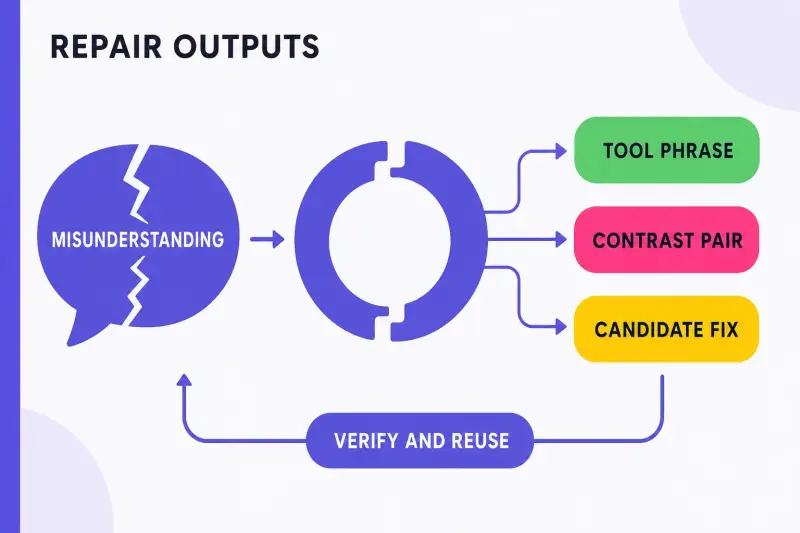
A misunderstanding in a foreign-language conversation feels like the moment learning stops. The mechanism says the opposite. Repairing a misunderstanding is a learning event because the repair sequence draws out simplified, contrastive, and reworded language aimed at one precise gap, and each step of that sequence can leave material behind that the learner can save and reuse. A repaired exchange can leave behind material aimed precisely at what you were missing.
This article walks the sequence step by step and names what each step deposits. It stays at the mechanism level on purpose: if what you want is exact phrases for surviving a breakdown in Spanish, that script book is what to do when you run out of Spanish mid-conversation, and this article will not duplicate it.
Where the sequence comes from
The steps below are not a self-help invention, and knowing their origin helps you trust them. Conversation analysts Emanuel Schegloff, Gail Jefferson, and Harvey Sacks mapped the structure of repair in a 1977 paper that is still the reference point, introducing terms like trouble source for the thing that caused the problem and distinguishing self-repair, fixing your own talk, from other-repair, someone fixing it for you. One of their famous findings: in ordinary conversation, speakers show a strong preference for letting people fix their own talk, offering signals and opportunities before supplying a correction outright.
Second-language researchers then connected this machinery to learning. Michael Long's interaction work described how clarification requests, confirmation checks, and comprehension checks drive what he called negotiation of meaning, and Merrill Swain argued that being pushed to reformulate your own failed output is one of the moments learners notice their gaps most sharply. These are hypotheses about mechanism rather than guaranteed outcomes, but they converge on one claim: the repair sequence is where conversational input gets custom-fitted to one learner's exact problem. For the broader view of communication skill as the actual goal that repair serves, see effective communication and language learning and its practice-side companion, practicing effective communication in a foreign language.
The repair sequence, step by step
Since the whole argument rests on the sequence, here it is as a table. Each row gives the step, the signal you can actually observe in a conversation, and the learning material the step deposits. Read it top to bottom as a timeline of a single repaired misunderstanding, from the moment something goes wrong to the moment the fixed version gets used.
| Step in the sequence | What it looks like in the conversation | What it leaves behind for the learner |
|---|---|---|
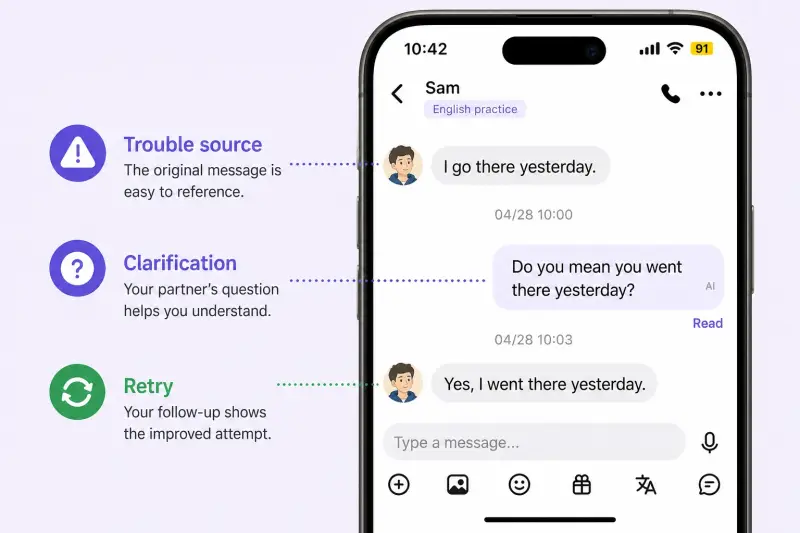
| Trouble source | A word, sound, or sentence that did not land | A precise marker of where your language breaks for real listeners |
| Repair initiation | A pause, a puzzled "hm?", a repeated word with rising tone | Training in reading the earliest signals of non-understanding |
| Clarification request | "What do you mean?" or its equivalent | A reusable all-purpose tool phrase, in both directions |
| Confirmation check | "You mean tomorrow, right?" | The pattern for verifying your guesses instead of bluffing |
| Rephrasing | The same idea rebuilt with simpler or different words | A second version of one meaning, which is contrast you can study |
| Correction | The fixed form, supplied by the partner or by yourself | A before-and-after pair anchored to your own sentence |
| Word-search appeal | "It is a kind of... what is the word..." plus the partner's guess | A strategy for extracting exact vocabulary from any speaker |
| Retry | The repaired version used again | One successful retrieval attempt, not proof of acquisition |
None of this requires advanced level, which is the hub argument of this cluster: even tiny, scoped exchanges can generate repairable moments, and learning through conversation before you know much covers how beginners keep the scope small enough. The table describes one pass through the sequence; the reason it matters for learning is what happens across many passes, which the next section takes up.
Why repair material differs from prepared study material
Material from a repair sequence has three properties that are hard to build into materials prepared in advance, and naming them explains the title of this article. It is targeted: the rephrasings and corrections aim at the exact point where your language failed, not at an average learner's predicted weakness. It is contrastive: a repair typically produces two versions of one meaning, the one that failed and the one that worked, and the difference between them is precisely the lesson. And it is self-generated: the fix is anchored to a sentence you actually produced, in a situation you were part of, rather than to an example someone else chose.
A single repaired misunderstanding can produce a tool phrase, a contrast pair, and a candidate fix to verify all at once, several reusable items from one short stretch of conversation. The practical consequence is a habit change: instead of steering conversations away from your weak areas, you let breakdowns happen in low-stakes settings and harvest them. The harvesting system, what to save and how to queue it, is exactly the method described in letting real conversations decide what you study next, so the two articles are meant to be used together.
Where HelloTalk fits the repair sequence
Text-based exchange changes repair in one fundamental way: the whole sequence stays visible instead of vanishing into air, and HelloTalk's features build on that. HelloTalk's chat-based learning tools keep the trouble source, the clarification, and the correction in one scrollable thread, and the built-in correction tool can keep partner-supplied edits beside the original sentence, creating visible before-and-after pairs when a correction is provided, with in-chat translation available when a clarification request itself is not understood.
HelloTalk's Moments feed runs the sequence in slow motion: post a sentence you suspect is off, and native speakers who come across it can supply rephrasings and corrections on their own schedule, no live pressure, no guarantee of who answers, and the whole exchange preserved for later study. HelloTalk's Voicerooms and Livestreams let you watch repair happen between other speakers in real time, which offers examples that help you notice repair-initiation signals, the pauses and puzzled sounds, before you ever have to produce them yourself.
And HelloTalk's AI learning tools close the verification loop, since AI grammar correction offers another check on a partner's fix, with an explanation, and AI pronunciation scoring provides a score that can point sound-level review in a useful direction. Most of HelloTalk's core features are available for free.
FAQ
Is a conversation full of repairs a failed conversation?
No. Repair is a normal feature of ordinary conversation, including conversations between native speakers. For a learner, a conversation with several repaired misunderstandings can produce several study-ready items, provided the repairs are saved rather than endured.
Should I initiate repair or wait for my partner to notice?
Initiate early. The 1977 conversation-analysis work found speakers tend to give people a chance to fix their own talk first, so initiating repair yourself surfaces the problem sooner and keeps the misunderstanding from compounding.
What is the difference between a clarification request and a confirmation check?
A clarification request asks the other person to re-explain because you did not understand, while a confirmation check states your best guess and asks if it is right. The second adds an output attempt, because it involves producing a version of the meaning yourself.
Does repairing in text count, or only in speech?
Text repair counts, and it leaves every step of the sequence visible and copyable afterward. Spoken repair adds time pressure and listening difficulty, so text first, voice second is a common path.
Will constant repairs annoy my conversation partners?
Repair is a normal communicative process, but correction preferences vary by person and exchange, and partners are learners too. To reduce interaction load, avoid requesting correction of everything at once, and keep individual exchanges scoped small enough that breakdowns stay occasional rather than constant.
How do I remember what a repair taught me?
Save the exchange verbatim, both versions of the repaired sentence, and reuse the fixed version in your next conversation. The retry adds a retrieval attempt with the fixed version; a repair that does not get retried is easy to lose.
The next time a conversation breaks, you are not off track. You are in the middle of a repair sequence, and every step of it can leave something behind. Have more of those moments on HelloTalk.