
What Should You Do When You Run Out of Spanish Mid-Conversation?
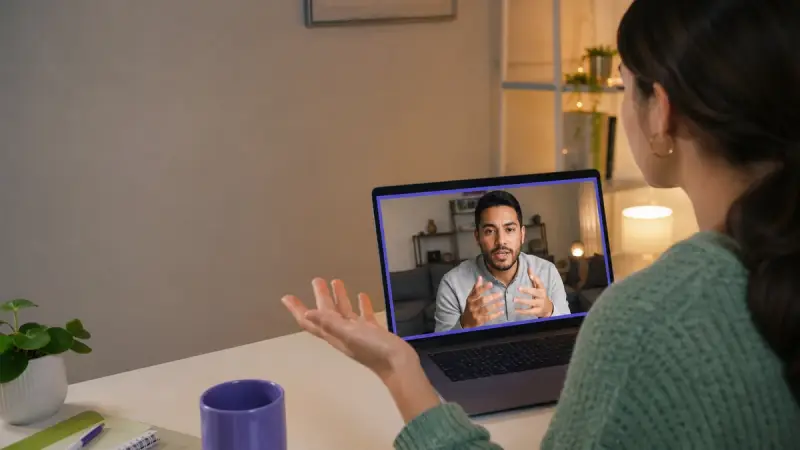
The conversation has started, and suddenly the Spanish is gone: a missing word, a sentence you did not catch, or a confused look at something you said. When you run out of Spanish mid-conversation, a short repair line in Spanish can keep the exchange moving in a way that switching to English or going silent does not. A repair line can keep the exchange moving, hand the problem to your partner in a form they can help with, and give you another piece of Spanish to practice.
This article is a script book for that exact moment. It is not about preparing before a conversation or finding a partner; it assumes you are already mid-exchange and stuck.
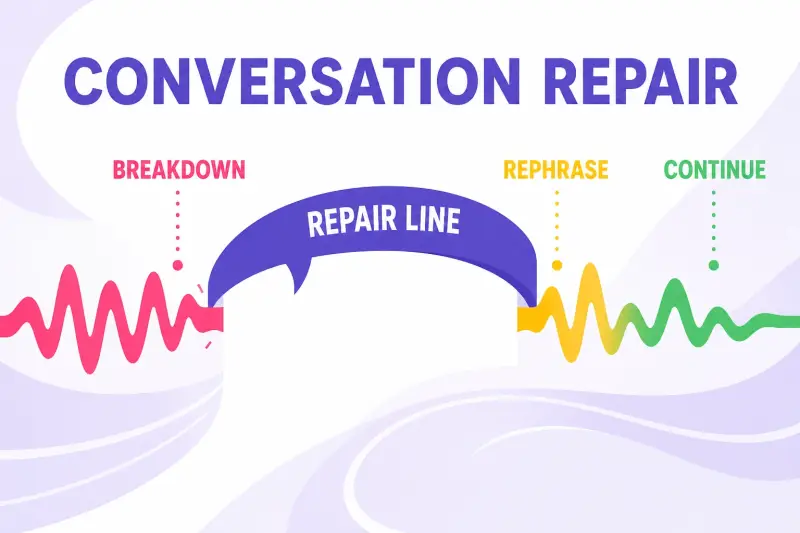
Why memorize repair lines instead of improvising
Improvising a way out of a breakdown can demand fluency that may not be available under pressure, so it helps to rehearse the lines below as complete chunks. Rehearsing repair lines as formulaic sequences can reduce how much language you have to compose word by word under pressure. Drilling five or six of these lines until they are automatic gives a breakdown a handle to reach for instead of a sentence to improvise. For the very first exchange, before any of this applies, the first Spanish conversation guide is the earlier step.
There is a second payoff. Each repair line is designed to request a specific kind of reply, a repetition, a slower version, a confirmation, or the missing word itself; if a response arrives, it is targeted input you can reuse within the same conversation. The general mechanics of why breakdowns produce such good learning material are covered in why repairing a misunderstanding is a learning event; this article stays on the Spanish lines themselves.
The six stuck scenarios and their exact lines
Because breakdowns come in recognizable types, an efficient preparation is one line per type. The table below covers six common stuck scenarios, the exact Spanish to say, the response each line requests, and your immediate next move. Read your way down the first column until you find the situation you keep hitting, and drill that row first. A wider stock of everyday lines to rebuild from lives in Spanish conversation phrases.
| Stuck scenario | Say this in Spanish | Response the line requests | Your next move |
|---|---|---|---|
| A word is missing | "¿Cómo se dice 'deadline' en español?" | The word itself, such as "fecha límite" | Repeat it inside a full sentence right away |
| You understood nothing | "Perdón, ¿puedes repetir más despacio, por favor?" | A slower, possibly simplified repetition | Confirm the part you caught: "Ah, ¿el sábado?" |
| You half understood | "¿Quieres decir que el plan es para mañana?" | Confirmation or correction of your version | Continue with the confirmed version in your reply |
| You were misunderstood | "Perdón, quería decir otra cosa. Quería decir que..." | A reset, with the idea heard again | Rebuild the idea with simpler words |
| You know the meaning, not the word | "No sé la palabra, pero es como un tipo de fruta, es amarilla..." | A guess at the word, such as "¿Un plátano?" | Accept and repeat: "¡Sí, un plátano!" |
| You doubt your own sentence | "¿Se dice así? ¿O cómo lo dirías tú?" | The natural version of the sentence | Save both versions, use theirs next |
The table gives you the lines; what turns them into skill is the reuse step in the last column, because a supplied word or corrected sentence is easy to lose unless it re-enters the conversation soon. The next section deals with the two habits that make that reuse easier to attempt.
Downgrading and reusing: the two habits behind every row
The rows above share two underlying habits worth naming, and they can transfer to scenarios beyond those listed in the table. The first is downgrading: when a sentence collapses, rebuild the idea with smaller pieces instead of chasing the original phrasing. "No encuentro las palabras exactas, pero la idea es..." is a legal move in any conversation, and shorter clauses with high-frequency verbs often survive where the ambitious sentence died.
The second habit is immediate reuse. Whatever the repair produces, the new word, the slower repetition, the natural rewording, should appear in your very next message, because reusing it inside the same exchange creates an immediate retrieval attempt with the new material. If the conversation ends before you can reuse something, save the exchange itself, not a summary; the system for turning saved breakdowns into a study plan lives in letting real conversations decide what you study next.
How quickly a fix should ideally arrive, in-turn, end-of-turn, or later, is its own efficiency question, taken up in whether faster feedback makes Spanish practice more efficient. If breakdowns are hitting you constantly rather than occasionally, one possibility is that the conversations are scoped too broadly for your current base. The hub article on learning through conversation before you know much covers scope control.
Where HelloTalk fits when you are stuck
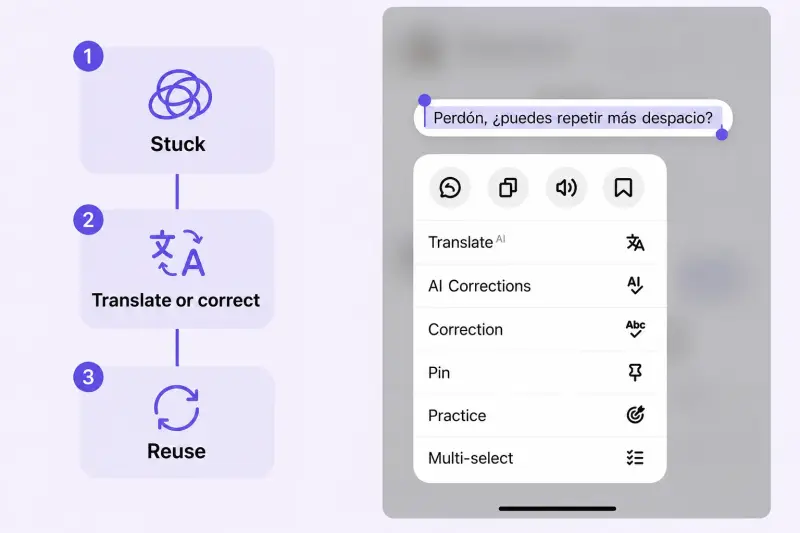
The broader layers that feed a conversation practice habit are covered in what a fast-start Spanish resource mix should include. HelloTalk's features map onto the stuck moment unusually well. HelloTalk's chat-based learning tools are the direct backstop: if a repair line fails, in-chat translation decodes the reply without leaving the thread, transliteration makes unfamiliar spelling easier to parse, while read-aloud lets you hear the reply, and the correction tool lets a partner return your broken sentence with a suggested edit visible in place.
HelloTalk's AI learning tools cover the doubt scenario before it becomes a freeze, since AI grammar correction offers a suggested answer and explanation for "¿Se dice así?" questions privately, and AI pronunciation scoring returns a score that flags sounds worth reviewing. HelloTalk's Voicerooms and Livestreams are the training ground for the listening rows of the table: entering a Spanish room as a listener can provide exposure to fast, real speech in a setting where nothing depends on your reply, exposure you can use to practice adapting to that speed before it shows up in your own conversations.
And HelloTalk's Moments feed is a place to post saved breakdowns: share the sentence that failed and ask how people would say it, and native speakers who see the post can offer versions, with replies not guaranteed but the pool of potential readers large. Most of HelloTalk's core features are available for free.
FAQ
Should I ever just switch to English when stuck?
As a last resort in a practical situation, yes, communication comes first. In practice conversations, treat English as the fire exit, not the door: switching immediately can skip a chance to practice repair that the stuck moment was offering you, so try one Spanish repair line before reaching for it.
How many repair lines should I memorize?
The six lines cover the six scenarios in this guide, one per row of the table. Drill them until they come out without thinking, because a repair line you have to construct on the spot is harder to retrieve under pressure.
What if I do not understand the answer to my repair line?
Chain repairs without shame. "¿Puedes repetir más despacio?" followed by "¿Puedes escribirlo?" is a completely normal sequence, and asking someone to write a word is often a quick fix in a voice conversation.
Is it rude to ask a partner to slow down or repeat?
No. Asking someone to slow down or repeat is a normal communicative move in any conversation, not a special imposition. A polite "por favor" attached to any line in the table keeps the register friendly, and a speed request is an ordinary thing to make on an exchange.
Do these lines work in every Spanish-speaking country?
Broadly, yes. The lines in the table are neutral, standard formulations that are broadly understandable across Spanish-speaking countries, while local wording and register can vary. Regional vocabulary differs, but repair language is among the more portable parts of the language.
How do I practice repair lines before I need them?
Use them on purpose in low-stakes exchanges: ask "¿cómo se dice?" for a word you could look up, or "¿se dice así?" for a sentence you are fairly sure of. Rehearsing the lines when calm can make them easier to retrieve when you are not.
A memorized repair line turns running out of Spanish from a dead end into a move you know how to make. Drill the six rows above, then go get stuck on purpose: HelloTalk is a good place to practice.