What Should a Fast-Start Spanish Resource Give You Besides Lessons?
A fast start in Spanish needs more than a course, and the missing piece is usually not more lessons. Lessons, review decks, input sources, and output drills all prepare language in advance; none of them can react to the sentence you produced this morning. The part a fast-start Spanish setup can lack is the handoff that turns one lesson item into a real response and then into the learner's next study item.
This article follows that handoff step by step: take one structure from this week's lesson, turn it into a sentence about yourself, hand it to a real reader or listener, record what comes back, and bring that reaction into your next review session or lesson. The familiar five resource types appear only as a short background map, because the handoff between them is the part resource roundups usually skip.
Why lessons alone start fast and stall fast
Lessons feel fast at the beginning because Spanish rewards structure early, and that is worth acknowledging before criticizing anything. Spanish is one of the languages the US Foreign Service Institute places in its easiest category for English speakers, with roughly 600-750 class hours estimated for its own intensive courses. Separately, as a practical observation rather than a conclusion drawn from that classification, much of the early grammar is regular and tends to respond well to structured teaching from the first chapters.
The stall tends to come later, and it follows a recognizable pattern. A course can teach you to form "quería preguntarte algo," but it cannot tell you whether the sentence you improvised yesterday sounded natural, and it cannot ask you an unplanned follow-up question. Lessons are a preparation resource, and preparation resources by definition cannot respond to language you produce after they were written.
That limitation is where this article stays: prepared material will not react to what you just said, so the useful question is not which extra resources to collect but how one lesson item gets carried to someone who can react to it. For app-by-app comparisons, which this article deliberately avoids, see the best Spanish learning apps guide as a separate read, with the roundup of apps for learning Spanish fast as its speed-focused companion.
A short map, then the handoff this article follows
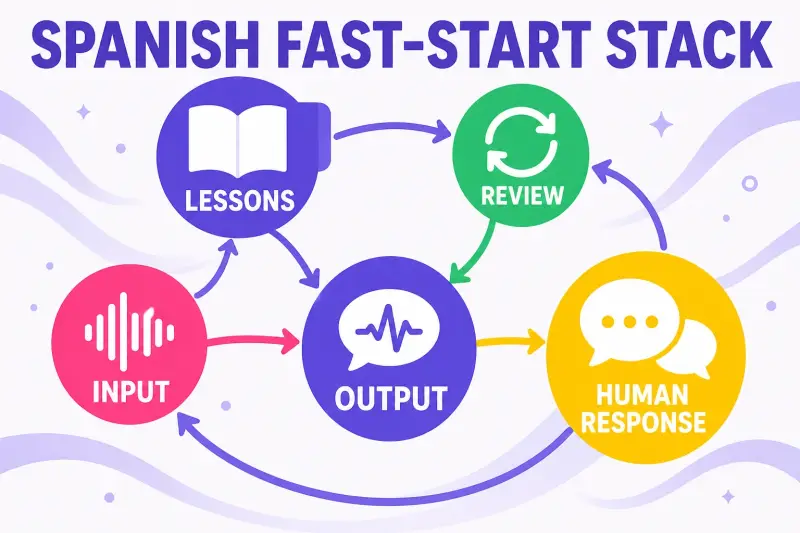
Five resource types show up in almost every serious Spanish setup: structured lessons, spaced review, comprehensible input, output practice, and a human response layer. The infographic above shows that wider map for context only. This article does not teach you how to assemble the full stack; it magnifies one connection inside the picture, the line that runs from your output to a real response and back into your study materials. Lessons, seen this way, are not the whole system but the start of a handoff chain.
The table below walks one lesson item through that chain. Read it as a sequence of handoffs rather than a list of tools: each row is one step, what you produce at that step, the human signal the step can surface, and what the step sends back into your studying.
| Handoff step | Learner output | Human signal | What returns to study |
|---|---|---|---|
| Take one structure from this week's lesson | The structure copied out as your target for the week | None yet, this step is preparation | One concrete, testable target |
| Turn it into a sentence about yourself | A single personal sentence built on that structure | None yet, the sentence is still a draft | A reusable example tied to your own life |
| Hand the sentence to a real reader or listener | The sentence sent in a chat or posted where Spanish speakers can see it | A real reply, if one arrives: a correction, a question, or a rewording | First contact between lesson material and a real person |
| Record the reaction | A short note on what came back | A follow-up question, a natural rewording, or a misunderstanding signal | The exact point where your Spanish held or broke |
| Bring the reaction back | The note reviewed beside the original lesson item | None, this step is yours again | Your next review card or your next question in class |
The table is the article in miniature: preparation on the first two rows, contact in the middle, and learning consolidated on the last two. One boundary applies to the middle row: if no reply arrives, the handoff has simply not completed and there is no human signal to carry back, and trying a different format, venue, or time is the reasonable next step, with no promise implied about whether or when a reply comes. Languages where writing systems reshape this whole architecture need a different treatment, which is why the Japanese version of this question is handled separately in the real-speaker layer of a Japanese beginner stack.
What the response layer actually gives you
The response layer earns its place by producing three things no prepared material contains. First, follow-up questions aimed at your last sentence, which force retrieval under mild, real pressure. Second, natural rewordings: you say something understandable but stiff, and the reply models how a native speaker would actually phrase it. Third, misunderstanding signals, which tell you precisely where your Spanish breaks down for a real listener rather than for an answer key.
The response layer is also where the handoff itself gets stress-tested. When an exchange goes wrong in real time and you run out of words, the exact recovery lines are in what to do when you run out of Spanish mid-conversation.
Spanish is unusually well suited to a response-layer strategy because the pool of potential responders is enormous: the Instituto Cervantes counted almost 500 million native speakers and more than 600 million total speakers in 2024, across 21 countries and territories where Spanish is official. Pool size is broad potential reach, not a promise of availability or replies from any individual, and that boundary matters as much as the number. Once responses start arriving, the question of how quickly you need them answered is less obvious than it sounds, which is why whether faster feedback makes Spanish practice more efficient gets its own article.
What this layer cannot do also matters. Partners are not teachers, and a chat is not a curriculum. If you try to make conversation carry the structure job, you get the mirror image of the lesson-only stall. The full argument for treating access to real people as a resource category in its own right is laid out in the cluster hub on learning through conversation before you know much, so this article will not re-derive it.
One handoff, start to finish
Here is the smallest complete version of the loop this article describes. Suppose this week's lesson introduced the request pattern behind "quería preguntarte algo." You turn it into one sentence about your own life, perhaps a question you genuinely want to ask someone about their city. You send that sentence to a partner or post it where Spanish speakers can see it.
Whatever comes back, a follow-up question, a natural rewording, or a confused reply, you write it down next to the original lesson item, and that note becomes either a new review card or the first thing you ask in your next lesson. A handoff is complete only when the reaction it produced changes what you review or ask next.
Spanish keeps this loop comparatively easy to run: a familiar alphabet and regular early grammar mean lesson material can often reach a real reader in the same week it was introduced, with no script barrier in between. If you want a full first month sequenced around loops like this one, the Spanish fast-start stack for the first 30 days is the extension of this article, not a repeat of it; this article stops at the single handoff.
Where HelloTalk fits in a fast-start stack
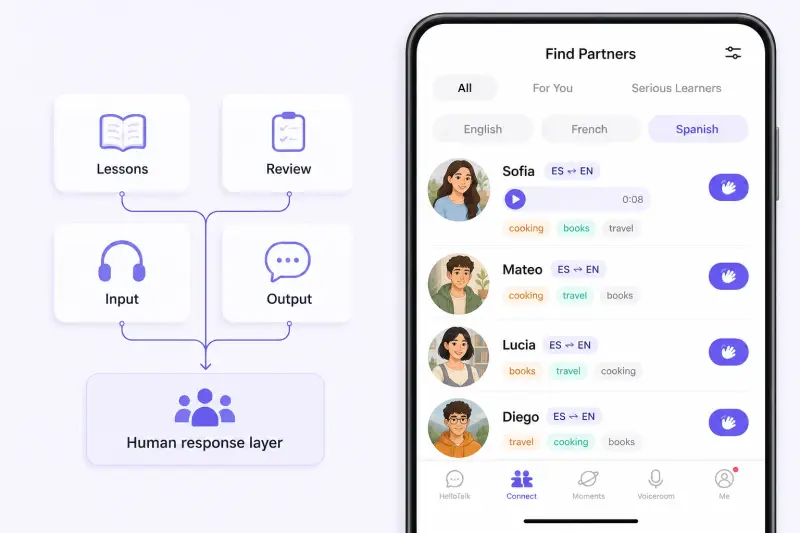
HelloTalk's job in this article's loop is the middle of the handoff: putting your sentence in front of real people and making their reactions usable. HelloTalk's chat-based learning tools handle the reading half of that exchange, since in-chat translation and transliteration let you decode a reply without leaving the conversation, and the built-in correction tool means a partner can fix your sentence inside the thread where you wrote it.
HelloTalk's Moments feed works as a low-pressure destination for the hand-it-over step: post one Spanish sentence from this week's lesson, and native speakers who see it can respond or correct it without any scheduling. HelloTalk's Voicerooms and Livestreams sit just outside the handoff but support it, since joining a Spanish-language room as a listener lets you hear how real voices phrase the structures you are about to test.
HelloTalk's AI learning tools cover the check right before the handoff leaves your hands: AI grammar correction offers suggested corrections for a sentence before you send it to a person, and AI pronunciation scoring provides scores and flags sounds to review first. Most of HelloTalk's core features are available for free, which keeps the handoff easy to try.
FAQ
Can I skip lessons entirely and just use conversation?
You can, though you give up what structure is good at. Lessons compress grammar that chat exposes only unsystematically, and conversation works best as the layer that tests lesson material against real people, not as a replacement for structure.
How many exchanges per week does the response layer need?
Two or three short exchanges of 10-15 minutes each is a manageable starting cadence, not a threshold. The goal is regular contact between your produced Spanish and real readers, not marathon sessions, and short exchanges are easier to keep up.
What should my first messages to a Spanish partner say?
Introduce yourself in one or two simple sentences, say you are a beginner, and ask one easy question about the other person. Short openers are easier to answer, and they keep the first exchange low-pressure for both sides.
Do I need different partners for different layers?
No. The layer model describes resource types, not people. One partner exchange can supply follow-up questions, rewordings, and misunderstanding signals all at once, and the other four layers are handled by materials rather than humans.
Is a tutor the same thing as the response layer?
A tutor overlaps with it but is a different resource: tutors bring structure, planned correction, and teaching skill, which partners do not owe you. The response layer described here is the informal, high-frequency contact with real speakers that fits between lessons.
How soon should a beginner add the response layer?
Early is a reasonable option, and the opening weeks are one possible schedule rather than a rule. The earlier your Spanish meets real readers, the earlier you find out which lesson material survives contact with actual people, and beginner-level exchanges can be kept small enough to be manageable from the start.
If your Spanish stack already has lessons, review, and input, the missing piece may be the handoff that puts what you produce in front of someone who can respond. HelloTalk exists to help you make that handoff.