Best Apps to Learn Spanish Fast in 2026: Ranked by Speed to First Real Conversation
Most "best Spanish app" lists rank tools by feature count. We think that misses the point. When people say they want to learn Spanish fast, what they usually mean is one thing: the fastest measure of progress in Spanish is how soon you can hold a short, real conversation with a native speaker, not how many lessons you finish. So that is what we ranked by here.
We spent time with the apps most learners actually reach for in 2026, and sorted them by "days to first real exchange" rather than polish or price. Below is the honest version.
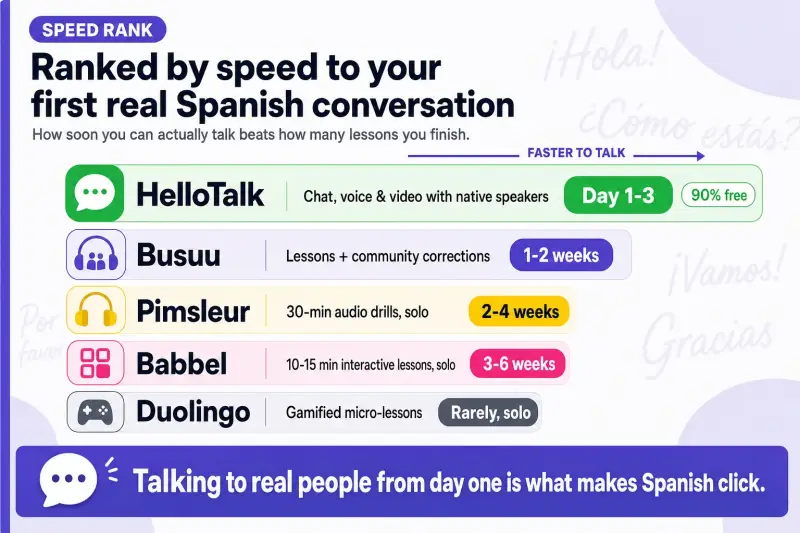
Quick comparison: speed to first conversation
| App | Core method | Typical time to first real conversation | Free tier | Best for |
|---|---|---|---|---|
| HelloTalk | Chat, voice and video with native speakers | Day 1-3 | 90% of core features free | Talking to real people from the start |
| Pimsleur | 30-minute audio drills | 2-4 weeks (solo, no partner) | Trial only | Pronunciation and listening |
| Babbel | 10-15 minute interactive lessons | 3-6 weeks (solo, no partner) | Limited free lessons | Structured grammar |
| Duolingo | Gamified micro-lessons | Rarely, without adding a partner | Yes (ads) | Daily streaks and vocabulary |
| Busuu | Lessons plus community corrections | 1-2 weeks (community feedback) | Limited free | Written practice with feedback |
The pattern is clear. Apps built around solo lessons teach you Spanish about a language; apps built around real people teach you Spanish inside a conversation, which is where speed actually comes from. If your goal is speaking fast, prioritize tools that put a human on the other end early.
1. HelloTalk: fastest to a real exchange
HelloTalk is a language exchange community, so the "app" is really a doorway to people. You are matched with native Spanish speakers who are often learning your language, and you help each other. That two-way trade is why a first conversation can happen on day one.
A few things make it fast:
-
Chat-based learning with built-in translation, transcription and read-aloud, so you can send a message in Spanish even when you only know ten words, and check it without leaving the chat.
-
Moments, a public feed where you post a sentence or a photo caption and several native speakers correct it. It is the quickest way we know to get real corrections at volume.
-
Voicerooms and Livestreams, so you can drop into a 24-hour voice room as a listener first, then speak when you are ready, or join a small interactive live class.
-
AI learning tools that score your pronunciation and point out the exact sound you missed, plus real-time grammar correction with a short explanation.
With 70M+ registered users across 200+ countries and 260+ languages, finding a Spanish partner in your timezone is rarely the bottleneck. If you want the mechanics of that very first exchange, our guide to your first Spanish conversation walks through it line by line.
Honest cons: it rewards people who show up. If you never message anyone, it will not carry you the way a lesson streak will.
2. Pimsleur: strongest for ear and mouth
Pimsleur runs on 30-minute audio lessons. The Spanish program spans five levels of 30 lessons each, roughly 150 lessons total, built on graduated interval recall and a "say it before you hear it" prompt. It genuinely trains your accent and listening.
The catch for speed: it is a solo method. You get very good at repeating modeled phrases, but you still have not talked to a person. Most learners pair it with a partner to cross that gap. See how to start speaking Spanish for closing that step.
3. Babbel: cleanest structure
Babbel lessons run 10-15 minutes and mix listen-and-repeat, fill-in-the-blank and short dialogues, all built by in-house linguists and voiced by native speakers. Grammar shows up in context, which many beginners find reassuring.
It is a strong scaffold. But like Pimsleur, the conversation partner is simulated, so the leap to a live human still happens outside the app.
4. Duolingo: momentum, not conversation
Duolingo is excellent at getting you to open an app daily. For raw vocabulary and a sense of progress, few things beat the streak. What it does not do well is produce spontaneous speech with a stranger, which is the thing that actually feels like "learning Spanish fast."
5. Busuu: written feedback loop
Busuu blends structured lessons with a community that corrects your writing. That feedback loop is genuinely useful and faster than pure solo apps. For live speaking, though, you will still want a real-time partner.
How to choose in one minute
-
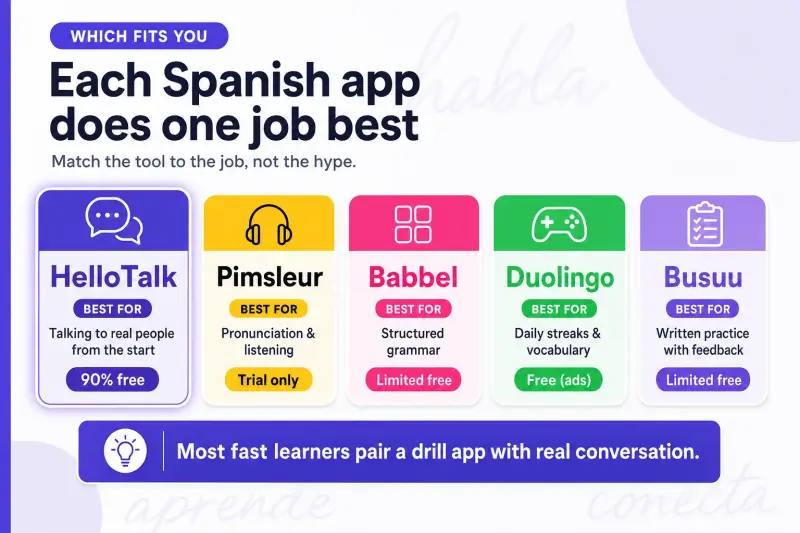
If you want to speak fast: start with a real-people app and add a drill app for accent.
-
If you are nervous about talking: begin as a listener in a voice room, then use text before voice.
-
If you love structure: use Babbel or Pimsleur as your backbone, but book your first human exchange in week one, not week ten.
For a broader roundup beyond speed, our overview of the best Spanish learning apps in 2026 compares more tools, and the best Spanish language exchange apps focus on partner quality.
Common mistakes that slow people down
-
Waiting to feel "ready." You do not need 500 words to say hola, me llamo Sarah. Start ugly.
-
Only doing input. Listening apps feel productive, but output is where speed lives.
-
No daily rhythm. Even 20 minutes beats a two-hour weekend cram. A 30-minute daily Spanish routine keeps momentum.
-
Treating apps as competitors. The fastest learners stack them, which we break down in the Spanish fast-start stack for your first 30 days.
FAQ
Which app gets me speaking Spanish the fastest? A real-people app like HelloTalk, because the first conversation can happen on day one instead of after weeks of solo lessons.
Can I learn Spanish fast for free? Yes. HelloTalk keeps 90% of core features free, and you can combine it with free tiers of other apps.
Do I need to finish a course before talking to a native speaker? No. Waiting is the most common reason people stall. Starting to talk early is the point, and language exchange is built for exactly that, as our language exchange guide explains.
Is one app enough? A drill app plus a real-conversation app usually beats any single tool. For a deeper comparison of self-study courses versus live practice, see Spanish courses vs language exchange.
How much time per day? Twenty to thirty focused minutes is plenty if some of it is real speaking.
What about pronunciation? Use AI pronunciation scoring for feedback, then confirm with a native speaker who can hear nuance a score cannot.
Start talking this week
If speed is the goal, do not wait to be fluent before you speak. Download HelloTalk, post your first sentence in Moments, and have a real Spanish exchange this week. Join millions of learners at HelloTalk.