
A Daily Spanish Practice Routine That Actually Moves the Needle (30 Minutes or Less)
Most of us don't stall in Spanish because we're lazy. We stall because our "practice" is one giant, undefined block that we keep postponing. You sit down, feel like you should do everything at once, and end up doing nothing.
The fix is boring and it works: a fixed daily routine with named blocks, each with a job. This article is the hub for our whole daily-practice cluster, so we'll lay out the full routine template here, then point you to the deeper pieces when you need them.
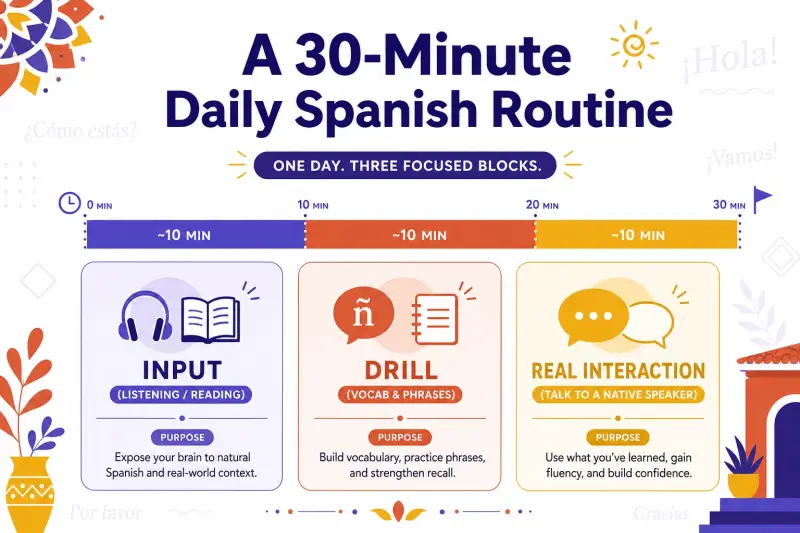
A daily Spanish routine works best when it splits your time across three jobs: input (reading and listening), output (writing and speaking), and one real interaction with a native speaker. Miss any one of them and progress gets lopsided.
Why a routine beats "study more"
Language ability is built from repetition, not marathons. The Foreign Service Institute, which trains US diplomats, estimates Spanish takes roughly 600-750 class hours to reach professional working proficiency, because it's a Category I language closely related to English. That's a big number, but it's spread over time. What matters is whether those hours actually accumulate, and daily beats sporadic every time.
Consistent short sessions produce better retention than occasional long ones, because spacing your exposure across days is what locks vocabulary into long-term memory. Studies on spaced practice consistently show 15-20 minutes a day outperforms a single two-hour cram once a week. We go deeper on the exact dose in how many minutes of Spanish per day actually makes a difference, so if you want the numbers, start there.
The 30-minute routine template
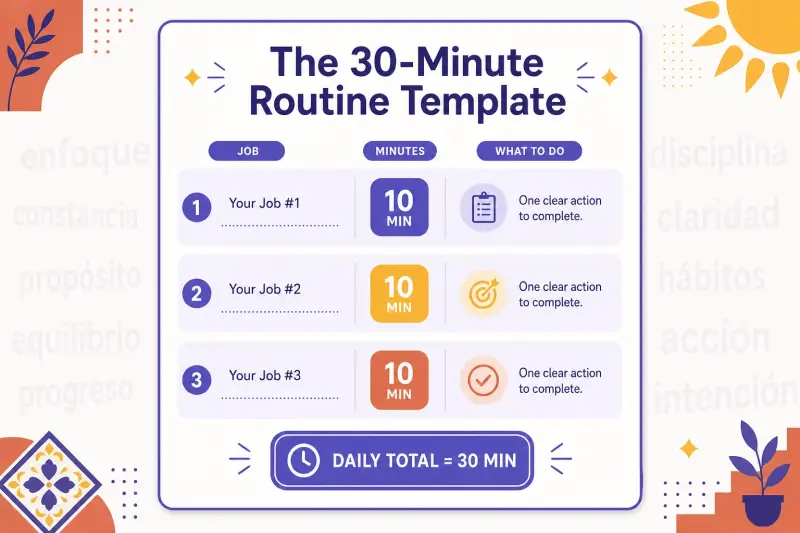
Here's the core template. It fits in 30 minutes, but every block scales down if you only have 15.
| Block | Time | What you do | Output produced |
|---|---|---|---|
| Warm-up review | 5 min | Review yesterday's new words with a flashcard app | Recall of 10-15 words |
| Input | 10 min | Read a short article or watch a clip with subtitles | 5-8 new words noted |
| Output | 5 min | Write 3-4 sentences using today's new words | A short written text |
| Real interaction | 8 min | Send voice/text to a native speaker, read their reply | Corrected real message |
| Wrap-up | 2 min | Log the words you missed for tomorrow's review | Tomorrow's review list |
The magic is in the last two blocks. Review and input are easy to do alone. Output and real interaction are where most solo learners quietly skip, and they're exactly the parts that build speaking ability.
One way to link the input, output and interaction blocks is to keep a single short story running across several days, reading it, retelling it from keywords, then bringing that retelling to a partner who may reply whenever they can.
Where the real-interaction block happens
You can't fake the interaction block with an app that only grades you. You need actual native speakers, ideally without booking a lesson every single day.
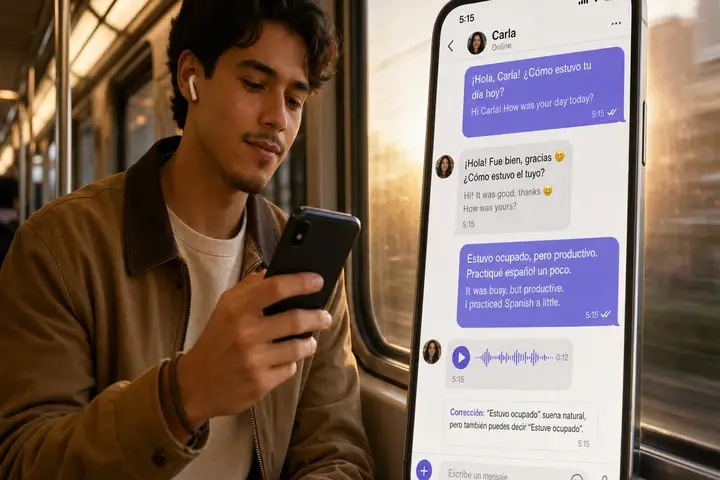
This is where a language exchange app fits the routine cleanly. On HelloTalk, the chat is built for learners: messages come with inline translation, phonetic transcription, read-aloud, and real-time grammar correction, so you never leave the conversation to look something up. That makes the 8-minute interaction block frictionless. You write a couple of sentences in Spanish, a native speaker replies and corrects you, and you've closed the loop for the day.
The single most valuable eight minutes in a Spanish routine is one corrected exchange with a native speaker, because it gives you feedback no textbook can. HelloTalk has 70M+ registered users across 200+ countries and 260+ languages, so finding a Spanish speaker to trade daily messages with is quick, and 90% of its core features are free.
For the input block, HelloTalk's Moments feed doubles as a stream of real posts from native Spanish speakers, so you're reading how people actually write, not textbook Spanish. If listening is your focus, its 24-hour Voicerooms let you drop in as a silent listener first, which is a low-pressure way to fill the input block with real speech.
How to adapt the routine to your life
The template is a starting point, not a cage. A few adjustments that keep it alive:
-
If mornings are chaotic, run input at night and interaction at lunch.
-
If you're a total beginner, spend more of the block on input and keep output to one sentence.
-
If you're intermediate, flip it: more output, more interaction, less passive input.
That last point connects to a bigger idea. Beginners need mostly input to build raw material; intermediate learners need to force output to activate it. We break this down in input versus output in language learning, which is worth a read once your routine is stable.
And if your problem isn't the routine itself but sticking to it past week three, that's a different fight. We cover it in how to build a Spanish practice habit that lasts.
Common mistakes that quietly kill routines
A few patterns we've watched sink otherwise good plans:
-
All input, no output. You feel productive but can't speak. Fix: never skip the output block, even if it's one sentence.
-
No fixed time. "Later today" becomes never. Fix: anchor practice to an existing habit, like coffee.
-
Too ambitious. A 90-minute plan lasts four days. Fix: shrink it until it's almost too easy to skip.
-
No feedback. Practicing errors just makes them permanent. Fix: get one thing corrected daily.
For a general framework on building a plan around your specific goal instead of copying someone else's, language learning strategy by goal is a useful companion, and language learning strategies that actually work covers the methods worth your time.
If you're a working adult with no free time
The template above assumes you can find one clean 30-minute block. If your day is meetings back to back, you'll want the version that breaks the routine into pockets across the day. We built that one specifically in the ideal daily Spanish schedule for working adults.
On the platform side, the same loop can include joining Livestreams when you want a slightly more guided room, and checking one line with AI pronunciation scoring or AI grammar notes before you hit send without changing this article's theme.
Frequently Asked Questions
How long should a daily Spanish routine be? For most people, 20-30 minutes daily is the sweet spot. It's long enough to include input, output, and interaction, and short enough that you'll actually do it every day. Fifteen minutes still works if you keep all three jobs, just smaller.
What's the best time of day to practice Spanish? The best time is whatever time you'll actually keep. Anchoring practice to an existing daily habit (morning coffee, commute, lunch) beats picking an "ideal" time you won't protect.
Can I get fluent with 30 minutes a day? You can reach conversational Spanish with 30 focused minutes a day over one to two years, especially if part of that time is real conversation. Fluency depends more on consistency and speaking practice than on session length.
Do I need a tutor for the routine to work? No. A daily corrected exchange with a native speaker on a language exchange app covers the feedback a beginner needs. Tutors help most later, when you want structured correction of specific weaknesses.
What if I miss a day? Miss a day, not two. One skip is normal; two in a row is how routines die. Just restart the next day at half length to lower the barrier back in.
Should I focus on grammar or conversation? Both, but not equally. Spend most of your time on input and interaction, and let grammar come from noticing patterns in corrections rather than studying rules in isolation.
Keep the Three Jobs in One Day
Pick your 30-minute slot, block out the five parts above, and run it once today. The routine only compounds if it starts. Set up your daily interaction block with a native speaker at HelloTalk, and if you want the bigger picture on trading practice with real speakers, our language exchange guide ties it all together.