
How Many Minutes of Spanish Per Day Actually Makes a Difference?
It's the question everyone asks and almost nobody answers honestly: how many minutes of Spanish per day do you actually need? Ten? Thirty? An hour? Most articles dodge it with "as much as you can." That's useless when you're trying to plan a real day.
So let's answer it properly, with a dose-response view: what different daily amounts actually buy you, and where the returns start to flatten. This is the numbers piece in our daily-practice cluster. If you want the full block-by-block plan those minutes go into, see our daily Spanish practice routine.
Fifteen to thirty minutes of focused Spanish per day is the point where progress becomes reliable and visible, and it beats a single long weekly session by a wide margin. Below fifteen, gains are slow but real; above sixty, returns per extra minute start dropping for most people.
First, the total you're working toward
To judge a daily dose, it helps to know the destination. The Foreign Service Institute puts Spanish at roughly 600-750 class hours to reach professional working proficiency, since it's one of the easiest languages for English speakers. That's the "professional" bar; conversational Spanish comes far sooner.
Here's what that total means at different daily doses.
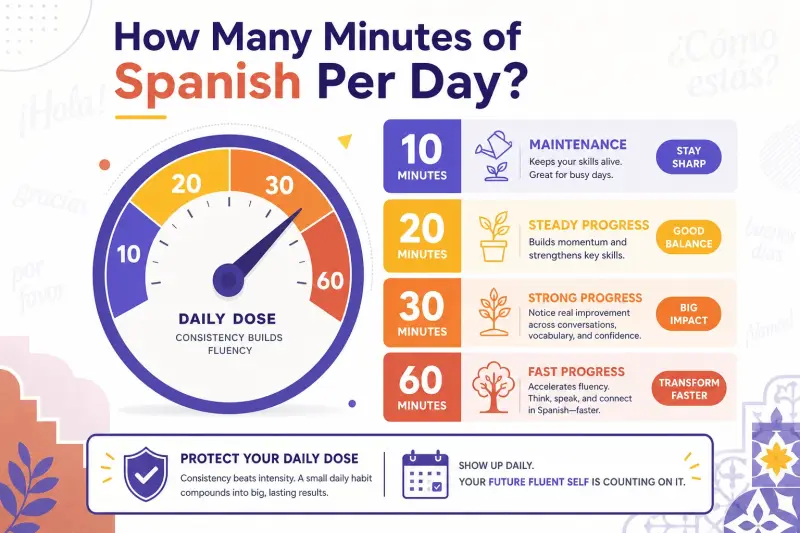
| Minutes per day | Hours per year | Rough time to ~600 hours | What it realistically gets you |
|---|---|---|---|
| 10 min | ~61 hrs | ~10 years | Slow drip; good for maintenance, weak for real progress |
| 20 min | ~122 hrs | ~5 years | Steady conversational growth if consistent |
| 30 min | ~183 hrs | ~3.3 years | The sweet spot: visible monthly progress |
| 60 min | ~365 hrs | ~1.6 years | Fast, but hard to sustain daily long term |
Two honest caveats. First, these assume the time is focused, not passive background listening. Second, quality of practice bends these numbers a lot: 20 minutes with real conversation and feedback beats 40 minutes of passive scrolling.
Why consistency beats length
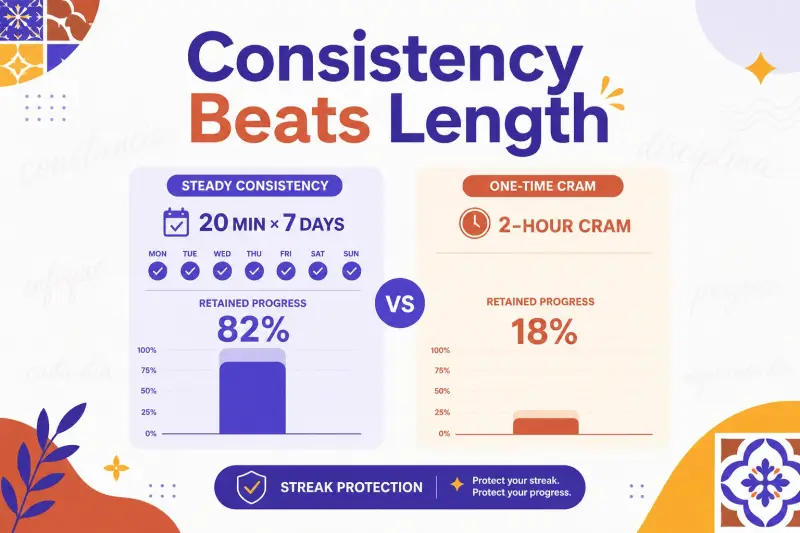
Here's the part that matters more than the exact number. Research on spaced practice consistently shows that short daily sessions produce better long-term retention than the same total time crammed into one weekly block. Fifteen minutes a day (about 105 minutes a week) will typically outperform a single two-hour Sunday session, even though the weekly cram is longer.
Spreading practice across days is what moves Spanish into long-term memory, so a shorter daily habit usually beats a longer weekly one even at equal total time. Your brain treats each day's exposure as a fresh retrieval, and retrieval is what makes memory stick.
This is also why chasing a huge daily number backfires. A 90-minute plan you keep for a week loses to a 20-minute plan you keep for a year. If keeping the daily habit is your real struggle, how to build a Spanish practice habit that lasts is the piece to read next.
The catch: not all minutes are equal
Two learners both do 30 minutes. One scrolls a grammar app and taps multiple-choice answers. The other reads a short article, writes three sentences, and trades a few messages with a native speaker who corrects them. After a month they are not in the same place.
The minutes that count most are the ones spent producing Spanish and getting it corrected, not the ones spent passively recognizing it. This is the input-versus-output gap. Recognition feels like progress and is easy to rack up; production is harder and is what actually builds speaking ability. We unpack the balance in input versus output in language learning.
So when you count your minutes, weight them. A rough rule: one minute of real conversation is worth several minutes of passive review for building speaking ability.
How to get high-value minutes without more time
If output and correction are the high-value minutes, the goal is to pack more of them into whatever time you have. That's easier with a tool built for it.
On HelloTalk, the chat with native speakers has inline translation, phonetic transcription, read-aloud, and real-time grammar correction, so even ten minutes turns into corrected output instead of guesswork. Its AI pronunciation scoring points out the specific sounds you're getting wrong, so a five-minute speaking check is genuinely diagnostic rather than vague praise. With 70M+ registered users, the reply usually comes fast enough to keep a short session moving.
For the input half of your minutes, HelloTalk's Moments feed gives you real posts from native Spanish speakers, and its Voicerooms let you listen to live conversation, so passive time is at least real Spanish rather than textbook Spanish. Roughly 90% of core features are free, so raising the quality of your minutes doesn't require a subscription.
A simple rule for picking your number
-
If you can only protect one number, make it 20 minutes daily. It's sustainable and clearly moves the needle.
-
If you have more time and can keep it, 30 minutes is the sweet spot.
-
Whatever you pick, weight it toward output and correction, and keep it daily.
For matching the amount and type of practice to what you're actually trying to achieve, language learning strategy by goal helps you avoid over- or under-investing. And if your constraint is a packed workday, the ideal daily Spanish schedule for working adults shows how to hit the number in pieces.
On the platform side, the same loop can include joining Livestreams when you want a slightly more guided room without changing this article's theme.
This Spanish daily-practice cluster works as four linked pieces: the 30-minute routine hub, building a habit that lasts, how many minutes per day actually help, and a working-adult pocket schedule. For how live exchange fits any routine, see the language exchange guide.
Frequently Asked Questions
Is 10 minutes of Spanish a day enough? Ten minutes daily keeps Spanish alive and slowly builds it, which is far better than nothing. But for visible progress within months, 20-30 minutes is a more realistic minimum, ideally with some real conversation in it.
How many minutes a day to become conversational? Around 20-30 focused minutes daily, with real speaking practice, can get most people to conversational Spanish within roughly one to two years. Consistency and output matter more than hitting a large daily total.
Is it better to do 15 minutes daily or 2 hours once a week? Fifteen minutes daily almost always wins, even though it's less total time. Spacing practice across days locks vocabulary into long-term memory in a way a single weekly session can't.
Do longer sessions ever help? Yes, occasionally. A longer weekend session is great for immersion, reading, or a long conversation. Just don't rely on it as your main engine; the daily drip is what compounds.
Does passive listening count toward my minutes? Partly. Real Spanish input counts, but weight it below active output. Ten minutes of speaking and getting corrected builds more ability than ten minutes of background listening.
Why do my minutes feel wasted? Usually because they're all passive recognition, no production. Shift some of your time to writing and speaking and getting corrected, and the same number of minutes will feel far more productive.
Pick a Dose You Can Protect Tomorrow
Choose your daily minutes, protect them, and spend most of them producing Spanish and getting corrected. The fastest way to fill your high-value minutes is real conversation, so start on HelloTalk. For the full picture on learning through real exchange, see our language exchange guide.