The Fastest Italian Learning Stack in 2026: Tools Ranked by Impact Per Hour
Most people trying to learn Italian fast have the opposite problem you'd expect. They don't lack tools. They have five apps, three YouTube channels, two textbooks, and a podcast, and they're going nowhere because their time is scattered across all of it.
Speed doesn't come from more tools. It comes from the right small set of tools, each doing the one job it's best at. So instead of a giant list, this is a lean stack ranked by what matters most: impact per hour.
The single tool with the highest impact per hour for learning Italian is real conversation with native speakers, because it trains recall, pronunciation, and listening at once, which no single-purpose app can do. Everything else in your stack should feed that.
The ranking principle: impact per hour
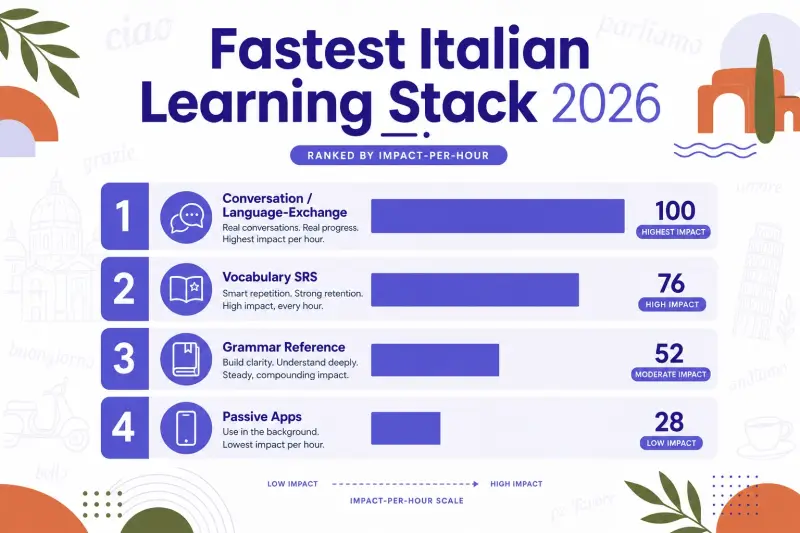
Every tool trades your time for some kind of progress. The question is how much progress per hour. A flashcard app gives you vocabulary recognition per hour. A grammar course gives you rules per hour. Real conversation gives you recall, pronunciation, listening, and confidence, all at once, which is why it tops the ranking.
Here's the full stack, ranked, with the one job each tool should do.
| Rank | Tool type | The one job it does best | Impact per hour |
|---|---|---|---|
| 1 | Language exchange (native speakers) | Real speaking with instant correction | Highest |
| 2 | Spaced-repetition vocab (Anki, Memrise) | Locking in high-frequency words | High |
| 3 | Audio course (Pimsleur) | Speaking drills and pronunciation | High |
| 4 | Structured course (Babbel, Busuu) | Grammar sequence and lessons | Medium |
| 5 | Gamified app (Duolingo) | Daily habit and basic vocab | Medium-low |
| 6 | Comprehensible input (podcasts, shows) | Listening and passive vocabulary | Medium, only paired with output |
Notice that the popular defaults, gamified apps and passive input, sit near the bottom. They aren't useless, but they have low impact per hour for the goal of speaking, and they're where most learners waste their time. For a broader head-to-head of Italian apps specifically, see Italian learning apps compared.
Why conversation ranks first
Italian rewards early speaking more than most languages. It's in the US Foreign Service Institute's easiest tier for English speakers, roughly 600 to 750 hours to professional working proficiency, and nearly 60% of English vocabulary has Latin roots, so a huge slice of Italian words are already half-familiar. That means you can start producing real sentences early, and every hour of actual conversation moves you faster than an hour of passive review.
Because Italian's Latin-based vocabulary and phonetic spelling let you speak usable sentences early, spending your top hours on conversation instead of app drills is the fastest route to fluency.
The trap is that conversation is the hardest tool to source alone. You can download a vocab app in seconds, but finding native speakers who'll correct you daily used to be the bottleneck. That's the gap a language exchange closes.
The number-one slot: a language exchange
For the highest-impact hour in your stack, you want native Italian speakers, instant feedback, and no cost barrier. On HelloTalk, the four modules each cover a different tool job so you can consolidate several apps into one:
-
Chat-based learning. Message native Italian speakers with translation, transcription, read-aloud, and real-time grammar correction built into the chat, which replaces a separate translator and a separate grammar checker.
-
Moments. Post an Italian sentence or caption and get corrections from several native speakers at once, which is faster and broader feedback than a single tutor gives.
-
Voicerooms and Livestreams. Join a 24-hour live Italian voice room as a listener first, then speak, plus interactive live mini-lessons, replacing the speaking-practice slot most stacks are missing.
-
AI learning tools. AI pronunciation scoring names the exact sound you're getting wrong, AI grammar correction explains fixes in real time, and image translation turns your surroundings into vocabulary, covering jobs you'd otherwise need extra apps for.
HelloTalk has more than 70M registered users across 200+ countries and 260+ languages, with 90% of core features free and over 1 billion messages daily. It won the 2017 Google Play Best Social App award and was featured on the global Google Play homepage in 2024. Practically, that means the highest-impact tool in your stack is also the free one, and it can absorb three or four of the paid apps people usually juggle.
Building your lean stack
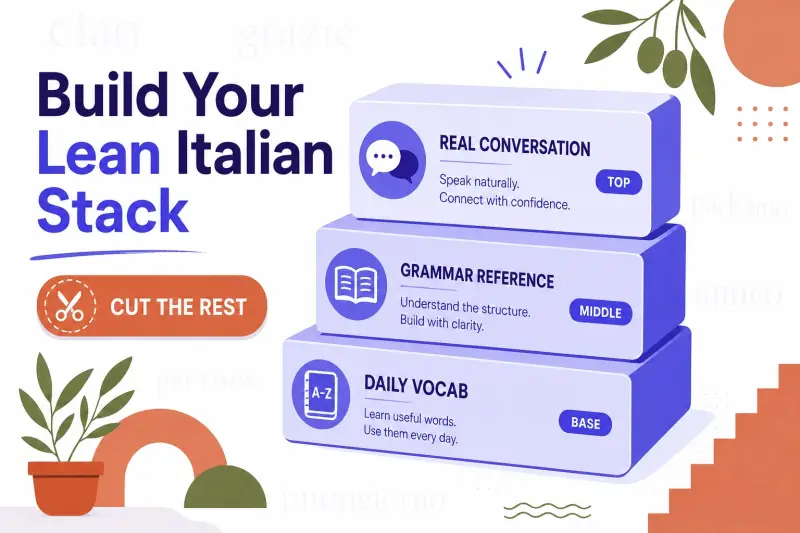
You don't need all six ranks. You need one from the top for speaking, one for vocabulary, and optionally one for structure. Here's a setup that stays lean.
-
Speaking (rank 1): A daily language exchange for real conversation and correction.
-
Vocabulary (rank 2): A spaced-repetition app loaded with the 1,000 most common Italian words as phrases.
-
Structure (rank 3 or 4), optional: An audio course or a structured app for grammar sequencing, if you want a backbone.
That's it. Three tools, maybe two. The magic isn't the apps, it's that every hour points at speaking. We walk through the full speed philosophy in how to learn Italian quickly and what works, and if you're deciding between building this stack yourself or paying for a course, read intensive Italian versus self-study.
Common stack mistakes that kill speed
-
Collecting instead of using. Five apps at 20% completion beat you every time. Pick the lean stack and go deep.
-
Putting passive input at the top. Shows and podcasts are great support, but as your main tool they build recognition, not speech. Pair them with output, as we explain in immersion versus spaced repetition.
-
Skipping the speaking slot. A stack with no conversation is a reading stack, not a speaking stack.
-
Ignoring your goal. The best stack for a trip differs from the best stack for exams. Match tools to your goal using choosing a language learning strategy by goal, and if you want a reality check on timelines see can you learn Italian in 3 months. The broader method sits in our pillar on language exchange.
This Italian speed cluster splits one question into four angles: what actually speeds Italian up, intensive study versus self-study, what three months can realistically cover, and a high-impact tool stack. Speaking partners still sit outside any stack, so keep a path like the language exchange guide open early.
Frequently Asked Questions
What's the best app to learn Italian fast in 2026? No single app does it all. The fastest setup pairs a language exchange for real speaking, a spaced-repetition app for high-frequency vocabulary, and optionally an audio course like Pimsleur for pronunciation drills.
How many apps do I actually need to learn Italian? Two or three, not five. One for speaking with native speakers, one for vocabulary, and optionally one for grammar structure. More tools usually scatter your time and slow you down.
Is Duolingo enough to learn Italian? Duolingo is fine for daily habit and basic vocabulary, but it ranks low on impact per hour because it lacks real conversation. Use it as a warm-up, not your main tool, and add speaking practice.
Why is conversation ranked above apps? Because one hour of real conversation trains recall, pronunciation, listening, and confidence at once, while a single-purpose app trains only one of those. Italian's easy vocabulary for English speakers makes early speaking especially efficient.
Do I have to pay for the best Italian learning stack? No. The highest-impact tool, a language exchange with native speakers, can be free, and a solid vocabulary app costs little or nothing. A lean free-to-cheap stack outperforms an expensive scattered one.
How do I stop app-hopping and stick to a stack? Choose one tool per job, delete the rest, and anchor your routine to daily speaking. When your main habit is a real conversation someone is expecting, the other tools fall into supporting roles.
Build the Stack, Then Open a Chat
The fastest Italian learners in 2026 aren't the ones with the most apps. They're the ones who put conversation at the top and let a couple of lean tools feed it. Cut the clutter, load your high-frequency words, and make daily speaking the center.
The top slot is free. Download HelloTalk at hellotalk.com, find an Italian speaker, and put your stack to work with your first real conversation today.