Intensive Italian vs Self-Study: Which Gets You Speaking Faster?

There are two very different ways people try to learn Italian fast. One is intensive: a structured course, often several hours a day, sometimes abroad, with a teacher setting the pace. The other is self-study: you build your own routine from apps, videos, books, and conversation partners, on your own schedule.
Both can work. The wrong one for your life will stall you. So let's compare them on the only metric that matters for speed, which is how fast you can actually speak, not how much material you cover.
Intensive courses get you to a defined level faster in raw weeks, but self-study paired with daily speaking practice usually gets you talking sooner and costs far less. The right answer depends less on which is "better" and more on your budget, schedule, and self-discipline.
What "intensive" really means
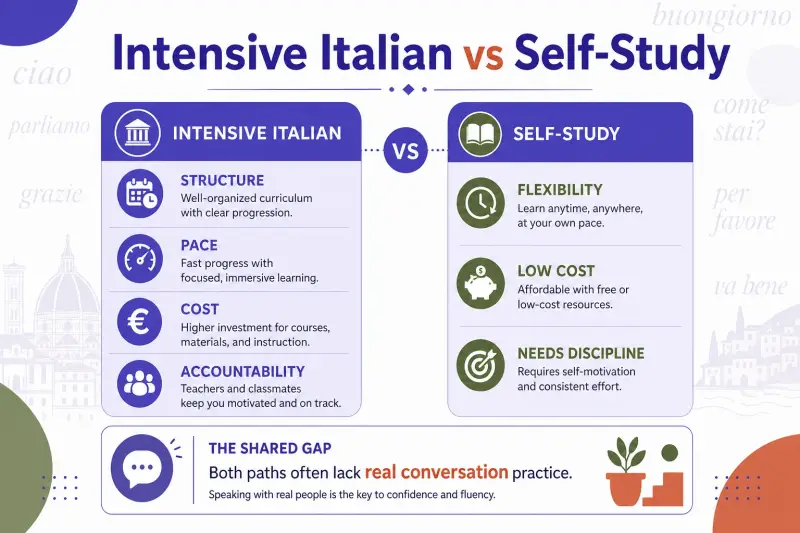
Intensive Italian usually means 15 to 25 hours a week of structured instruction, often over 2 to 8 weeks. It mirrors how the US Foreign Service Institute trains diplomats, roughly 24 to 30 weeks of full-time study (around 600 to 750 hours) to reach professional working proficiency in Italian, which sits in the FSI's easiest language tier for English speakers.
Compressed into a short intensive block, you can realistically move through A1 to A2 in a few weeks, because A1 takes about 60 to 100 guided hours and A2 lands around 180 to 200 total. The engine here is momentum: you don't forget Monday's lesson by Friday because you're using it Tuesday, Wednesday, and Thursday.
Intensive study works because it removes the biggest self-study killer, which is the gap between sessions where you forget what you learned.
What self-study really means
Self-study is not a lesser version of a course. It's a different tool. You choose your materials, control the pace, and pay little or nothing. The catch is that you also supply the discipline and, crucially, you have to manufacture speaking practice, because reading and watching alone don't teach production.
Self-study wins on flexibility and cost. It loses whenever motivation dips, because nobody is waiting for you. We break down how to structure it well in how to self-study Italian online, and for the overall speed strategy see how to learn Italian quickly and what works.
Head to head
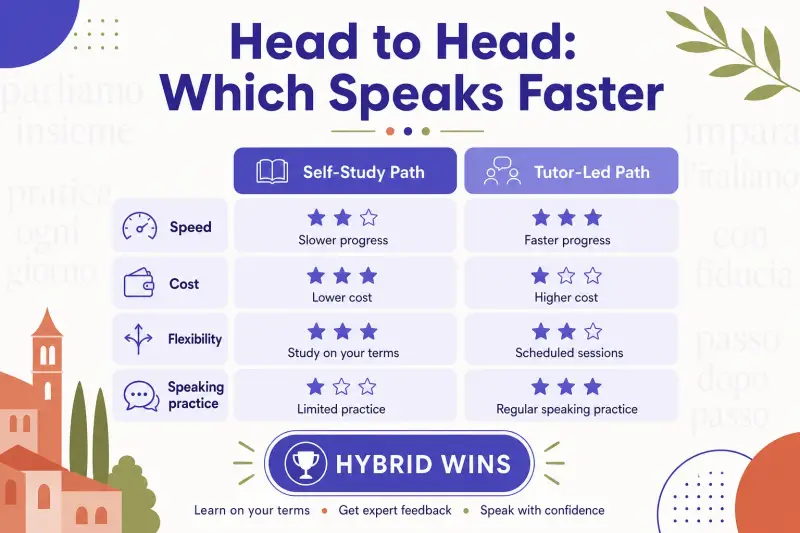
| Factor | Intensive course | Self-study |
|---|---|---|
| Weeks to A2 | Fast, often 4-8 weeks full time | Variable, 3-6 months part time |
| Cost | High, hundreds to thousands | Low to free |
| Schedule fit | Rigid, demands blocks of time | Flexible, fits around work |
| Speaking practice | Built in, but limited to class hours | You must create it |
| Motivation support | External structure keeps you going | All on you |
| Personalization | Set curriculum, one pace for the room | Fully your choice |
| Best for | Deadlines, sabbaticals, immersion trips | Working adults, tight budgets |
Notice the row that decides speed: speaking practice. An intensive course gives you speaking time inside class, but it stops at the end of the day. A self-studier can actually speak more per week if they build in daily conversation, and that is where most self-study plans quietly fail.
The gap both paths share: real conversation
Here's the thing neither path solves on its own. Intensive classes limit your speaking to scheduled hours with the same teacher and classmates. Self-study, left alone, often has no speaking at all. The learners who move fastest, in either camp, fix this the same way: daily conversation with native speakers.
This is where a language exchange fills the gap for both. On HelloTalk, you get native Italian speakers who correct you in real time, and the four modules cover the parts a classroom or a solo routine leaves out:
-
Chat-based learning. Every message with a native speaker comes with built-in translation, transcription, and instant grammar correction, so you get teacher-style feedback without a teacher's schedule.
-
Moments. Post a short Italian text or caption and several native speakers correct it, giving self-studiers the peer review a classroom provides.
-
Voicerooms and Livestreams. Join a live Italian voice room as a listener, then speak when ready, which recreates the class speaking environment on your own time, around the clock.
-
AI learning tools. AI pronunciation scoring flags your exact problem sounds and AI grammar correction explains fixes, filling the between-lesson feedback gap both paths have.
HelloTalk has over 70M registered users across 200+ countries and 260+ languages, with 90% of core features free and over 1 billion messages sent daily, so the speaking practice that classrooms ration and self-study lacks is available any hour, at no cost.
Adding a free language exchange to self-study can close most of the speaking-practice gap that makes intensive courses faster, at a fraction of the price.
So which should you choose?
Choose intensive if you have a hard deadline, a block of free time like a sabbatical or a summer, and the budget. It's the fastest route to a defined level when time is short and money isn't.
Choose self-study if you're a working adult, your budget is limited, or you can't commit to fixed hours. Just don't skip the speaking layer. To see how the pure tool question shakes out, compare setups in the fastest Italian learning stack for 2026, and match method to your goal in choosing a language learning strategy by goal.
If you're genuinely trying to hit a level in a tight window, read our reality check in can you learn Italian in 3 months before you commit money to an intensive program.
A hybrid that beats both
Most people don't have to pick a pure lane. The strongest plan we've seen is self-study for input and structure, plus daily language exchange for output, with a short intensive burst only if you have a real deadline. You get the flexibility and low cost of self-study, the daily speaking of a class, and the momentum of intensive study when it counts.
For beginners deciding where to even start, the best way to learn Italian in 2026 and learn Italian online for beginners lay the groundwork before you commit to a path.
This Italian speed cluster splits one question into four angles: what actually speeds Italian up, intensive study versus self-study, what three months can realistically cover, and a high-impact tool stack. Speaking partners still sit outside any stack, so keep a path like the language exchange guide open early.
Frequently Asked Questions
Is an intensive Italian course faster than self-study? In raw weeks to a set level, usually yes, because it removes the forgetting gap between sessions. But it costs far more and limits speaking to class hours, so self-study plus daily conversation practice often gets you talking sooner in real terms.
Can I reach A2 Italian with self-study alone? Yes. A2 takes roughly 180 to 200 total hours. Self-study can cover that, but you must add speaking practice, because reading and listening alone build recognition, not the ability to talk.
How much does an intensive Italian course cost? It varies widely, from a few hundred dollars for online intensives to several thousand for in-person immersion programs abroad. Self-study can be done for free using apps and a language exchange.
Which is better for a busy working adult? Self-study, almost always. Its flexibility fits around a job, and the missing speaking practice can be added for free through a language exchange in short daily sessions.
Do intensive courses guarantee I'll speak faster? No. They guarantee structured exposure, not fluency. Speed still depends on how much you produce the language out loud, which is why many course students add a language exchange for extra speaking.
Can I combine intensive study and self-study? Yes, and it's often the best plan. Use self-study for daily habit and input, add daily conversation for output, and use a short intensive block only when you have a deadline.
Choose a Path, Then Speak on It
Whichever route fits your life, the deciding factor is the same: daily speaking with people who correct you. A course rations it, self-study often forgets it, and a language exchange gives it to you free, any hour.
Download HelloTalk at hellotalk.com, find an Italian speaker today, and add real conversation to whichever path you choose. That's the piece that turns study into speaking.