
Can You Learn Italian in 3 Months? An Honest Look at What's Possible
"Learn Italian in 3 months" is one of the most searched promises in language learning, and one of the most misleading. The honest answer depends entirely on what you mean by "learn." Fluent? No. Able to hold real conversations and handle daily life in Italian? Very possibly, if you put in the right hours the right way.
Let's skip the hype and look at the actual numbers, then map out what a real 3-month plan gets you.
In three months of consistent daily study, most learners can realistically reach a solid A2 and touch B1 in Italian, which means holding everyday conversations, but not fluency. That is a genuinely useful level, and it's achievable if you understand the math.
The math behind three months
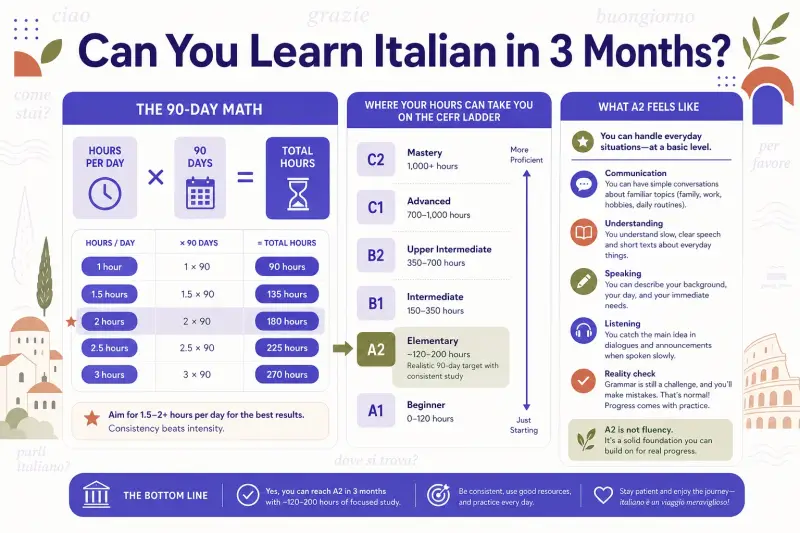
CEFR levels give us hours to work with. Reaching A1 in Italian takes roughly 60 to 100 guided hours, A2 lands around 180 to 200 total hours, and B1 sits somewhere near 350 to 450 total. Italian is in the US Foreign Service Institute's easiest tier for English speakers, with about 600 to 750 hours to professional working proficiency, so these lower levels come faster than in most languages.
Now put that against a 3-month calendar.
| Daily study time | Total hours in 3 months | Realistic level reached |
|---|---|---|
| 30 minutes | ~45 hours | Strong A1, basic phrases and survival Italian |
| 1 hour | ~90 hours | Solid A1, early A2 |
| 2 hours | ~180 hours | Full A2, conversational on familiar topics |
| 3+ hours | ~270+ hours | A2 into B1, comfortable everyday conversation |
So the promise isn't a lie, but it comes with a price tag in hours. Thirty minutes a day gets you survival Italian. Two focused hours a day gets you genuine conversation. There's no shortcut around the hours, only smarter or dumber ways to spend them.
The difference between "some Italian" and "conversational Italian" in three months is almost entirely daily time on task, not talent or a secret method.
What A2 actually feels like
A2 is the sweet spot for a 3-month goal, so it's worth knowing what it buys you. At A2 you can order food, ask for directions, describe your day, talk about family and work in simple terms, and understand slow, clear speech on familiar topics. You'll still stumble, and fast native conversation will lose you. But you can function.
That is a far cry from fluency, and pretending otherwise is why so many people feel like failures at month three. The goal isn't fluency in 90 days. The goal is to be genuinely conversational, which A2 delivers. For the full-speed strategy that underpins any timeline, see how to learn Italian quickly and what works.
Why most 3-month attempts stall (and how to not)
The failures rarely come from lack of effort. They come from spending the hours on the wrong things.
-
Too much passive input. Watching shows and doing app lessons feels like progress but builds recognition, not speech. Balance input and output from week one. We explain the trade-off in immersion versus spaced repetition.
-
No speaking until you feel "ready." In a 3-month sprint you never feel ready, so you have to speak badly from week one or you'll finish 90 days able to read but not talk.
-
Grammar overload. You don't need every tense in three months. You need present, past, near future, and the ability to be understood.
-
Inconsistency. Missing days is the real killer. The math above assumes you actually show up daily.
The single fastest way to waste a 3-month window is to spend it consuming Italian instead of producing it, because only production builds the ability to speak.
The plan that actually fits 90 days
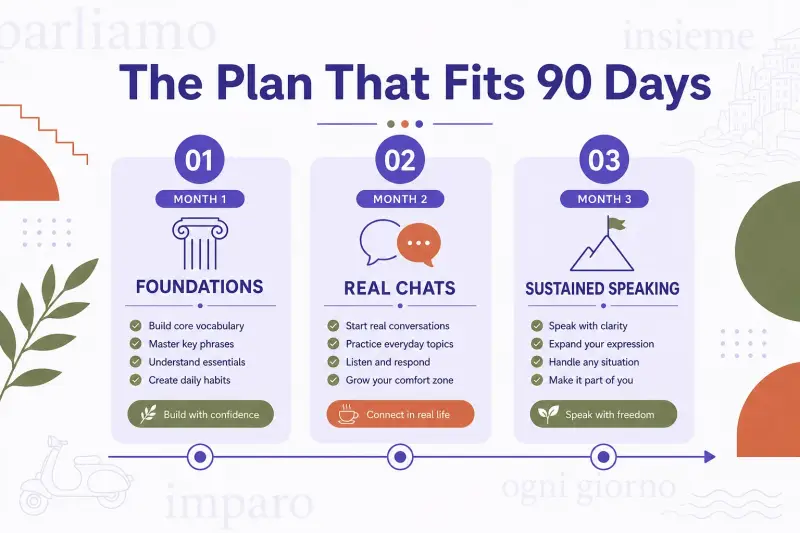
To hit conversational Italian in three months, front-load speaking and high-frequency vocabulary. Here's the shape.
-
Weeks 1-4: Learn the 500 most common words as phrases, master pronunciation early (Italian is largely phonetic, so this pays off fast), and start speaking daily even if it's one sentence.
-
Weeks 5-8: Push into A2 grammar, expand to 1,000 words, and increase conversation length. Get corrected relentlessly.
-
Weeks 9-12: Live entirely in the language you have. Daily real conversations, less new grammar, more using what you know until it's automatic.
The non-negotiable across all twelve weeks is daily speaking with feedback. That's the part you can't fake alone, and it's where a language exchange changes the outcome.
Why a language exchange makes 3 months realistic
The hours only count if a chunk of them are spent speaking with someone who corrects you. A course rations that time and costs money you may not have for a 90-day push. A language exchange gives it to you free, every day.
On HelloTalk, the four modules let you spend your 3-month hours on real interaction instead of passive review:
-
Chat-based learning. Message native Italian speakers with translation, transcription, and instant grammar correction built in, so every text is also a mini lesson.
-
Moments. Post a daily Italian sentence and get corrections from several native speakers, which compounds fast over 90 days.
-
Voicerooms and Livestreams. Join a live Italian voice room as a listener, then speak up, building spoken confidence from week one instead of week ten.
-
AI learning tools. AI pronunciation scoring catches the exact sounds tripping you up, and AI grammar correction explains fixes on the spot, so your solo hours improve too.
With over 70M registered users across 200+ countries and 260+ languages and 90% of core features free, you can find an Italian speaker to practice with every single day of your three months without paying a cent. That daily real conversation is what turns 180 study hours into actual speaking ability.
Because a language exchange converts study hours into conversation hours for free, it is the most reliable way to reach conversational Italian inside a 3-month window.
If you're weighing a paid intensive against a free self-study sprint for these 90 days, compare them in intensive Italian versus self-study, and pick your exact tools in the fastest Italian learning stack for 2026. For the overarching method, our pillar on language exchange ties it together.
This Italian speed cluster splits one question into four angles: what actually speeds Italian up, intensive study versus self-study, what three months can realistically cover, and a high-impact tool stack. Speaking partners still sit outside any stack, so keep a path like the language exchange guide open early.
Frequently Asked Questions
Can you become fluent in Italian in 3 months? No. Fluency needs far more than 90 days can hold, given the roughly 600 to 750 hours the FSI estimates for professional working proficiency. But you can reach A2 and touch B1, meaning solid everyday conversation, which is a genuinely useful level.
How many hours a day to learn Italian in 3 months? For conversational ability, aim for about 2 hours a day, totaling roughly 180 hours over three months, which maps to a full A2. Thirty minutes a day gets you survival phrases instead.
What level of Italian can I realistically reach in 3 months? A solid A2, with early B1 if you study 2 to 3 hours daily. That means holding everyday conversations on familiar topics, understanding slow clear speech, and handling daily life in Italian.
Is 3 months enough to visit Italy and get by? Yes, comfortably. Even a strong A1 to A2 covers ordering, directions, shopping, and small talk. A2 makes a trip genuinely smoother and more fun.
What's the biggest mistake in a 3-month Italian plan? Consuming Italian without producing it. Passive input builds recognition, but only speaking builds speech, so a plan without daily conversation ends with you able to read but unable to talk.
Do I need to pay for lessons to learn Italian in 3 months? No. Free self-study plus a free language exchange for daily speaking practice can carry you to conversational Italian in 90 days without paid lessons.
Define Your 90-Day Speaking Target
Three months is enough for real, usable Italian if you spend the hours on speaking. Set your daily time, front-load high-frequency words, and talk from day one.
The daily conversation part is free. Download HelloTalk at hellotalk.com, find an Italian speaker, and send your first sentence today. Day one of ninety starts the moment you do.