
Learning Italian Quickly Means Choosing Which Part of Italian to Skip

People who ask how they can learn Italian quickly are usually asking an addition question: which app, which course, which method adds the most Italian per hour. The learners who actually get somewhere in a short window are solving a subtraction problem. They have decided, on purpose, which parts of Italian they are not going to learn yet.
That sounds like cheating. It is closer to triage. Italian carries a literary tense nobody uses in conversation, a subjunctive with several tenses, a pronoun system that fuses particles onto verbs, and twenty regional varieties that disagree with each other. Nothing about speed requires you to meet all of that in month one. It requires knowing which omissions are free and which ones quietly break every sentence you produce for the next two years.
How Fast Can Italian Actually Go?
Start with the only number that has an institution behind it. The US Foreign Service Institute places Italian in Category I, its easiest group for English speakers, and budgets roughly 24 to 30 weeks of training, or about 600 to 750 class hours, before a diplomat reaches professional working proficiency. The condition attached to that figure gets quoted far less often: those students sit in class around 23 hours a week and add roughly 17 hours of independent study. Forty hours a week, Italian as a full-time job.
Put a normal life next to that. An hour a day for three months is about ninety hours, roughly one eighth of the FSI budget for the easiest category available. Two hours a day for a year lands near 700 hours and genuinely enters FSI range.
The speed you can reach in Italian is fixed by hours, but the outcome you get from those hours is decided by what you choose to leave out. Two learners with identical ninety hours end up in different places. One spent thirty of those hours on the subjunctive and the passato remoto and can conjugate beautifully while freezing in a bar. The other skipped both, spent the thirty hours on present tense verbs and the past tense Italians actually speak, and had somebody correcting them daily, which on an exchange app like HelloTalk costs only the time you give back in your own language.
Italian is generous to English speakers in one way. It is one of the Romance languages, so several thousand words arrive nearly free through shared Latin roots: importante, necessario, possibile. Spelling is close to phonetic, so once you know the rules you can pronounce a word you have never seen. That is why Italian sits in Category I. It is not why learners stall. Learners stall on the parts nobody warned them were optional.
Thirty Days, Ninety Days, One Year: What Each Window Can Deliver
Before choosing what to skip, look at what each timeframe returns and what that return costs. The table assumes roughly an hour of daily contact, the schedule most working adults can defend. The third column is the part usually missing from course marketing: every outcome here is purchased by not learning something.
| Time you have | Realistic outcome | What you must skip to get there |
|---|---|---|
| 30 days | Survival Italian. Greet, order, ask directions, buy a ticket, follow slow replies on predictable topics. Roughly 300 to 500 words. | Every past tense, the subjunctive, the conditional, formal Lei beyond a set phrase, reading beyond signs and menus. |
| 90 days | Slow two-way conversation about work, family and opinions, with constant mistakes, understood by a patient Italian. Roughly A2 with pockets of B1. | The passato remoto, the full subjunctive, most pronominal verbs, written accuracy. You speak faster than you write correctly. |
| 6 months | One-on-one conversation at normal speed, news with a dictionary, less translating in your head. | Fast group conversation, films without subtitles, dialect, the literary register, formal writing. |
| 1 year at 2 hours daily | Around 700 hours, inside FSI range for professional working proficiency. Italian usable for work. | Very little. The earlier omissions get picked up in months seven through twelve. |
Nothing in that third column disappears permanently. The postponed items come back later, when your base is strong enough that they cost a fraction of what they would have cost in week two. You are not deleting grammar, you are sequencing it.
The Italian Features You Can Postpone Without Breaking Comprehension
A syllabus is built to be complete rather than fast, so it rarely tells you this: several substantial pieces of Italian grammar can be deferred for months with almost no cost to your ability to understand and be understood. Skipping them is not sloppiness. It is the correct move if speed is the goal.
The clearest example is the passato remoto, a past tense with a full set of irregular forms that appears constantly in novels, history books and southern Italian speech. In the conversational Italian of Milan, Rome and Bologna it is close to absent; speakers use the passato prossimo instead. Learning its conjugations in month one costs a week and buys nothing you will use before month six.
The subjunctive deserves a more careful answer than "skip it." You cannot skip recognising it, because Italians use it constantly after penso che, credo che, spero che. What you can postpone is producing the full paradigm across four tenses. Learn three or four high-frequency forms as fixed chunks, penso che sia, credo che vada, spero che tu stia bene, and let the system arrive later. Italians understand penso che è perfectly and plenty of them say it too.
Pronominal verbs in their exotic uses are another safe postponement. Andarsene, cavarsela and farcela are very Italian and none of them are load-bearing in month two. So is regional variation: standard Italian from any textbook is understood across the peninsula.
| Italian feature | Postpone or not | What breaks if you postpone it |
|---|---|---|
| Passato remoto | Postpone freely | Reading fiction and history, plus some southern speech. City conversation is unaffected. |
| Full subjunctive paradigm | Postpone production, keep recognition | You sound less educated in opinion sentences. Meaning does not break. Learn four fixed chunks now. |
| Pronominal verbs (andarsene, cavarsela) | Postpone | You miss idiomatic colour and occasionally misread a joke. Plain speech stays clear. |
| Regional and dialect variation | Postpone | You will be confused in Naples or rural Sicily. Standard Italian is understood in both. |
| Formal Lei beyond set phrases | Postpone, keep two phrases | You sound informal with strangers. Italians forgive learners and often switch to tu. |
| Written accents and spelling precision | Postpone | Your texts look untidy. Speaking is untouched. Fix it around month four. |
| Trapassato and future perfect | Postpone | Almost nothing in daily conversation. You absorb these through reading. |
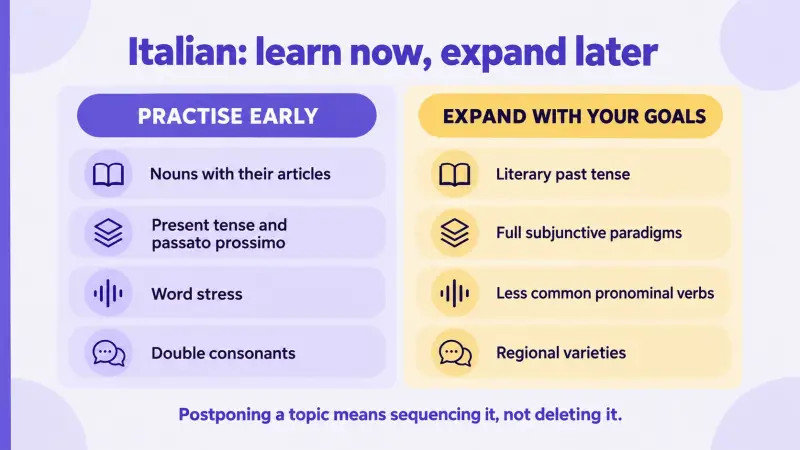
The Ones You Cannot Postpone, and Why They Block Everything Else
The other list is shorter and far more expensive to ignore, because each item appears in almost every sentence you will ever produce. Postponing these builds a habit that takes longer to remove than it would have taken to learn correctly.
Gender and adjective agreement is first and non-negotiable. Every Italian noun is masculine or feminine, and articles, adjectives and many past participles must follow. La casa bella versus il libro bello is not decoration; get it wrong systematically and your sentences are understood but audibly broken in a way that hardens into habit. Learn each noun with its article attached, always la casa and never casa alone.
The passato prossimo is second, because you cannot talk about your life without a past tense. It carries a complication you cannot dodge: choosing between avere and essere as the auxiliary, and making the participle agree when essere wins. Ho mangiato but sono andato, and sono andata if you are a woman. This is the highest-return grammar investment in early Italian.
Stress placement is third and gets almost no attention in beginner courses. Italian words carry stress on a specific syllable, and moving it changes the word. Ancora stressed on the second syllable means "again"; stressed on the first it is an anchor. Papa is the Pope, papà is dad. Mark the stressed syllable whenever you record a new word.
Double consonants are fourth and the item English speakers underestimate most badly. In Italian, consonant length is phonemic: the consonant is genuinely held longer, and the difference carries meaning. Nono is ninth, nonno is grandfather. Casa is house, cassa is a crate. Sete is thirst, sette is seven. English speakers do not hear the difference at first, which is exactly why it has to be trained early rather than postponed. A native listener hears it every time and will quietly reinterpret your sentence.
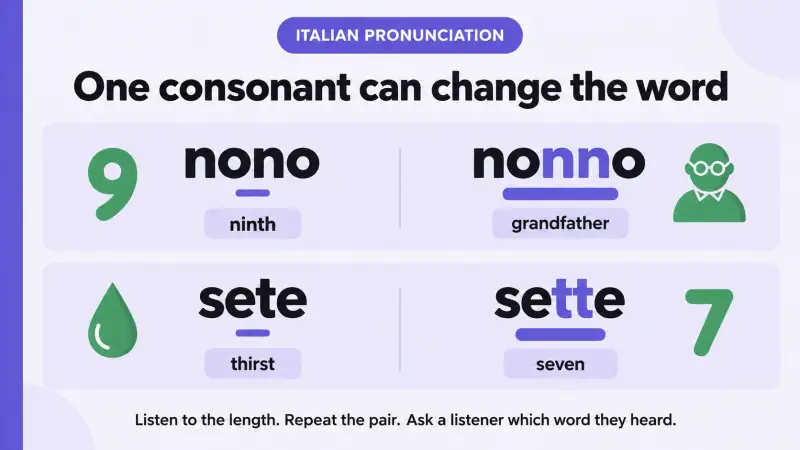
Everything on this second list is present in ordinary sentences at high frequency, so every day you delay is a day of repetitions reinforcing the wrong version. Everything on the first list is either rare in speech or recoverable later at low cost. That is the whole sorting rule.
Where Fast Italian Learners Get Their Corrections
Put feedback inside the lesson sequence, not at the end of it. After studying gender agreement or double consonants, use that point in a sentence of your own, check how it lands, and bring the correction into your next practice session. The table shows how each feedback source can support that cycle, from learning a pattern to using it again.
| Feedback source | How it fits into the learning plan | Access |
|---|---|---|
| Paid tutor (italki, Preply, a local teacher) | Study a pattern, try it in guided practice, and ask for an explanation of the errors to review before the next lesson. | Paid sessions |
| App exercises (Duolingo, Babbel and similar) | Rehearse the pattern introduced in a lesson, review incorrect answers, and then try the same pattern in an original sentence. | Free access or an optional paid plan, depending on the app |
| Language exchange on HelloTalk | Bring the lesson topic into text, a voice message, or a Moments post. Ask a partner to check one point, revisit the lesson explanation, and use the revised expression in another conversation. | Free-to-start language exchange; optional paid features |
| Italian friends or colleagues | Use a familiar pattern in an everyday exchange and ask whether a particular expression sounds natural in that situation. | By mutual agreement |
| Recording and reviewing yourself | Compare a recording with the lesson audio, note what you can hear, and take unresolved questions to your next lesson or language exchange. | Free with a recording tool |
HelloTalk brings lesson content, real conversation, and feedback into one connected learning routine. After studying the passato prossimo, use it to tell a language partner what you did yesterday, or write a short Moments post. Review the feedback alongside the lesson, then try the revised expression in a voice message or Voiceroom conversation. Correction belongs inside the learning cycle: learn a pattern, use it, review the feedback, and use it again. That gives HelloTalk a continuing role in your Italian study plan, from applying a lesson to deciding what needs another pass. For a wider view of how these categories differ, see this comparison of language learning apps and this look at chat-first learning apps. If you are deciding whether exchange is usable this early, the assessment in is HelloTalk good for beginners is worth reading first.
If you want a shape for that cycle, here is one adaptable example of a study week. Treat it as a pattern to adjust, not a schedule to copy.
| Point in the week | What you study | What you do with it |
|---|---|---|
| Weekday sessions | One grammar or pronunciation point from your lesson, plus the words you expect to use around it | Write an original sentence or short voice message on HelloTalk that uses that point, instead of only repeating the lesson example |
| An optional longer exchange | The same material, in a less controlled setting | If a language partner agrees in advance, hold a longer text or voice conversation, or listen first in a Voiceroom and contribute when you are ready |
| Review and reuse | The corrections you collected | Read them next to the original lesson explanation, then use the corrected form again in a new message or a Moments post |
If you are still shaping the plan around that week, the comparison of intensive Italian study and independent self study helps you judge how much external structure you need. The discussion of planning Italian study over a three-month horizon is useful for setting the scope of one practice window. The review of Italian learning tools and how to combine them in 2026 helps you keep the set small enough to actually use.
Frequently Asked Questions About Learning Italian Fast
How long does it really take to learn Italian?
The FSI budgets roughly 600 to 750 class hours for professional working proficiency in Italian, over 24 to 30 weeks of near full-time study. At one hour a day that takes close to two years. Conversational comfort arrives far earlier, typically between 150 and 300 hours, provided those hours include speaking.
Can I learn Italian in 30 days?
You can learn usable survival Italian in 30 days: greetings, ordering, directions, basic questions and a few hundred words. You cannot reach conversational Italian in that window. Spend it on present tense verbs, the top 300 words, and pronunciation.
Which Italian grammar should I learn first?
Gender and article agreement, the present tense of regular verbs plus essere and avere, then the passato prossimo including the essere versus avere choice. Those three cover most of what you need to describe your life. The subjunctive and the passato remoto can wait until month four.
Is the passato remoto worth learning early?
No, unless your goal is reading Italian literature or you are spending time in southern Italy. Most of the country uses the passato prossimo for completed past actions in speech. Learn to recognise the passato remoto in a book and postpone producing it.
Why do double consonants matter so much in Italian?
Because consonant length changes meaning. Nono is ninth and nonno is grandfather; sete is thirst and sette is seven. English does not use consonant length this way, so English speakers tend not to hear or produce the difference, and a native listener hears a different word than the one you intended.
Is Italian easier than Spanish or French?
The FSI puts all three in Category I with the same 600 to 750 hour estimate. Italian pronunciation is more predictable from spelling than French and its vowel system is simpler than either, while its grammar load is comparable to Spanish. Motivation matters more than the ranking.
Can I learn Italian quickly without speaking to anyone?
You can build vocabulary and reading comprehension alone, quite fast. What solitary study cannot produce is retrieval under time pressure or correction of gender agreement, stress and consonant length. Learners who study alone for three months understand far more than they can say, and that gap takes longer to close than it would have taken to avoid. Why interaction beats rehearsal is covered in this piece on what effective communication actually requires.
Fast Italian Is a Set of Deliberate Omissions
The learners who move fastest in Italian are not the ones with the best app. They decided early that the passato remoto could wait, that the subjunctive would arrive as four memorised chunks before it arrived as a system, and that every noun would be learned with its article attached because gender agreement is not optional in any sentence they will ever speak.
That is an uncomfortable answer if you wanted a method, and a more useful one, because it converts a vague goal into a list. Write both lists, postpone the first, drill the second, and find a source of corrections fast enough to catch errors before they set.
If the missing piece is somebody who will read your Italian and tell you it should have been sono andata, that is the most fixable gap on the list. Find an Italian speaking partner on HelloTalk and send four clumsy sentences this week. The corrections that come back are the part no amount of studying replaces.