
The Most Efficient Way to Learn Spanish in 2026, According to Research
There is no shortage of Spanish methods, and most of them work a little. The question worth asking is which combination gives us the most progress per hour. When we line up how people actually acquire languages against what wastes effort, a fairly consistent picture emerges.
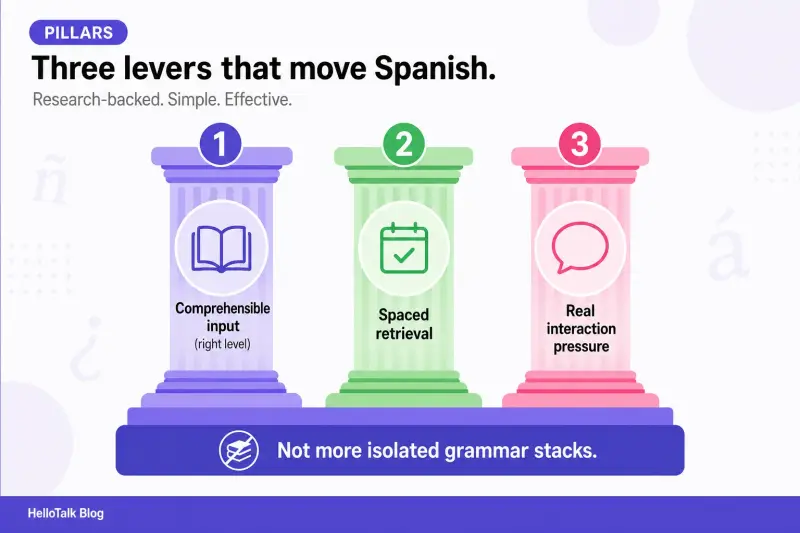
The most efficient way to learn Spanish combines three things: large amounts of comprehensible input, spaced repetition of what you learn, and regular spoken output with feedback. Drop any one of the three and progress slows noticeably.
Why these three, and not more grammar
Language acquisition research has long distinguished between learning about a language and acquiring the ability to use it. You can memorize every conjugation table and still freeze in a real conversation. The efficient method treats grammar as scaffolding you absorb through exposure and use, not as the main event.
Here is how the three pillars compare in what they actually deliver.
| Pillar | What it builds | Evidence-backed principle | Efficient daily form |
|---|---|---|---|
| Comprehensible input | Intuition, listening, vocabulary in context | Acquisition happens when input is slightly above your level | Listen to and read Spanish you mostly understand |
| Spaced repetition | Long-term retention | Reviewing at increasing intervals fights forgetting | Review your own phrases and errors on a schedule |
| Output with feedback | Recall, fluency, accuracy | Producing language and getting correction drives noticing | Speak and write to native speakers, get corrected |
The efficient weekly rhythm
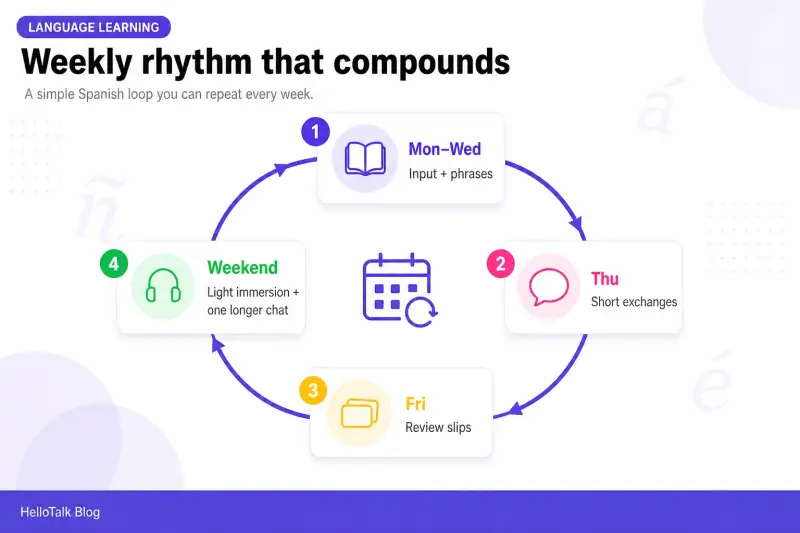
You do not need a rigid schedule, but the proportions matter. A rough split that works for most learners:
-
Roughly half your time on input you enjoy and mostly understand.
-
Roughly a third on real output, speaking and writing.
-
The remainder on spaced review of what came up during input and output.
The mistake most learners make is spending 90% of their time on input and review, and almost none on output, then wondering why they cannot speak. Output is the hardest to arrange, so it gets skipped. Fixing that single imbalance is the highest-leverage change most people can make.
Spaced repetition, done right
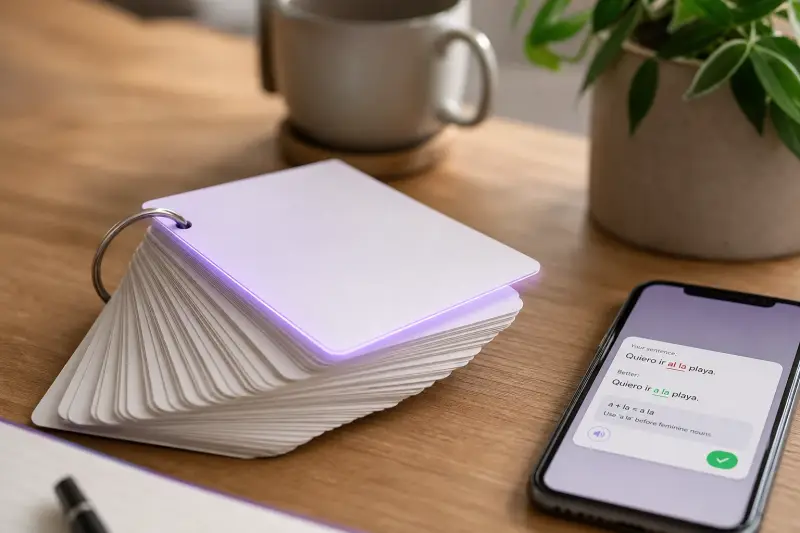
Spaced repetition is powerful, but it fails when the material is random. Reviewing 200 unrelated words is far less useful than reviewing the 20 phrases you tried to say this week and got wrong. The most efficient review is built from your own real mistakes, not a generic word list. That way every review card carries context, emotion, and a reason to remember.
If the weekly rhythm above is more than your schedule allows, compress it into a twenty-minute Spanish routine that still produces output.
Where HelloTalk fits the method
The one pillar people cannot do alone is output with feedback, and that is exactly where a global community helps. HelloTalk connects you with native Spanish speakers among its 70M+ registered users, spanning 200+ countries and 260+ languages, and it processes over 1 billion messages daily, so there is always someone to practice with.
Mapping the app to the three pillars:
-
Chat-based learning covers output with feedback directly. You write or send voice messages to native speakers and get real-time grammar correction, transcription, and translation inside the chat.
-
Moments adds low-pressure output plus input. Post a short paragraph for correction from several natives, and read authentic Spanish posts as comprehensible input.
-
Voicerooms and Livestreams give you spoken input and output at once. Join a 24-hour Spanish voice room as a listener, then contribute when ready.
-
AI learning tools power your spaced review. AI pronunciation scoring flags specific sounds, and AI grammar correction explains each fix so your review is built from real, contextual mistakes.
Because most core features are available for free, none of this depends on a subscription. HelloTalk was named the 2017 Google Play Best Social App and was featured on the global Google Play homepage in 2024.
Common efficiency killers
-
Choosing input that is too hard, so it stops being comprehensible.
-
Reviewing generic word lists instead of your own material.
-
Treating output as a final exam rather than daily practice.
-
Switching methods every two weeks before any of them compounds.
FAQ
What is the single most efficient Spanish activity? Speaking with a native speaker who corrects you, because it combines recall, feedback, and motivation in one session. It is also the hardest to arrange, which is why most people underuse it.
Is comprehensible input enough on its own? It builds strong listening and intuition, but without output you will understand far more than you can produce. The efficient method pairs input with speaking.
How is this different from just using an app? Apps handle input and review well but rarely provide real, responsive output practice with humans. The efficient method deliberately adds that piece.
Does spaced repetition really work for Spanish? Yes, especially when the cards are your own phrases and mistakes rather than random vocabulary. Context makes the reviews stick.
How soon will I notice results? Most learners who add regular output notice a jump in speaking confidence within a few weeks, even though vocabulary size changes more slowly.
Where to go next
If you are just deciding where to focus, start with how to learn Spanish efficiently and what to stop doing. Short on time? See how to learn Spanish efficiently in 15 minutes a day. And to sequence your resources, read what to prioritize among Spanish learning tools.
For a practical priority order, see how to learn Spanish efficiently.
The method is simple to state and harder to keep balanced: input, review, and real output every week. You can add the output piece right now at HelloTalk.