
When Vietnamese Lessons and Your Conversation Partner Sound Different: Matching Audio to Real Use

Your course audio plays "Chị ơi, mai chị rảnh không?" and you follow every syllable. Then your conversation partner sends a voice message with what the text says is the same question, and you catch maybe two words of it. You replay it four times, compare it to the lesson file, and start wondering whether the course audio is wrong, your ears are the problem, or you picked the wrong textbook entirely.
Any of those is possible, and so are several other things: speaking speed, recording quality, an unfamiliar word, or the demands of the task itself. Region is one of the factors worth checking, because Vietnamese materials are recorded in different regional varieties. A useful first step when Vietnamese lesson audio and your conversation partner sound different is to decide whose speech you actually need to follow, then check whether your listening material matches that answer, rather than switching courses because one voice was unfamiliar.
Here is the working order: name your listening target, check the regional label on your audio, compare one short message across both sources, ask your partner about their own speech, keep the lesson work that already functions, and test the result on something you have not heard before.
Identify Who You Need to Understand Before Changing Resources
"I want to understand Vietnamese" is not an answer you can act on this week. "I want to understand my partner's mother, who grew up in Cần Thơ and speaks quickly on video calls" is.
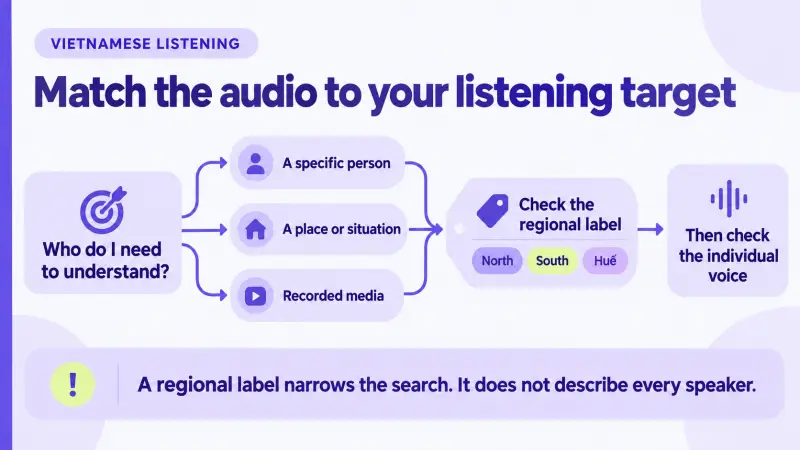
Write one sentence naming the person, the place, or the situation you are preparing for. Three questions usually get you there:
Who will you talk to most in the next six months, and where did that person grow up? If you are travelling or moving, which city will you actually be standing in? And is any of your listening aimed at recorded material such as news, songs or dubbed shows rather than at a live conversation?
The answers point in different directions. A learner whose in-laws live near Huế and a learner starting a job in Ho Chi Minh City need different primary audio, even though they are learning the same language and can use much of the same course. A learner who mostly wants to follow national broadcasts has a third answer again.
This is also the moment to be honest about how many targets you have. If you have more than one, it helps to name which is primary, so you know which audio gets most of your listening time.
Use SVFF’s Regional Course Labels to Check Your Audio Choice
Once you know who you are listening for, you need materials that tell you which variety they were recorded in. This is the part most learners skip, because level and lesson count are printed in larger type than region.
SVFF's course catalog labels its Vietnamese courses by region, including North, South and Huế, which means you can check a course's regional variety before you commit listening time to it. Use that label the way you would use a size tag: read it first, then look at everything else.
Three practical checks follow from this:
Open your current main resource and look for a stated region. If it names one, compare it to the sentence you wrote in the previous section. If it names none, that is one more thing to check. You are not studying wrong material, you are studying material of unknown origin, which makes a mismatch harder to interpret.
If the label and your target disagree, that does not make the course useless. Keep using it for vocabulary, grammar and reading practice, and add listening material aimed at the person you actually need to follow.
And keep the limits of a label in view. A regional label tells you which broad variety a recording belongs to; it does not tell you how any individual speaker talks. Two people labelled the same way can differ by generation, by city, by how much they have moved, and by whether they are reading a script or chatting. A label narrows the field. It does not finish the job.
Compare the Same Short Message Across Your Lesson and Your Partner
Abstract descriptions of regional differences do not stick. One short sentence, heard twice from two sources, does.
Pick a message you already understand on paper, six to ten syllables long. Play it from your course. Then, if a conversation partner is happy to help, ask them to record the same sentence as a voice message. Listen to both back to back, twice, and write down the exact syllable where you stopped following.
Say you use "Chị ơi, mai chị rảnh không?" ("Chị, are you free tomorrow?"). In your course audio you hear every part of it. Step one is the same sentence from your partner:
Partner, reading the same sentence: "Chị ơi, mai chị rảnh không?"
You, after four replays: you followed "Chị ơi, mai chị", and the final "không" arrived shorter and softer than in the course recording.
Step two is a later reply, which tests something different: whether you can follow the same speaker when the words are not set in advance.
Partner, replying freely: "Rảnh chứ. Mai mấy giờ em?" ("Free, of course. What time tomorrow?")
You, after four replays: you caught "rảnh chứ" and "mai", and "mấy giờ" arrived as one blurred sound you could not split.
That is a usable result. It is not "southern Vietnamese is hard". It is "in fast speech from this person, mấy giờ compresses, and I have never heard that compression before".
Whatever you notice, keep it tied to the recordings in front of you: this syllable, from this speaker, sounded different from the course version in this specific way. That is something you can check again next time. A general rule about how a whole region pronounces a sound is not something one pair of recordings can settle.
To keep the comparison from turning into a vague impression, log it. The point of the table below is to separate four things people usually merge: what the audio was labelled, what you know about the speaker, what you actually heard, and what you will do next. The rows below are a filled-in example of the format rather than measurements from real recordings. Fill one row per source, and read your own version as a sample record, not as a description of a region.
| Region label on the audio | What you know about this speaker | How the same short message sounded | The exact point you lost it | Next practice step |
|---|---|---|---|---|
| South (course audio) | Studio recording, speaker unknown, deliberate pace | Every syllable separate, final "không" clearly audible | Nothing missed | Keep as the reference version |
| South (partner voice message) | Grew up in Cần Thơ, lives in Ho Chi Minh City, talks fast | Final "không" shorter and softer than in the course version | The final "không" | Ask for that syllable alone, then inside the full question |
| North (a separately labelled recording) | Studio recording, speaker unknown | The start of "rảnh" did not match the version I had learned | The first sound of "rảnh" | Contrast only, not this month's target, and worth checking again |
Three rows are enough to see a pattern forming. They are not enough to conclude anything about how everyone in Cần Thơ speaks.
Ask About a HelloTalk Partner’s Own Speech, Not a Whole Region
There is a question learners ask constantly that is easy to over-read: "How do southern people say this?" It asks one person to speak for millions, so even a well-informed answer is easy to take as a regional rule when it usually describes that person's own habits rather than a whole region.
Ask about the person instead, and only as far as the practice needs. "Do you mind telling me where you grew up?" "At home, do you say nhé or nha?" "When you say this word fast, does it sound like what I just recorded?" These are answerable, and the answers tell you about that speaker's own usage, which is what you were trying to learn. Nobody is obliged to share where they grew up or where they live, so treat all of it as optional.
Two short openers that work in a first exchange:
You: "Mình mới học tiếng Việt. Bạn lớn lên ở đâu?" ("I've just started learning Vietnamese. Where did you grow up?")
You, later: "Ở nhà bạn nói 'nhé' hay 'nha'?" ("At home, do you say 'nhé' or 'nha'?")
You can run this whole exchange inside HelloTalk chat, where text and voice messages sit in the same thread, so the written sentence and the recorded version of it stay side by side for later comparison. When you want several speech backgrounds rather than one, a short Moments post asking how a specific phrase sounds where people live can bring replies from more than one person, and HelloTalk Voicerooms let you listen to a group conversation before you say anything yourself. HelloTalk voice and video calls add the part a recording cannot supply: someone who can slow down, repeat, and answer a question about the sentence they just said.
Expect address terms to come up immediately, because "bạn", "anh", "chị" and "em" are among the first things you have to choose whenever a message addresses the person directly. If that part is still shaky, sorting it out is a separate job worth doing properly, and choosing Vietnamese forms of address in real community conversations is where to start.
One caution on reading responses. If your partner asks "you mean tomorrow, right?", that is an ordinary conversational check and often a sign of interest. It is not evidence that your pronunciation failed, and it is not a diagnosis of your listening.
Keep Useful Lesson Work and Add the Sounds You Actually Meet
The temptation after a bad voice message is to abandon the course and start a differently labelled one from lesson one. That usually costs weeks and returns you to material you already knew.
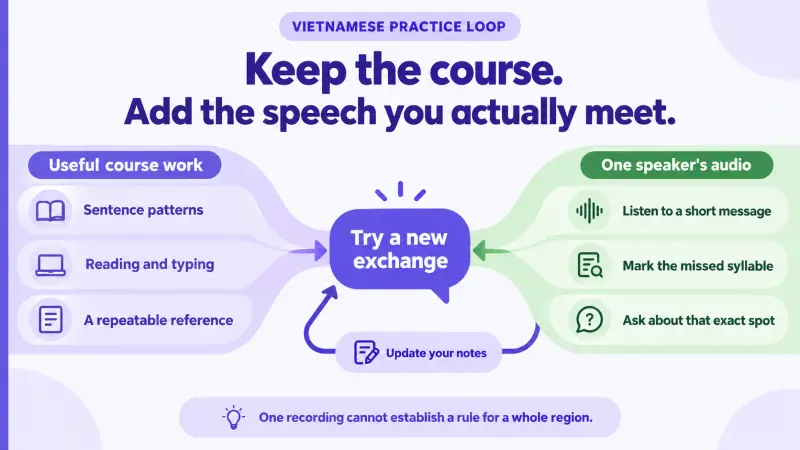
Much of what a Vietnamese course gives you carries over when you change listening targets. Sentence patterns, question formation, the tone marks and what they mean in writing, reading and typing with diacritics, and the general habit of producing sentences are not tied to one region. Some vocabulary and everyday usage do vary by place, so expect a few words and expressions to need adjusting. The part that needs the most rebuilding is ear training: which sounds merge in fast speech, which particles a person actually uses, and how a familiar written word arrives when someone says it at conversational speed.
So the repair is additive. Keep your course lesson where it is. Add a small, regular slot for the speech you meet. One adjustable version of that, offered as a suggestion rather than a prescription:
- Keep your normal lesson session unchanged.
- Twice a week, take one voice message from a partner, about ten seconds long, and listen three times before reading any transcript.
- Write the one syllable you missed into your comparison log.
- Once a week, record yourself saying one sentence and send it, asking whether anything sounded off to that person.
Adjust the counts to your week. These are sizes that make the loop repeatable, not targets you have to hit for the method to work.
Finding people to run this with is its own task, and it is worth treating as a setup problem rather than a motivation problem. If you are still assembling a group of Vietnamese speakers to practise with regularly, the overview of how to get into actual conversations in the Vietnamese learning community covers that side.
Check Understanding in a New Exchange, Not Just a Repeated Recording
Here is the trap at the end of the process. You replay the same voice message until it finally sounds clear, feel the relief, and record that as progress.
Getting comfortable with a recording you have already decoded is useful practice, but on its own it does not show that you can follow the same speaker in a new exchange. The more times you replay one file, the more of it you are recalling rather than working out fresh.
A real check needs new material from the same speaker on a related topic, plus a reply that only works if you caught a specific detail. Ask your partner to send something short and unscripted about the same plan, then answer with the detail in it.
Partner: "Chiều mai anh bận tới năm giờ, sáu giờ mình gặp được không?" ("Tomorrow afternoon I'm busy until five, can we meet at six?")
You: "Dạ được, sáu giờ em tới." ("Yes, that works, I'll come at six.")
If your reply contains "sáu giờ", you caught and confirmed that detail, which is more than a replay can show. If your reply is only "Dạ được", you may have understood it and you may have agreed to an unknown time, and neither of you can tell which.
Run this check a few times before concluding anything. One miss on one message is one data point, and it can come from background noise, an unfamiliar word, or a tired afternoon just as easily as from a regional feature. Patterns across several exchanges are what tell you where to aim next, and the broader habits for making yourself understood mid-conversation are covered in this guide to practising effective communication in a foreign language.
Keep the lesson work that already functions and add the sounds you actually meet, instead of restarting a course because one voice was unfamiliar. A labelled course gives you consistent, repeatable audio you can return to; a person gives you responsive, unpredictable speech that no fixed recording can produce for you. Running both together on HelloTalk, where you can study a phrase, send it as a voice message, and hear how one specific person says it back, is how the two halves stop competing and start feeding each other.
Frequently Asked Questions About Vietnamese Regional Audio
Should I learn northern or southern Vietnamese first?
Start with whichever variety matches the people you will actually talk to over the next several months. If you have no specific person yet, pick one labelled variety, stay with it long enough to build a stable reference, and treat the other as a later addition rather than a parallel track.
Does a mismatch mean my course is wrong?
No. A course recorded in one regional variety is doing exactly what it says when it sounds unlike a speaker from elsewhere. Its grammar and reading content still apply, and most of its vocabulary does too, though some words and everyday expressions vary by region. Its audio is simply aimed at a different listening target than yours.
How do I tell which region a recording uses if it is not labelled?
You often cannot tell reliably as a beginner, which is the reason to prefer materials that state it. SVFF's course catalog labels its Vietnamese courses by region, including North, South and Huế, so a labelled catalog is a faster way to check than trying to identify a variety by ear.
My partner does not sound like the regional description I read. What does that mean?
Most likely that the description was a generalisation and your partner is an individual. People move, mix influences from family and school, and shift how they speak depending on who they are talking to. Ask that person how they say a specific phrase rather than trying to fit them to a category.
Can I end up understanding both northern and southern speech?
Many learners do, usually by getting comfortable with one variety first and then gaining exposure to the other through conversation and media. Working on both at once from the beginning can leave every recording feeling unfamiliar if neither gets much listening time, which is why many learners prefer to lead with one.
How many voice messages should I compare before deciding something is a regional difference?
Enough that the same thing happens repeatedly with the same speaker, and ideally with more than one speaker from similar backgrounds. A single instance tells you what you missed that day; it does not tell you why.
Will asking my partner to repeat things slow the conversation down?
It does slow that moment down, and that is usually a reasonable trade. Asking about one specific syllable, rather than asking for the whole message again, keeps the exchange moving and gives you something precise to practise afterwards.
What about Huế and other central speech?
Central varieties are their own targets, not a midpoint between north and south. If your listening target is a central speaker, look for material labelled for that region rather than assuming northern or southern audio will transfer.