
Vietnamese Forms of Address in Community Conversations: Moving From Lessons to Real Relationships

Your textbook lists anh, chị, em, bạn and cô with a one-line gloss for each, and you can recite all of them. Then someone new in a Vietnamese learning group messages you, and you stall on the very first word: you do not know their age, you do not know whether they would rather be called chị or bạn, and you do not know what that makes you in the same sentence. The chart has no entry for this specific person.
The way out is not more vocabulary. Read address forms inside dialogues where two people have already settled on a pair, then ask your own conversation partner directly and keep their answer somewhere you can scroll back to.
Compare Address Choices in a Dialogue, Not in an Isolated Word List
A word list gives you definitions with the relationship stripped out, which is the one thing you actually need. In a Vietnamese exchange the word you use for the other person and the word you use for yourself are usually chosen together, so it helps to decide the two as a pair rather than one at a time.
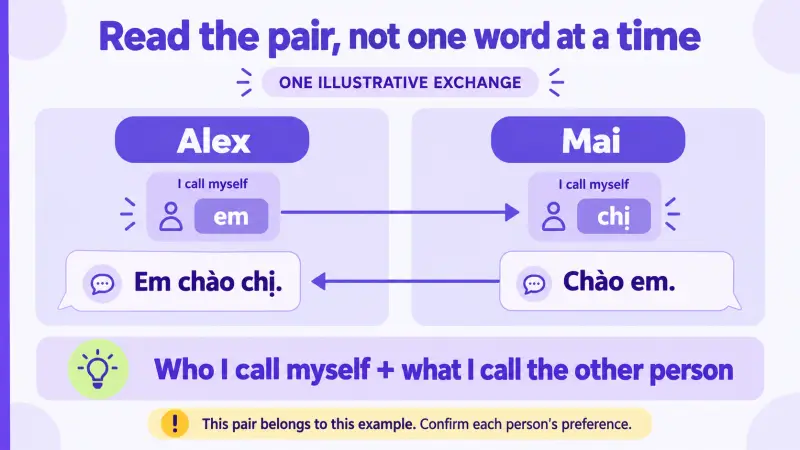
Here is the same introduction between the same two people under two different relationships. When the other person is a few years older:
You: "Em chào chị. Em tên là Alex."
Mai: "Chào em. Chị tên là Mai."
You are em, she is chị, and both words appear across those two lines. Now the same introduction between people of the same age:
You: "Chào bạn. Mình tên là Alex."
Mai: "Chào bạn. Mình là Mai."
Nothing about the vocabulary got harder. The pair changed, and the word for yourself changed with it. These are the combinations the two speakers in each version use, not an age formula you can apply to everyone. A word list can tell you that chị means older sister and mình is a casual way to say I, but only a dialogue shows you which pair two particular people settled on and what that decision was based on.
Three resources handle different parts of this, and treating them as interchangeable is where most of the confusion starts. The table below compares what situation each one puts in front of you, what the address choice rests on inside that situation, what you can verify for yourself, and what you should not turn into a universal rule.
| Resource | Situation it gives you | What the address choice rests on | What you can check directly | What not to generalize |
|---|---|---|---|---|
| NIU Vietnamese Lesson 1 grammar page | An explanation of address terms plus substitution tables and question-answer drills covering greetings, names and nationality | The relationship assumed between the speakers in each drill | That address forms show up inside greetings and introductions rather than as a standalone chart | It is an older university teaching page, so treat any absolute statement about who must use which form as dated rather than as current usage |
| VietnamesePod101 absolute beginner lesson on asking someone's name | A first meeting shown in three variants in the public transcript: a general one, one addressed to a woman and one addressed to a man | How the same opening is handled when the person you are greeting changes | The public transcript, where you can compare the three variants side by side | Three scripted variants are still three scripted variants, and a readable transcript does not mean every line recording and lesson note is open access |
| HelloTalk chat and voice with a specific person | The relationship you are actually in, with whatever name, age or preference that person chooses to share | What this one person says they want to be called and what they call you back | Their own words, still sitting in the thread | One partner's preference is their preference, not a rule covering every Vietnamese speaker you will meet |
NIU Vietnamese Lessons: Notice How the Speakers’ Roles Shape the Exchange
Read the NIU Lesson 1 grammar page as an explanation of address terms followed by substitution tables and question-answer drills, rather than as a plain vocabulary page. For each greeting, name or nationality item, mark three things: who is speaking to whom, what each speaker calls the other, and what each speaker calls themselves.
Take a two-line greeting between a younger person and an older man, written here as an illustration for this article rather than copied from that page. In line one, the younger speaker calls the other anh and calls themselves em. In line two the older man replies, calls the other em and calls himself anh. The two words swap owners across the lines, but the pair itself holds steady for the whole conversation. That swap is the mechanism, and it is invisible in a glossary.
A practice pass that takes about fifteen minutes, adjustable to however much time you have:
- Copy three items from the page's drills into a notebook, one line-pair at a time.
- Under each, write two short columns: what speaker A calls B, and what speaker A calls themselves.
- Rewrite one exchange as if the two speakers were the same age, and circle every word that had to change.
Step three is the one that does the work, because it forces you to move a whole pair rather than swap a single noun.
One honest limit worth keeping in mind: this is an older teaching resource, so copy the structure of the exchanges and be careful with any line that states flatly who must use a given form. Usage shifts over time, and individual people have preferences of their own. The page also cannot know anything about the person currently typing to you, which is what the next two steps are for.
VietnamesePod101: Compare Different First-Meeting Situations
A first meeting is not one fixed scene, and the address question feels hardest when you treat it as one. The VietnamesePod101 absolute beginner lesson on asking someone's name has a readable public transcript that already sets three first-meeting variants side by side, a general one, one addressed to a woman and one addressed to a man, so you can compare how the same opening shifts with the person you are greeting. Across those variants the self-introduction stays Tôi tên là..., a useful reminder that changing how you address someone does not automatically change what you call yourself. The line-by-line audio and some of the lesson notes have access restrictions, so plan your study around the transcript.
Read those three variants first, then extend them. The three openings below are written for this article rather than taken from the lesson, and they show how much a self-introduction changes across situations before a single new word is needed.
Messaging someone in a learner group when you know nothing about them:
"Chào bạn, mình là Alex. Mình đang học tiếng Việt. Mình nên gọi bạn là gì?"
That last line means "What should I call you?" and it does the entire job of the paragraph you were about to overthink.
Messaging someone after a mutual contact told you she is older than you:
"Em chào chị ạ. Em tên là Alex, bạn của David. Rất vui được làm quen với chị."
Here a third person supplied information you did not have, which gives you a reasonable starting pair. You can still check it with her rather than treat it as settled.
Meeting a friend's mother in person:
"Cháu chào cô ạ. Cháu là Alex, bạn của Mai."
You become cháu, and she is addressed with a generation term. Cô is one common choice for a woman of a parent's generation, while some families use bác or dì depending on relative age and local habit, so ask your friend directly how you should address her. What your friend calls her own mother comes out of a different relationship, so it is not automatically the term for you.
Asking how to address someone is a normal opening move in Vietnamese, not an admission that your Vietnamese is weak. The three openings above differ mainly in how much you already knew about the relationship, not in difficulty.
Confirm How to Address Each Other in a HelloTalk Conversation
A recorded lesson was finished before you met this person, so it cannot tell you what your particular conversation partner wants to be called. That part has to come from them.
Start with a neutral pair and a direct question in your first message, then work from whatever their reply gives you:
You: "Chào bạn, mình là Alex. Mình đang học tiếng Việt ạ. Mình nên xưng hô với bạn thế nào cho đúng?"
Mai: "Chào Alex. Mình sinh năm 1995, còn bạn?"
You: "Mình sinh năm 2001. Vậy mình gọi bạn là chị nhé?"
Mai: "Ừ, gọi chị cũng được."
Sharing your own birth year in the same message is one way to keep the exchange even when both of you are comfortable doing that. You do not have to name a year at all: asking which term someone prefers works on its own, and so does saying you would rather not give a year. Mai's question back is also not a sign that your first message failed. It may be part of settling the pair, or it may be ordinary conversation, and you can carry on either way.
Two habits are worth building in at this point. Do not infer someone's age or identity from a profile photo, since photos are unreliable and many profiles do not show the person at all. And treat the reply you get as one person's preference about their own name, which it genuinely is, rather than as a ruling that covers everyone else in the group.
This is where the platform layer matters in a very practical way. HelloTalk keeps the exchange in a text thread, so you can scroll back to the line where your partner told you what to call them, sitting right next to the greeting you wrote. HelloTalk voice messages let you hear which term that person uses for you out loud, which is the version you will need if you ever move to a call. HelloTalk Moments shows short public posts and comments, so you can read how people address each other outside your own thread before you copy a form into it. HelloTalk Voicerooms let you enter as a listener first and hear several people in one room address each other in real time, including the adjustments they make when someone new joins. If you are still deciding where in the app to start, the HelloTalk Vietnamese community guide walks through the wider setup around those conversations.
Adjust When the Relationship or Conversation Setting Changes
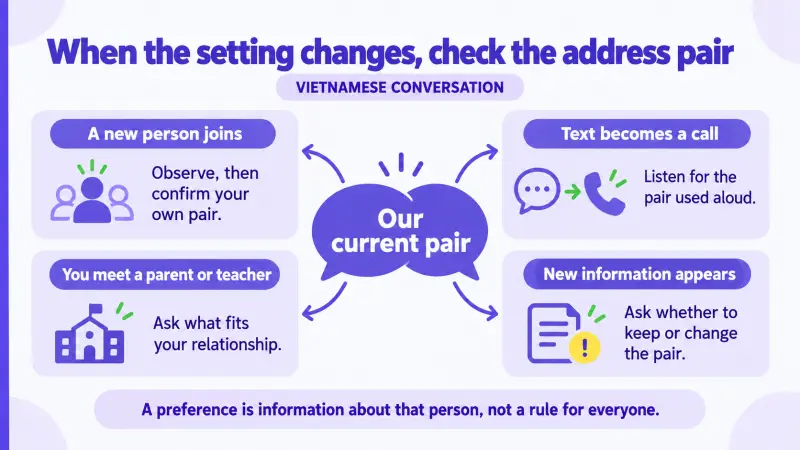
The pair you agree on in a first chat is a starting point rather than a permanent label, because address forms can shift when the relationship or the setting shifts. Nothing has gone wrong when that happens; you just need a line ready.
The table below is a quick reference for the four changes that catch learners most often. Read it as "what changed, what to listen for, one thing you can say," and treat the sample lines as starting scripts rather than fixed formulas.
| What changed | What to listen for | One line you can use |
|---|---|---|
| A third person joins the call and looks older than both of you | Which term your partner uses for the newcomer, and which one the newcomer uses for you, rather than how old they look | "Em chào anh ạ." (once that pair has been confirmed as the right fit for you and the newcomer, committing to em for yourself) |
| You move from typing to a voice call | Whether your partner keeps the same pair out loud, and whether they add ơi when getting your attention | "Chị ơi, cho em hỏi một chút ạ." |
| You are introduced to your partner's parent or teacher | Ask your partner beforehand which term you should use, since your relationship to that person is not the same as theirs | "Cháu chào bác ạ." or, to a teacher, "Em chào cô ạ." |
| You discover you are the same age after a week of chị and em | Whether your partner wants to keep the pair or switch | "Hóa ra bọn mình bằng tuổi nhau. Mình gọi bạn là bạn nhé?" |
Some address habits also vary by region and by family, and hearing them is far easier than reading about them, which is the point of building regional audio into your Vietnamese conversation practice. What one person switches to is still that person's choice, so keep the observation and skip the rule-making.
Repair a Mismatch and Continue the Conversation
Getting a form wrong is usually a small, repairable moment, and the repair can be as short as one clause. A brief acknowledgement, then a look at how the other person responds, is normally enough to keep going.
Watch how the correction fits inside a normal exchange:
You: "Chào bạn, hôm nay bạn có rảnh không?"
Mai: "Chị rảnh sau 8 giờ nhé."
You: "Dạ, em xin lỗi ạ. Vậy sau 8 giờ em nhắn cho chị nhé?"
Mai signalled the pair she expects simply by calling herself chị. You acknowledged it in four words and then kept the plan moving in the same message. That is the whole repair.
If you are not sure which direction to correct in, ask rather than guess: "Mình nên xưng hô với bạn thế nào cho đúng?" works just as well in the middle of a conversation as it does at the start. And if your partner asks a follow-up about your age or hometown right after you introduce yourself, it may be part of settling the address question or simply ordinary conversation, and neither reading means your sentence was broken.
A mismatch can often be repaired in one short line so the conversation continues, and it does not require restarting the relationship. Repairing and moving on is a general conversation skill that carries across languages, and the practical guide to communicating in a foreign language covers how to do it without stalling.
If you want the correction and the original message to stay in one place, HelloTalk holds text chat, voice messages, Moments and Voicerooms in the same app, so the text thread where the address form changed stays there to scroll back through.
Frequently Asked Questions About Vietnamese Forms of Address
Is it rude to ask a Vietnamese speaker how old they are?
Age often feeds directly into which address pair two people use, so questions about age or birth year commonly appear early in first conversations. Many speakers treat it as a practical question rather than a personal one, and offering your own birth year first can keep the exchange balanced if you are happy to share it.
Some people would still rather not answer, and that choice is worth respecting. Among peers in an online group, bạn and mình is one starting point you can consider while you wait, and you can ask which term they would prefer rather than assume one pair fits every person whose age or relationship to you is unknown.
What should I use when I know nothing at all about the person?
Bạn for them and mình for yourself is a common neutral starting point among peers in online groups, and it gives you a working sentence immediately.
Pair it with a direct question such as "Mình nên gọi bạn là gì?" so the guessing stage can end after a message or two instead of running on.
Can I just use tôi and bạn with everyone?
Tôi is widely understood and often appears with strangers and in formal or written contexts, so using it is not an error.
Some speakers find tôi distant in a friendly chat, and if your partner moves to a kinship pair, following their lead generally reads as warmer. Keep tôi as a tool for certain settings rather than as a way to avoid the whole question.
Does someone's profile photo tell me which form to use?
No. Photos do not reliably show age, and plenty of profiles use images that are not of the person at all.
Asking costs one line and lets the other person tell you themselves, which guessing never does.
What if my partner tells me to use a form my textbook says is wrong?
Following the person you are talking to usually works for that conversation, and you can keep the textbook pattern as background knowledge about how the system usually works. If a term they suggest for you does not sit right, you can say so and ask about another.
One person's preference is real information about that person. It does not overwrite the rest of the language, and it does not mean your materials were wrong.
Do address forms change between text chat and voice?
The pair itself usually carries over. What voice adds is the surrounding material, such as the vocative ơi when someone calls your attention and sentence-final particles like ạ and nhé that often get trimmed out of short typed messages.
Listening to how your partner addresses you out loud, in a voice message or a call, is the way to check what those extras sound like in your own case.
How do I address a whole group rather than one person?
Mọi người works as a general way to address everyone present, and "Chào mọi người" is a straightforward opening in a group chat or a voice room.
In a room with several speakers, listening for a few minutes before you say anything tells you a lot about who is addressing whom, and you can enter a HelloTalk Voiceroom as a listener first for exactly that reason.