
Online German Reading Communities Compared: From Reading a Book to Discussing It

You finished a German novel on your own, marked four passages you wanted to argue about, and then went looking for someone to argue with. The first club you find is written for B2 and up. The second lists reading groups whose start dates have already passed. The third turns out to be a yearly project calendar where the book-club month is not the month you are in.
So the practical answer comes first: the three names that keep appearing in this space solve different problems. NALEx Reading Club is the one built around level-separated groups, Speak German with Anna is an advanced small-group discussion with written preparation, and Easy German treats a book club as a scheduled project rather than a standing weekly meeting.
Quick Comparison: NALEx, Speak German With Anna, and Easy German
Before comparing them on atmosphere or personality, it helps to compare them on the four things that actually decide whether you can participate next month: the level the group is written for, who supplies the book, how the discussion happens, and what preparation you get. The last column is the one most comparison posts skip, and it is the one that matters most, because a published schedule is not the same as an open place.
Across these three, the level question is decided in a different place each time: NALEx Reading Club splits learners into A1-A2, B1-B2 and C1 groups, Speak German with Anna runs one B2-C1 discussion, and Easy German sets the level per dated project.
| Resource | Levels on its own page | Shared text | Discussion format | Preparation support | Current intake |
|---|---|---|---|---|---|
| NALEx Reading Club | Separate groups for A1-A2, B1-B2 and C1; one dated B1 listing says B1+ | A learner book selected for the group; you may need your own copy | Guided group discussion, described for the lower and intermediate groups | Worksheets provided, plus grammar work tied to the story | Not established; the dated September starts shown on the page have passed, so ask the organizer |
| Speak German with Anna | Described for B2-C1 and B2+ | One shared book per round, obtained separately by each reader | Small-group online discussion on Google Meet | Preparation questions in a shared document | Not established; confirm before you buy the book |
| Easy German | Set per project; the 2026 project calendar lists a B2 book-club project and an A1/A2 project | The book named for that specific dated project | Book-club projects placed on a yearly project calendar, alongside separate member community spaces | Project structure varies by project | Not established; check whether a book-club project is currently scheduled and what your membership covers |
| HelloTalk (not a book club) | Any level, because you choose what you send | Whatever you are already reading | Text and voice messages, Moments posts and Voicerooms with native speakers | None supplied; you write your own question | Learner-organized rather than an enrolled cohort, with free and paid access options |
None of these replaces the others. A level-banded reading course, an advanced discussion circle, a scheduled project and a running conversation with a native speaker do different jobs, and they can be combined. If you are still surveying the wider field, the broader guide to online community resources for learning German covers the non-reading parts of that map.
NALEx Reading Club: Match the Book and Discussion to Your Level
This is the resource to look at first if you are below B2, because it is the only one of the three whose page lists separate groups for different levels.
In the NALEx lower and intermediate groups, the reading is supported by worksheets and grammar work tied to the story, which means the book is handled as course material rather than as homework you finish alone. That changes what a session feels like. You are not expected to arrive with a literary reading; you are expected to have read the chapter and to be able to say something about it, with the moderator guiding the discussion.
Two practical details from the page are worth knowing before you commit. You may need to buy your own copy of the selected learner book, and audio is available when it happens to be included with that book, which is not a guarantee for every title. If listening to the same text is part of why you want to join, ask which book the next round uses and whether that edition has audio.
What the level bands change in practice
The same chapter produces very different discussion turns depending on which group you are in. The two exchanges below are written for this article around an invented book, not transcripts of any session, and they show different ways of expressing an idea rather than a strict CEFR assessment.
A B1-level answer stays close to the text and uses one clear reason:
Moderator: "Warum lügt die Hauptfigur am Anfang des Kapitels?"
You: "Ich glaube, sie hat Angst vor der Reaktion ihrer Familie. Auf Seite 40 sagt sie, dass sie es später erklären will."
A C1-level answer can compare motives and point at technique:
You: "Sie lügt weniger aus Angst als aus Gewohnheit. Der Erzähler deutet das schon im ersten Kapitel an."
Both answers are correct German, and both can come from a reader with a sharp take on the book. The second one simply carries more of that take in German: it hedges the comparison and leans on structures that take more practice to produce on the spot. A level-banded group is about the German you have available during the discussion, not about the quality of your thinking.
Speak German With Anna: Prepare for a B2-C1 Small-Group Discussion
If NALEx is where the level band comes first, this club is where the preparation comes first.
Speak German with Anna's book club is described for B2-C1 participants, with preparation questions shared in a document ahead of the small-group discussion on Google Meet. The shared book is obtained separately by each reader, and the listed titles rotate: recent listings have included contemporary fiction such as Lila Lila and a simplified-language edition of Die Leiden des jungen Werthers.
That second title is where people misread the club. A simplified-language edition makes the reading lighter; it does not make the discussion a beginner activity. The conversation is still described for B2-C1, and that published level, rather than any entrance test, is what the page states about who the round is written for.
The meeting rhythm is described as weekly, with one visible exception worth planning around: a listed month showed three meetings rather than four. Treat weekly as the normal pattern and check the actual dates for the round you want to join rather than budgeting a fixed number of sessions per month.
A three-sentence preparation habit
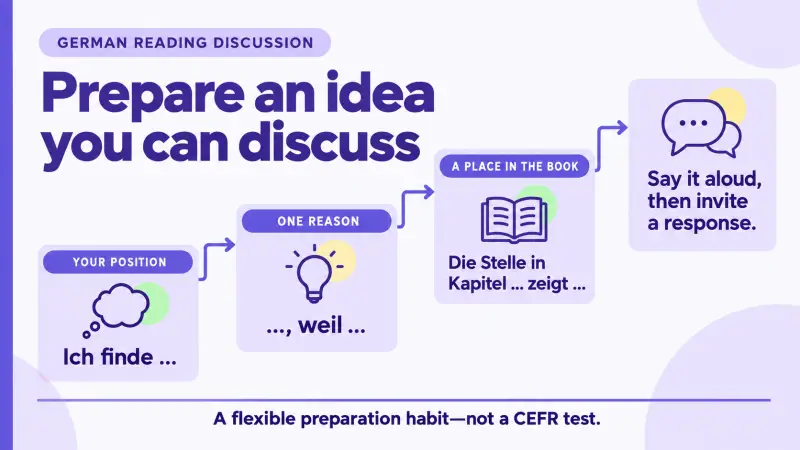
Preparation questions sent in advance are an invitation to write before you speak. A workable routine, offered here as a suggestion you can shrink or expand, is three sentences per question: your position, one reason, one place in the book. The question and answer below are written for this article around an invented book, not taken from either listed title or from any actual meeting.
Question: "Was hältst du von der Entscheidung der Hauptfigur?"
Your prepared answer: "Ich finde ihre Entscheidung nachvollziehbar, aber feige. Sie will Anerkennung, ohne dafür etwas zu riskieren. Die Stelle am Ende des vierten Kapitels zeigt das ziemlich deutlich."
It also helps to arrive with two phrases you can use without thinking: "Das sehe ich etwas anders, weil…" for stating a different view, and "Kannst du das noch mal anders formulieren?" for asking someone to rephrase something you did not catch. If speaking under time pressure is the part you are least confident about, building a routine of German speaking practice with native speakers in the weeks before the first meeting is one way to prepare for it.
Easy German: Check the Schedule of Its Book Club Projects
Easy German is a familiar name in German reading community roundups, and that is where a lot of disappointment starts, because people expect a club that meets every week.
Easy German schedules book-club projects as dated items on a yearly project calendar, so in any given month the useful question is whether a book-club project is running, not whether the club is open. On the 2026 project calendar, a B2 book-club project sits in February and March and an A1/A2 project sits in July. October on that calendar is a vocabulary challenge, not a book-club month.
The member Discord and the conversation membership calls are separate community features. This article did not audit how busy they are, and their existence is not evidence that a book club is running right now; membership entitlements differ, so participation in one specific dated project needs to be checked on its own terms rather than assumed from a membership label.
The upside of a calendar model is that you can plan. If a project at your level is scheduled months out, you know exactly how long you have to build the reading stamina for it. For A1 and A2 readers in that waiting period, a roundup of free online resources for German beginners gives you shorter texts and audio to keep the habit alive until the project opens.
Check the Reading Commitment and Current Intake Before Joining
Everything above comes from what these three publish. What this check of their pages did not establish is whether there is room for you this week.
Checking these three pages did not establish current availability for any of them, so one short message to the organizer is the step that turns a published schedule into a real answer. Some listings do carry detail: NALEx has shown dated course cards with seat information. But a past card describes a past round, so dated cards, calendars and start dates are planning information rather than confirmation that the next round is still open, and they are not a reason to buy the book yet.
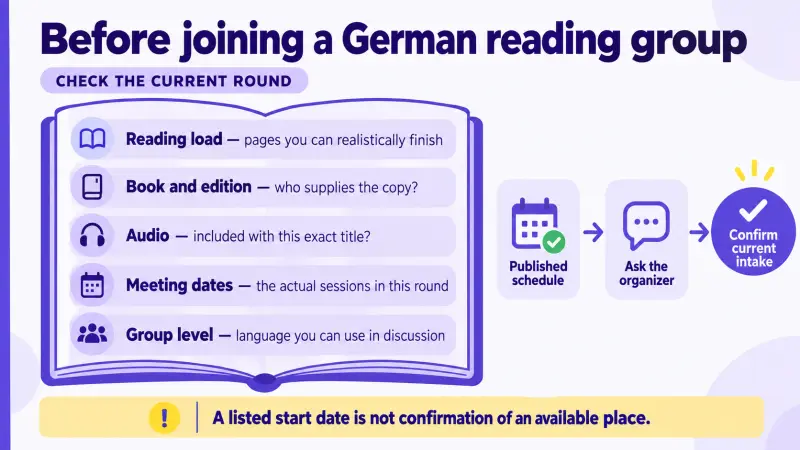
Before you send that message, work out your own limits, because the answer you get back only helps if you know what you can sustain. Five questions cover almost everything that goes wrong later:
- How many pages per week does this round actually expect, and is that realistic alongside your job or studies?
- Do you need to buy your own copy, and in which edition?
- Is audio included with this particular book, or only with some titles?
- How many meetings fall in the period you are signing up for, including any month that has fewer?
- Is the group level-banded, or will you be the lowest level in the room?
Then keep the message short, which also makes it easier to write in German as free practice:
"Guten Tag, ich interessiere mich für Ihre Lesegruppe auf B1-Niveau. Läuft gerade eine Gruppe, und wann beginnt die nächste Runde? Außerdem zwei Fragen: Muss ich das Buch selbst kaufen, und gibt es zu diesem Titel Audio? Vielen Dank und viele Grüße, Alex"
That is roughly: you are interested in the B1 group, you want to know whether one is running and when the next round starts, and you are asking about buying the book and about audio. Send it before you plan your reading schedule, not after.
Use HelloTalk to Continue a Reading Discussion Between Meetings
Here is the gap these clubs leave open. A discussion hour, however good, is one hour. The reaction you have on a Tuesday night at page 87 has nowhere to go, and by the next meeting you have usually forgotten why the passage bothered you.
That is the slot a native-speaker conversation fills, and it works best when you keep it small and specific. Your partner has probably not read your book, so give them the minimum context first: two sentences of your own summarizing what happens in the passage, then one concrete question, then your interpretation. A reader responding to how you argued it is a different kind of feedback from a worksheet: they can tell you that your wording is plausible, that it sounds unusual in German, or that a word you leaned on does not carry the weight you gave it.
A short exchange in HelloTalk chat might run like this, written for this article around an invented book rather than copied from a real conversation:
You: "Ich habe gestern Kapitel 3 gelesen. Meiner Meinung nach ist der Erzähler unzuverlässig, weil er sich zweimal widerspricht."
Emma: "Interessant. An welcher Stelle widerspricht er sich denn?"
You: "Auf Seite 54 sagt er, er sei nie in der Stadt gewesen. Später erzählt er von einem Café dort."
Notice what that follow-up question is and is not. It is a sign that your point landed and someone wants the evidence. It is not proof that your German was unclear, and one reader's take on the narrator is useful context, not a ruling on how the book must be read.
Three other things fit naturally in the week between meetings. HelloTalk's voice messages let you say your own two or three sentences about the chapter aloud and ask a native speaker whether your phrasing sounded like something a person would say. HelloTalk's Moments feed is a public place to post a two-sentence reaction in German where native speakers can reply to it or correct it. HelloTalk's Voicerooms let you join and listen before you speak, which is a low-pressure way to hear how German speakers actually disagree with each other in real time, phrases and interruptions included.
None of this is a book club, and it does not replace one. HelloTalk is where the conversation between sessions happens with real German speakers, while the scheduled club supplies the shared text, the moderator and the fixed hour that makes you finish the chapter at all.
Frequently Asked Questions About Online German Reading Communities
Can a beginner join an online German book club?
Some of them, yes. NALEx Reading Club lists separate A1-A2 reading groups, and Easy German's 2026 project calendar included an A1/A2 project in July. Speak German with Anna's club is described for B2-C1, so it is not a beginner option even in a month when the chosen book uses simplified language.
Do I have to buy the book myself?
Plan for it. The NALEx page notes that you may need your own copy of the selected learner book, and Speak German with Anna's shared book is obtained separately by each reader. For an Easy German project, check what that specific dated project includes before assuming anything.
Is audio included with the reading?
Only sometimes. NALEx describes audio as available when it comes with the selected learner book, which is a property of the edition rather than a feature of every round. Ask which title the next group is using and whether that edition has audio.
How often do these groups meet?
Speak German with Anna describes weekly meetings, and at least one listed month showed three rather than four, so check the actual dates for your round. Easy German's book clubs are projects on a yearly calendar rather than a standing weekly meeting, and NALEx runs its groups in dated rounds.
Is a book club currently accepting new members?
That is the one thing none of these pages confirms for you. Dates shown on a page can already be in the past, and seat information attached to an earlier round is not a promise about the next one, so send a short message to the organizer and ask whether a group is running and when the next round starts.
How many pages a week should I read for a discussion group?
Whatever you can finish without skipping the last chapter the night before. The three-sentence preparation habit in this article and any weekly page count you set are adjustable examples, not standards, and it is better to read forty pages you can talk about than a hundred you skimmed.
What if I read the whole book but freeze in the discussion?
Write before you speak. Prepare three sentences for each preparation question, one for your position, one for your reason, one for the passage you are pointing at, and rehearse those aloud. Sending the same three sentences to a native speaker in HelloTalk chat or as a voice message a few days earlier can get you a round of reaction to your own wording before the meeting.