
Making Plans in Spanish: Invitations, Alternatives, and Confirmations

You and your language partner agreed on Saturday at six. Then a message arrives: "Al final el sábado no puedo, ¿lo dejamos para el domingo?" You know how to invite someone in Spanish, but this is where the exchange stalls, because now you have to answer a cancellation, put a new time on the table, and check that it actually works for the other person.
This article walks one plan through five moves, in this order: invite, ask for the missing detail, decline an option, offer an alternative with a check question, confirm. That is the practice sequence used here, not a rule about how every plan has to go. Plenty of plans are settled in two messages and never involve a refusal at all. The five moves are laid out because they cover the points where an exchange most often gets stuck, and each section below gives you lines you can send today.
Make an Invitation Specific Enough to Answer
The invitation that goes nowhere usually sounds friendly and costs nothing to say. "¿Nos vemos algún día?" (Shall we meet up some day?) often gets "Sí, claro, ya me dices" (Sure, let me know), and then neither of you has anything concrete to accept or refuse.
An invitation is easier to answer when the day, time, place and activity are either stated in the message or already clear from the conversation, because the other person can then reply with a yes, a no, or a counter-proposal. Compare these two:
Vague: "Tenemos que quedar pronto." (We should meet up soon.)
Specific: "¿Quedamos el sábado a las seis en la plaza para tomar algo?" (Shall we meet Saturday at six in the square for a drink?)
A short invitation can work perfectly well when the context carries the rest. If you have been talking all week about the same exhibition, "¿Vamos el sábado?" is answerable, because the activity and the place are already settled between you. The test is not how long the message is. It is whether the other person can decide without asking you two more questions first.
One verb note, because it trips people up. In Spain, "quedar" is the everyday verb for arranging to meet: "quedamos a las seis." In much of Latin America you will hear "nos vemos a las seis," "nos juntamos" or "nos encontramos" more often. The construction "quedar en" (to agree to do something) travels widely: "Quedamos en vernos el domingo." Ask the person you talk to most which one sounds normal where they live, and copy that, rather than treating any single version as the correct one.
Before working through the moves one at a time, here is the whole exchange in one view, so that when a plan drifts you can see which message is missing. Read it as a sequence of jobs a message can do, not as a checklist every arrangement must pass through.
| Move | What the message has to achieve | Line that does the job | What can stall without it |
|---|---|---|---|
| 1. Invitation | Make a yes, a no or a counter-proposal possible, with day, time, place and activity stated or already clear | "¿Quedamos el sábado a las seis en la plaza para tomar algo?" | The exchange stays at "algún día" and nobody has anything to accept |
| 2. Missing detail | Get the one fact that is blocking your answer | "Antes de confirmarte, ¿a qué hora terminaríamos?" | You agree first and have to walk it back later |
| 3. Decline the option | Turn down this slot while making clear you still want to meet | "El sábado no puedo, pero me encantaría ir." | Saturday is off and nothing replaces it, even though you both wanted to meet |
| 4. Alternative plus check | Put a new time on the table and hand the decision back | "¿Y si lo dejamos para el domingo? ¿Te viene bien por la tarde?" | Both of you list your obligations and nobody is asked to decide |
| 5. Confirmation | Put one version of the plan in writing | "Entonces quedamos así: domingo, 18:00, en la cafetería de la plaza, a tomar algo." | Two people can leave the chat with two versions |
Ask for the Missing Details Before Agreeing
One common stall point is sending "sí, claro" before you have worked out the part you did not catch, and then trying to un-agree two days later. You can check this in your own chats: scroll back and see how many of your yeses went out before you knew the time.
Asking for the one missing detail before you answer keeps the invitation open, because your question gives the other person something specific to reply to. Five questions cover most gaps: "¿A qué hora quedamos?" (What time are we meeting?), "¿Dónde exactamente?" (Where exactly?), "¿Cuánto dura?" (How long does it last?), "¿Quién más va?" (Who else is going?) and "¿Hace falta reservar?" (Do we need to book?).
Signalling interest first helps, so the question does not read as hesitation:
Alex: ¿Te apuntas a la cena del viernes? (Are you in for dinner on Friday?)
Emma: Me encantaría. Antes de confirmarte, ¿a qué hora sería? Es que el viernes salgo tarde del trabajo. (I would love to. Before I confirm, what time would it be? It's just that I finish work late on Friday.)
Alex: Sobre las nueve, pero podemos esperarte. (Around nine, but we can wait for you.)
Emma: Perfecto, entonces cuenta conmigo. (Perfect, then count me in.)
"Es que" is doing quiet work there. It introduces an explanation without turning the message into an apology. If you want more of these small connectors and reactions that keep a chat moving, the collection of Spanish conversation phrases that come up in real chats covers the short replies that sit between the bigger moves.
Decline One Option Without Closing the Conversation
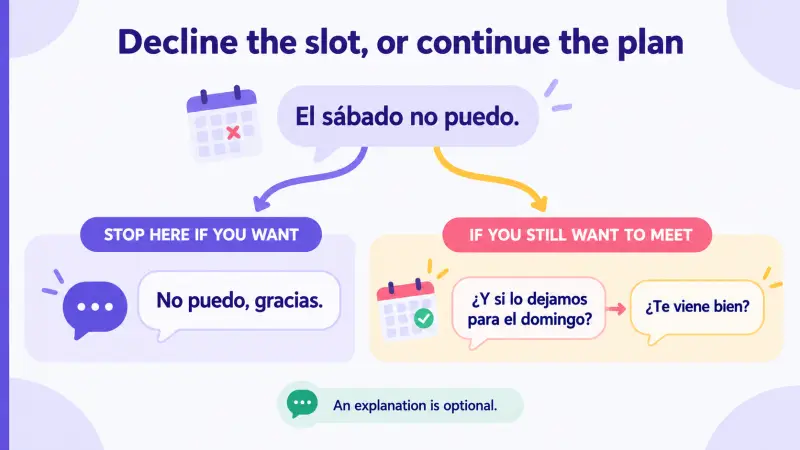
A short refusal is a complete answer. "No puedo, gracias" is polite Spanish, and nobody owes an explanation of their reasons, a replacement date, or a promise to keep talking. The question in this section is narrower: when you do want the meeting to happen another time, what does your message need to contain so that the arrangement survives the no?
A refusal can decline one arrangement while keeping the arrangement-making open, if it says clearly that you still want to meet and, where you can, points at another time. Three parts, in this order: interest, obstacle, continuation.
"Me encantaría, pero el sábado trabajo hasta las ocho. ¿Lo vemos para otro día?" (I would love to, but on Saturday I work until eight. Shall we look at another day?)
"Esa semana la tengo complicada, la verdad. ¿Te va bien la siguiente?" (That week is tricky for me, honestly. Does the following one work for you?)
"El sitio me queda un poco lejos. ¿Podríamos vernos en el centro?" (That place is a bit far for me. Could we meet in the centre?)
Notice that the last one declines a place, not a day. You can refuse any single element of a plan, and naming the element you are refusing is what keeps the rest of it intact.
The obstacle does not have to be personal. "Ese día no puedo" is enough on its own, and "prefiero dejarlo para otro momento" is a reasonable answer with no reason attached at all. If what you need is time rather than a different date, say that out loud instead of going quiet: "Déjame mirar el calendario y te digo esta noche." (Let me check my calendar and I'll tell you tonight.) The same instinct applies when you are pushing back on an opinion rather than a time slot, and the guide on giving opinions and disagreeing politely in Spanish goes deeper into the softening moves that keep disagreement comfortable.
Offer an Alternative and Check Whether It Works
An alternative is two messages' worth of work compressed into one: you propose, and you hand the decision back. It is easy to do the first half and stop, which leaves the plan floating between you.
Propose with a softened form. "¿Y si lo dejamos para el domingo?" (What if we leave it for Sunday?) and "¿Qué tal si nos vemos el jueves?" (How about we meet on Thursday?) both sound like suggestions rather than instructions. "Podríamos vernos el domingo en vez del sábado" uses the conditional for the same effect.
Then check. "¿Te viene bien?" and "¿Te va bien?" are common, "¿Te parece?" works in most places, and "¿Te sirve?" is frequent in parts of Latin America. Pick up whichever one your partner uses with you.
Here is the second round of the exchange, including the part that usually defeats people, when the other person accepts the idea but adds a new constraint:
Emma: El sábado no puedo, pero me encantaría ir. ¿Y si lo dejamos para el domingo? (I can't on Saturday, but I'd love to go. What if we leave it for Sunday?)
Alex: El domingo me viene bien, pero solo puedo antes de las cinco. (Sunday works for me, but I can only do before five.)
Emma: Entonces, ¿a las tres en la cafetería de la plaza? Así no vamos con prisa. (Three o'clock at the café in the square, then? That way we're not rushed.)
Alex: Genial, a las tres. (Great, three o'clock.)
Emma's second proposal takes Alex's constraint and builds it into her offer: "antes de las cinco" becomes "a las tres." That one habit, answering with a time that already fits the limit you were just given, is what makes the exchange feel cooperative instead of like two calendars colliding.
If you are flexible, say how flexible and let them choose: "Puedo el domingo o el martes por la tarde, lo que te venga mejor." (I can do Sunday or Tuesday afternoon, whichever suits you better.)
Practice Changing a Plan in a HelloTalk Conversation
Reading the five moves is the input stage. Producing them under mild pressure, when someone moves something on you, is a different skill. Classroom materials such as Rice University's Spanish invitations lesson plan are built around invitation sequences and response tasks, which is exactly what you want when you are learning the order of the moves, and a course like that also gives you a teacher and classmates to rehearse it with. What reading a fixed set of examples on your own cannot supply is the particular reply you will get this time, from a person with their own weekend.
So once you have worked through the lesson or course material, the next step is running the same moves with someone who can say no to you. A text thread on HelloTalk is a practical place to do it, because the whole negotiation stays visible: you can scroll back and see which message made the plan wobble. Ask your partner directly to make it difficult. Something like: "¿Me ayudas a practicar? Te invito a algo y tú me dices que no y me propones otra cosa." (Will you help me practise? I'll invite you to something and you say no and propose something else.)
These three rounds are a practice suggestion rather than a measured programme, and the point of the last column is that you reread the thread afterwards instead of closing the app the moment the chat ends.
| Round | What you ask your partner to do | What you have to produce in Spanish | What to check afterwards |
|---|---|---|---|
| 1 | Send you an invitation with one detail deliberately missing | A question that gets the missing fact and keeps your answer open | Did your partner answer the question you actually asked, or a different one? |
| 2 | Refuse your first alternative and give one hard constraint | A second proposal that fits their constraint, plus a check question | Did you build their limit into your time, or quietly ignore it? |
| 3 | Accept the time but change the place at the last minute | One confirmation message that leaves no doubt about day, time, place and what you are doing | Did they repeat the plan back the same way you wrote it? |
Two variations are worth adding once text feels comfortable. A HelloTalk voice call puts the same five moves in real time, where you cannot draft the alternative for forty seconds before sending it, and hearing "¿a las tres te sirve?" spoken quickly is very different from reading it. And if you cannot decide between two versions of an invitation, posting both to HelloTalk Moments invites feedback from individual speakers; whatever responses come back are opinions from real people in specific regions, not a rule for the whole language.
For the wider problem of holding the conversation around the plan, the guide on how to talk in Spanish and move from fear of speaking to an easy conversation covers the ground before and after this specific task.
Confirm the Final Plan in One Clear Message
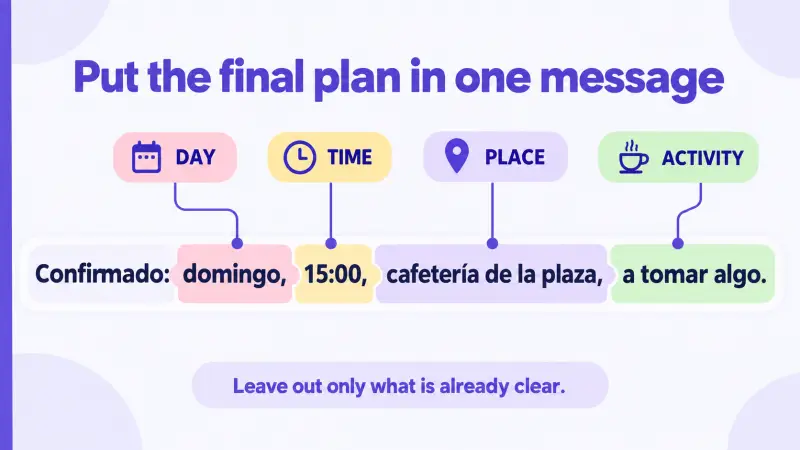
A confirmation message is worth sending after a plan has changed more than once, because it puts one version of the day, time, place and activity in writing where both of you can see it. After three rounds of adjustments, each person is carrying a slightly different plan in their head, and the version nobody wrote down is the one that goes wrong.
Send one message, not three:
"Entonces quedamos así: el domingo a las tres, en la cafetería de la plaza, a tomar algo. Si surge algo, te aviso." (So we're on for Sunday at three, at the café in the square, for a drink. If anything comes up, I'll let you know.)
Or shorter, for a chat: "Confirmado: domingo, 15:00, cafetería de la plaza, a tomar algo. Nos vemos." (Confirmed: Sunday, 15:00, café in the square, for a drink. See you.)
You can leave out anything that is genuinely settled and unambiguous in the thread. If the two of you have been discussing one specific concert for a week, "Confirmado: domingo a las tres en la plaza" is fine. The useful check is to reread your own message as if you had just woken up: if it still tells you where to be, when, and what for, it is doing its job.
Two small pieces of grammar earn their place here. "Te aviso" (I'll let you know) is the standard way to promise an update, and "avísame cuando salgas" (let me know when you leave) takes the subjunctive after "cuando" because the leaving has not happened yet. On the day itself, "¿Sigue en pie lo de esta tarde?" (Is this afternoon still on?) is a natural way to check without sounding like you doubt the person.
If the plan collapses at the last minute, the structure is the same, it just runs faster: obstacle, apology, alternative, check. "Lo siento, me ha surgido un imprevisto y no llego. ¿Lo movemos al jueves?" (Sorry, something has come up and I won't make it. Shall we move it to Thursday?) And once the plan finally happens, the next thing your partner will ask is how it went, which is where the walkthrough on telling a short story in Spanish picks up.
Frequently Asked Questions About Making Plans in Spanish
What is the most common way to ask someone to meet up in Spanish?
"¿Quedamos...?" is the everyday option in Spain, while "¿Nos vemos...?", "¿Nos juntamos...?" and "¿Nos encontramos...?" are more common in much of Latin America. All of them are easier to answer when a day, a time and a place are attached, as in "¿Nos vemos el jueves a las siete en tu barrio?"
How do I say no to a plan without sounding rude?
A short "No puedo ese día, gracias" is already polite, and you are not obliged to explain why. If you want the meeting to happen another time, add a continuation: "Me encantaría, pero ese día trabajo. ¿Lo dejamos para la semana que viene?" The difference is not politeness, it is whether anyone has been given something to reply to.
Is "quedamos" used everywhere in the Spanish-speaking world?
No. "Quedar" meaning to meet up is strongly associated with Spain. The related structure "quedar en" (to agree on something), as in "quedamos en vernos a las seis," is understood much more widely. Copy whichever version the people you actually talk to use.
What do I say if I need to cancel at the last minute?
Name what happened, apologise briefly, and propose a replacement in the same message: "Lo siento, me ha surgido un imprevisto. ¿Podemos moverlo al jueves?" Speakers in many regions use the preterite for that first part, "me surgió un imprevisto," while "me ha surgido" is common in Spain.
Should I use tú or usted when making plans?
It depends on the relationship, the region and what the other person does, not on the plan itself. tú is the usual form between friends and peers in many places, vos fills that role in parts of Latin America, and usted ranges from formal and distant in some regions to normal between close family members in others. Age on its own is not a reliable guide, so the practical move is to match the form the other person uses with you, or simply ask what they normally use.
How do I check on a plan the same day without sounding pushy?
"¿Sigue en pie lo de esta tarde?" (Is this afternoon still on?) or "¿Seguimos con lo del sábado?" (Are we still on for Saturday?) Both are neutral and give the other person an easy way to confirm or move it.
Which tenses do I actually need for this?
Fewer than you might expect. The present covers arrangements ("quedamos el sábado"), "ir a" plus infinitive covers intentions ("vamos a cenar fuera"), the conditional softens proposals ("podríamos vernos"), and the present subjunctive appears after "cuando" for something that has not happened yet ("avísame cuando llegues").