
Learning Two Languages at Once: How to Make Room for Both in Study and Conversation

Four days this week you opened the Spanish course, finished the lesson, and sent a couple of messages. Korean got opened once, on Tuesday, long enough to tap through a review screen and close the app again. Nothing collapsed, but one language is moving and the other is just sitting in your phone waiting for a better week.
The repair is usually not more discipline. Give each language one specific thing you will do with another person before the week ends, decide which language gets the new material and which one only gets maintenance, and keep their practice tasks from looking identical. Then judge the week by what you actually used, not by minutes logged.
Give Each Language a Reason to Stay in Your Week
A reason is not "I want to be conversational in Korean." A reason is a single concrete thing you will do in that language, with someone on the other end, before Sunday. Study slots protect the language you already enjoy, because enjoyment fills them automatically. Use tasks protect the language you keep postponing.
Two languages are easier to keep running in a busy week when each one has a specific use task, ideally with another person, rather than only a study slot on the calendar.
A use task has to be small enough that a bad Wednesday cannot cancel it. These all count, and each can be kept short; adjust the length to the day you actually have:
- Send one voice message answering a question your chat partner asked you yesterday.
- Post three sentences in Moments on HelloTalk about something that actually happened today, and read any replies that come back.
- Sit in a HelloTalk Voiceroom for ten minutes without speaking and write down two phrases you heard more than once.
- Answer one incoming message in the target language instead of switching to English.
Notice that the last two work even if nobody replies to you that day. If your weaker language currently has no partner, its use task should be a listening or reading task with a written output, so the week still produces evidence that you touched it.
The task decides the study, not the reverse
Once the use task is fixed, the study content has a shape. If Sunday's task is describing yesterday's cooking to a partner, then this week's lesson choice is past forms and food words, not whatever lesson comes next in the app. That single constraint is what stops the weaker language from turning into passive app-tapping.
Choose a Main Focus Without Letting the Other Language Disappear
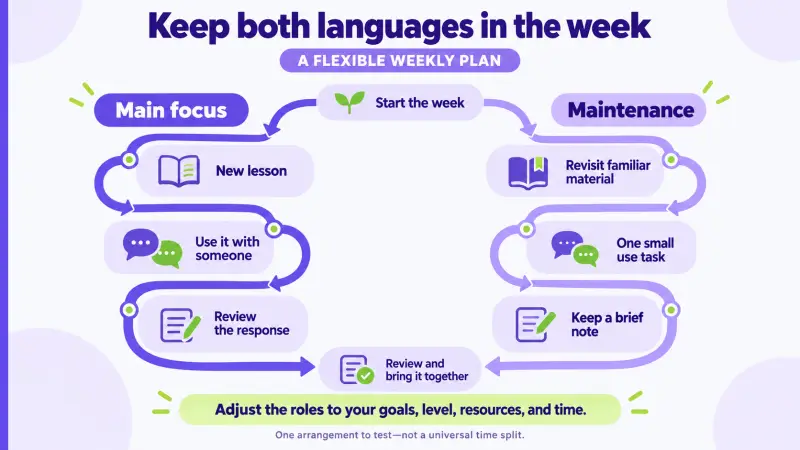
In this article, a main focus means one language receives new material this week: new grammar, new lessons, new vocabulary sets. The other language receives review of things you already half know, plus one exchange. That second language is not paused. It is running on a smaller loop. This is one arrangement you can test in a busy stretch, not a ban on studying new material in both languages; how much each language can carry depends on your level, goals, resources and time.
One arrangement worth testing in a busy stretch is to let one language take the new material this week while the other keeps a smaller review plus one real exchange, rather than zero contact.
You will find published advice on running two languages, including Duolingo's guidance on learning multiple languages. Read it as advice from a publisher, not as an experiment that settles the correct ratio between your two languages. Nobody has measured your week, so any specific split you see, including the example below, is a starting guess you correct later.
If you are unsure which language deserves the focus, let the nearest real deadline decide: a trip, an exam, a team that switched its meeting language, a person you want to talk to. Sorting focus by purpose rather than by enthusiasm is the same logic used in choosing a language learning strategy by goal, and it settles the argument faster than trying to feel equally motivated about both.
The table below is one worked week for a learner running Spanish as the focus and Korean as maintenance. It is written as an example of how the columns relate to each other, not as an optimal allocation of hours. Read it column by column: the stage explains why that use task is realistic, and the last column is what remains if the week falls apart.
| Language and role | Current stage | Next real use task | Course input this week | Review load | Minimum keep-alive task |
|---|---|---|---|---|---|
| Spanish, main focus | Can hold a short chat about daily routine, loses past forms when replying quickly | Voice message describing yesterday's cooking, then answer the partner's follow-up question | 3 lessons on past forms plus the lesson audio | Re-read 2 corrected messages, re-record 1 voice message | Send one written line about today |
| Korean, maintenance | Reads Hangeul slowly, roughly 200 words, has never spoken to anyone | One short Moments post with a photo, and read any replies it gets | 1 review lesson, no new grammar | 15 sentences you already know, said out loud | Listen 10 minutes in a Voiceroom, no speaking |
If you swap the roles next month, it usually helps to swap the whole row rather than only the study time. In this example, the language moved into maintenance keeps its use task and drops most of its new material, which is what keeps it from vanishing; adjust how much new material each one carries to your own level, goals, resources and time.
Separate Study Tasks When Their Cues Are Too Similar
Interference is often less about the two languages and more about the two tasks looking the same. Same hour, same app, same card format, same three sentence templates, same tired half of the evening. If you notice that the wrong word keeps arriving first when the two tasks share the same cues, changing one of those cues is something you can try and then observe.
This matters most for closely related pairs. A learner of Spanish and Portuguese has to keep "gracias" and "obrigado" apart under speed. A learner of Japanese and Korean will meet vocabulary with shared Chinese roots that sounds almost related, such as 図書館 (toshokan) and 도서관 (doseogwan) for "library". Similarity is a real feature of those pairs, but it is not proof that you must drop one.
Separation works better when it is deliberate rather than accidental. Use the table below as a checklist before your next week starts: pick at least two rows and make them genuinely different, instead of trying to change everything.
| What you separate | Spanish, focus | Korean, maintenance | What you are testing |
|---|---|---|---|
| Time and place | Morning, at the desk | Evening, on the couch | Whether a different time and place makes the intended language come first |
| Task type | Speaking and messaging | Reading and listening | Whether a different output channel makes the two tasks feel distinct |
| Partner and channel | Text chat with a regular partner | Voiceroom listening, then a Moments post | Whether different people and formats keep the two contexts apart |
| Note format | Short spoken recordings | Written phrase list with the source sentence | Whether different note formats give you different recall cues |
Separation can also apply to how you store vocabulary. If both languages live in identical decks of single words, one thing you can try is changing the unit for one of them, choosing single words, collocations or sentence frames according to the difficulty you actually hit. That choice is described in learning words as collocations and sentence frames.
Connect Each Course to a Real Conversation on HelloTalk
A course lesson finishes and leaves you with a form you can recognise but have not yet aimed at anyone in a message of your own. The loop that fixes this has three parts: the input from whatever course you use, a use event in that language with a real person, and a short review of what came back. HelloTalk's text chat, voice messages, voice and video calls, Moments and Voicerooms are where the middle part happens, in whichever of your two languages that week's task belongs to.
Start by agreeing the task language, because that is what stops a chat from drifting back into English. A line like this works in any pair: "Can we keep today's chat in Korean? I will switch to English only if I am completely stuck." Say the same thing to your Spanish partner on a different day, so each conversation has one working language rather than a mix of both.
Here is what the loop looks like after a Spanish lesson on past forms. You send this to Emma, a partner you message most weeks:
You: Ayer probé una receta nueva y salió fatal. ¿Tú cocinas cuando tienes poco tiempo?
Emma: Jajaja, ¿qué pasó? Yo casi siempre hago algo rápido. ¿Qué querías cocinar?
Her second question is the part your course did not give you. You practised "probé" and "salió", and she came back with "querías", a different past form doing a different job. That is the review material: save her question, and use "quería" plus a verb in your next message instead of only repeating the forms from the lesson.
The maintenance language runs the same loop at a smaller size. After a Korean review lesson you record one voice message: "어제 김치찌개를 만들었어요. 좀 짰어요." If David replies with "국물은 어땠어요?", the task is to understand his question and answer it with information you have not given yet, which is more than repeating the two sentences you prepared. Sitting in a Voiceroom on HelloTalk first, as a listener, is a reasonable version of this when you are not ready to send anything yet, and on a day when nobody answers your Moments post, the reading practice has to come from something you choose to read, such as other posts written in that language.
This is also the moment where course confidence and conversation confidence turn out to be different things. If you can complete exercises but freeze once the prompts disappear, the gap itself is the problem to work on, and moving from grammar exercises to conversation without hints deals with that step directly rather than assuming more exercises will close it.
Treat Mixed Words as a Clue, Not Automatic Proof of Failure
You are typing in Portuguese and "gracias" comes out. You are on a Japanese call and answer "네" before you hear yourself. The usual reaction is to conclude that two languages is one too many. That conclusion skips the useful part, which is what kind of slip it was.
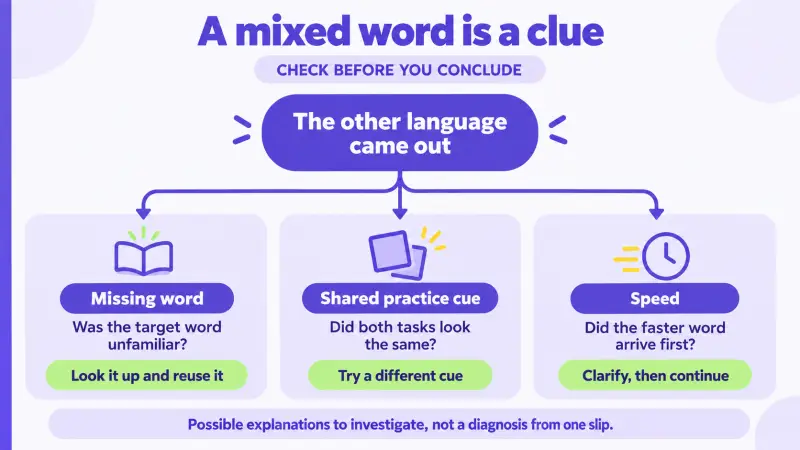
A mixed word is worth diagnosing before you treat it as proof that two languages are too many: it may be a missing word, a shared practice cue, or simply speed.
There are three common cases, and they need different responses. The first is a genuine gap: the word is not stored in the target language at all yet, so the other language fills the hole. Look it up, then use it in your next two messages on purpose. The second is competition: both words exist in your head, but they were learned under the same cue, at the same hour, in the same card format. If that case seems to fit, the separation table above is what to test first, alongside your usual review. The third is speed, which tends to show up when you are answering in real time and the faster word arrives before you can choose.
Repair lines are worth having ready, so a slip does not turn into a long pause. In Spanish: "Perdón, dije una palabra en francés. Se dice 'también', ¿verdad?" In Japanese: "すみません、今のは韓国語でした。" The Spanish line stays in the target language and checks the word with your partner; the Japanese line names what happened so the conversation can continue.
Be honest about the boundary too. In a private chat where both of you accept the mixed word, it may not need repairing at all. It matters more when it happens in exactly the situation you were training for, such as a work call or a first meeting, where an unplanned mix is more likely to need a quick clarification before you move on.
Adjust the Plan Using What You Actually Studied and Used
Give this ten minutes at the end of the week, and answer only three questions per language: what did I study, where did I try to use it, and what actually came back. A week with no reply is not a wasted week, but record it as input and preparation rather than as an exchange. Minutes recorded by an app do not answer any of the three.
A more useful weekly review records three separate things per language: what you studied, where you tried to use it, and what actually came back, rather than how many minutes an app recorded.
The answers map onto four decisions. If you studied a language but never used it, do not add study time; shrink the study and schedule a smaller, specific use task, ideally one with a person who already replies to you. If you used it but studied nothing, that is an acceptable maintenance week, and you only need input when the same gap keeps stopping you mid sentence. If neither happened, drop that language to its keep-alive task for one week and check again rather than deleting it from the plan. If both happened and the exchange felt comfortable, raise the difficulty of the use task, for example from a written message to a voice message or from a prepared topic to answering a question you did not expect.
One more thing worth tracking: which language your partner's follow-up questions land in. If every interesting question you receive is in the maintenance language, your focus may be pointing at the wrong one this month. That kind of evidence is more useful than motivation, and it sits alongside the broader set of language learning strategies for breaking inefficient study habits that apply whether you run one language or two.
When the week's plan is set, HelloTalk is where the two use tasks actually happen: a text or voice exchange in the focus language, and a Moments post or Voiceroom listening session in the one you are keeping alive.
Frequently Asked Questions About Learning Two Languages at Once
Is it a bad idea to study two languages at the same time?
It is not automatically a bad idea, and no source here establishes that it always fails. The practical risk is not your brain, it is your calendar: two languages, two study tasks and two use tasks rarely fit in the same week at equal size. Running one as focus and one as maintenance is one arrangement that makes the second one easier to keep.
Should I split my time evenly between both languages?
There is no verified optimal split, so treat any exact ratio you read, including the example in this article, as a starting guess. One arrangement worth testing in a busy week is giving only one language new material while the other keeps a small review plus one exchange, then adjusting it to your level, goals, resources and time.
How do I keep the second language alive during a very busy week?
Define its keep-alive task in advance and make it smaller than you think necessary: ten minutes of listening in a Voiceroom on HelloTalk, one Moments post, or fifteen sentences said out loud. The point of a keep-alive task is that it still gets done on your worst day, so the language does not need restarting later.
Are two similar languages harder to keep separate than two unrelated ones?
Similar pairs do give you more look-alike words to sort under speed, which is a real difficulty. It is not a rule that forbids the combination. What helps most is separating the practice cues: different hours, different task types, different partners, different note formats for each language.
What should I do when I mix words in the middle of a conversation?
Say a short repair line in the target language, ask your partner for the correct word, then use that word again within your next two messages. Afterwards, check whether the slip came from a word you never stored, from two tasks that share the same cue, or simply from speaking faster than you can retrieve.
Can I practise both languages with the same person?
You can, if you agree a task language per conversation instead of mixing both in one thread. Many learners find it simpler to keep one regular partner per language, so the chat itself becomes a cue. On HelloTalk you can agree that language at the start of the conversation and switch channels, such as moving to a voice message, without changing partners.
Do I need a separate course for each language?
Use whatever input each language actually needs, which may be a full course for the focus language and only review material for the maintenance one. What matters more than the source is that each lesson connects to a use event in the same week, so that studied material and used material do not drift into two separate lists.