
Grammar Exercises Feel Easy, but Conversation Does Not: Practicing Without the Pattern Hint

The page says "Past Simple" at the top, you fill in twelve blanks, and you get twelve right. Two hours later someone messages "So how was your weekend?" and you stall between I went, I have gone and I was going, then send "It was good" because it is safe. That gap is not proof that your grammar knowledge is broken. In this kind of exercise, the page had already answered one of the harder questions for you by printing the pattern in the heading.
So the repair is not more exercises. It is rebuilding the same material so the pattern is never announced: state the message instead of the form, shuffle situations that need different choices, then answer questions you had no chance to prepare.
Check What Changes When the Exercise Stops Naming the Pattern
A workbook item hands you most of the decision. The heading tells you which pattern to use, the bracketed verb tells you which word to change, and the sentence around it usually contains a time marker that confirms the answer. All that is left is production of the correct form.
A grammar exercise asks you to produce one named pattern correctly; a conversation asks you to pick the pattern first, then produce it while someone waits. In a live exchange you are deciding what you want to say, which structure carries that meaning, and which form that structure needs, all inside a few seconds, with a listener whose face or typing indicator is already responding.
This is also why a score can be read too broadly. The grammar research behind this article was run as a controlled task with scored items, and results from that kind of task describe performance on that kind of task. A controlled grammar study cannot on its own prove that the same practice gives you free conversational fluency, so a clean exercise page is not enough by itself to tell you how conversation will go.
Covering the hints is a quick way to check this for yourself, not a formal diagnosis. Take an exercise you finished recently, cover the heading and the bracketed verbs, rewrite three items as questions a real person might ask you, and answer out loud with a short time limit you can adjust. If the hesitation is about which pattern rather than how to conjugate it, selection is the part worth practising.
Where the difficulty comes from those hints, the practical move is to remove them one at a time rather than all at once. The table below lays out four practice types in order, from the most supported to the least: a labeled workbook item, a task that states only the message, a mixed set that shuffles situations, and a live question from another person. Read it by column to see what each type still gives you and what it forces you to decide. This is a practice design, not a measurement of results.
| Practice type | Hint still available | The choice you have to make | What you review afterwards |
|---|---|---|---|
| 1. Workbook item under a named pattern | The heading names the pattern, and the verb is often supplied in brackets | Only the form: conjugation, agreement, word order | Which forms you still get wrong when the pattern is handed to you |
| 2. Task that states only the message | The situation and what you want to communicate | Which pattern carries that meaning, then the form | Whether the meaning arrived: time reference, certainty, politeness |
| 3. Mixed set of shuffled situations | Nothing about grammar; consecutive prompts come from different situations | Switching between patterns with no warm-up | Which switch was slow, and which pattern you quietly avoided |
| 4. Live question you did not prepare | No pattern is named, although the question itself still carries language and context clues; topic and timing belong to the other person | Reading those clues, then choosing and speaking quickly, and repairing if needed | The reply you got, and the follow-up question it produced |
Keep the Message Goal and Remove the Grammar Label
Type two is a rewriting job you can do with the book you already own. Take the item, throw away the instruction line, and write down what a person would actually be trying to communicate in that moment.
A practice item becomes conversation practice the moment it states what you want to communicate instead of which pattern to use.
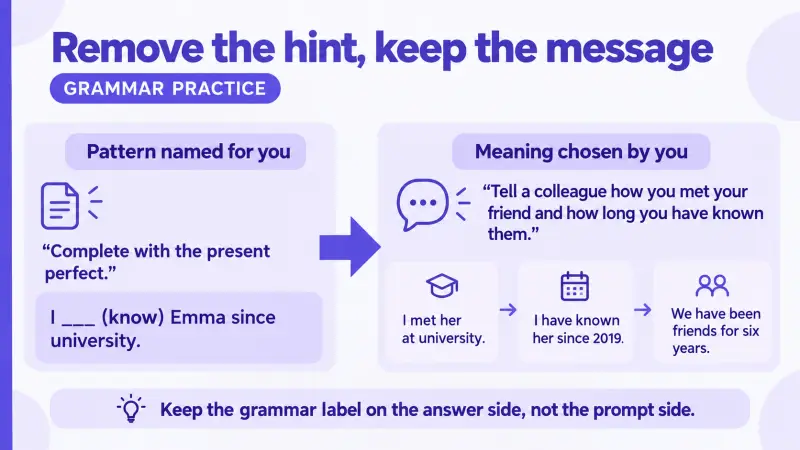
Here is the conversion on three real-looking items. Item: "Complete with the present perfect: I ___ (know) Emma since university." Rewritten task: tell a new colleague how you met your closest friend and how long you have known them. Now you have to decide between I have known her since 2019, I met her at university, and we have been friends for six years, and all three are available to you.
Item: "Choose preterite or imperfect: De niño, (comer) ___ pizza todos los viernes." Rewritten task: tell a Spanish-speaking friend what your family ate on a normal weeknight when you were eight, then what you ate last night. One task, two time frames, no label: Cuando tenía ocho años, comíamos arroz casi todas las noches. Anoche comí pasta. The exercise version asks you to obey the heading; the rewritten version asks you to notice that one situation is habitual and the other is a single finished event.
Item: "Put the verb in the correct position: weil ich müde ___ (sein)." Rewritten task: tell a friend why you left the party early. The finite verb still lands at the end of the weil clause, but nobody tells you that a reason clause is coming; you decide to give one.
Keep the grammar labels, just move them. Write the label on the answer side of your notes so it shows up during review, never on the prompt side. If your rewritten tasks keep producing the same three verbs, a vocabulary gap may be part of the problem, and building words into collocations and sentence frames fixes a different problem than this drill does.
Mix Situations That Need Different Choices
A chapter is a block: twenty items, one pattern, and your brain sets the pattern once and coasts. A conversation is a shuffle, because the person you are talking to has no idea which chapter you are on.
If every prompt in a practice set needs the same pattern, you are training the form and skipping the choice.
Build a six-prompt set where no two neighbouring prompts want the same structure, and answer each in one or two sentences without stopping to plan. This one is a suggestion you can copy for English and rebuild for any language you study:
- What did you do last Friday night?
- How long have you been studying this language?
- What did you usually do after school when you were twelve?
- What are you doing this Saturday?
- Have you ever changed jobs?
- What were you doing when the power went out?
Read it back and you will see the switches: a finished event, a period continuing to now, a habit in the past, an arrangement in the future, an experience with no fixed time, then an action interrupted mid-way. The painful part is rarely any single item. It is the jump from item 2 to item 3, or from item 4 back to item 5.
Tense is not the only thing that shuffles. Register moves too, and it moves according to who is asking. A classmate writes 昨日、来た? and うん、行ったよ fits the moment; a teacher asks 昨日、来ましたか。and はい、行きました fits instead. Both answers are grammatical, so the drill is not "which one is correct" but "who just spoke to me". The same shuffle runs through Spanish requests, where ¿Me pasas el agua? and ¿Podría pasarme el agua? are both fine sentences aimed at different tables.
Which situations belong in your set depends on what you need the language for, and choosing a learning strategy by goal is a faster way to pick six prompts than working through every pattern in the book. If you are running two languages at once, the shuffle also happens between languages, which is a scheduling question covered in balancing study time and conversation time across two languages.
Practice a Short Reply Before Building a Longer Explanation
When you try to answer a shuffled prompt with a full paragraph, you are making several choices at once while someone waits. Starting with one clause cuts the number of decisions you handle at the same time; the clauses you add after it are still chosen on their own time reference and meaning.
So split the drill in two. First give a one-clause answer and get the choice right. Then extend the same answer with a reason or a detail, keeping the first decision intact.
Question: "How was your week?"
Short: "Busy. I finished the report on Wednesday."
Extended: "Busy. I finished the report on Wednesday, so I've had two quiet days since then."
The extension is where the second choice shows up: the finished event stays in the past, while the period that reaches into today moves to the present perfect. Same information, two separate decisions, and the second one was easier to make with the first already settled.
German splits the same way with a different mechanism.
Short: "Ich war ziemlich müde."
Extended: "Ich bin früh ins Bett gegangen, weil ich ziemlich müde war."
Record both steps as voice notes rather than writing them. Typing gives you an edit window that conversation does not, and the short version is exactly the length you need when a question lands before you are ready. If you want the wider reasoning about why recognising a pattern and producing it are different skills, what input and output each build sets that out.
Use HelloTalk for Questions You Did Not Prepare in Advance
Everything above is still self-designed, which means you know roughly what is coming. What changes is that another person chooses the order, the topic and the timing, and their question still carries clues you have to read before you answer. Your coursebook or grammar app supplies the pattern, a live exchange supplies the unannounced choices, and your notes close the loop afterwards.
The simplest version is a question drill in HelloTalk text chat, where the conversation stays in the thread so you can reread your own answers later. Tell your partner exactly what you want before starting, since a partner who is trying to help may otherwise name the tense for you.
Here is a constructed example of how that exchange can look:
Alex: "Can I try something? Send me six questions about different times in any order you like, and please don't tell me which tense to use."
Sarah: "Sure. 1. What did you eat for breakfast today?"
Alex: "Toast and coffee, same as always. I ate at my desk again."
Sarah: "2. How long have you lived in your flat?"
Alex: "About three years now. I've lived here since I changed jobs."
Sarah: "3. Were you living alone before that?"
Alex: "No, I was sharing with two friends at the time."
Short answers like "Toast and coffee" are normal chat rather than mistakes. For this drill, add one full clause after them, because that is where you can see which form you reached for: a finished event, a period continuing to now, and a past situation in progress, with no heading to lean on.
HelloTalk Moments works for the version where you do not control who answers, since a post is visible to other members and can come back as several different follow-up questions on the same three sentences about your week. Say in your post that you want questions, not only corrections, so the replies give you something new to answer instead of only an edited paragraph. When someone does rewrite a line, ask them to add the version they would use themselves, so you can see which form a native speaker reached for in that situation.
HelloTalk voice messages are asynchronous, so they work as a lower-pressure step you can record after preparing and replay later; if you want the pressure, that is a rule you set for yourself, such as recording in one take without writing the answer first. HelloTalk voice and video calls are where the reply has to happen inside the exchange itself, and HelloTalk Voicerooms put several speakers into one live conversation where the shuffle happens to you rather than being planned by you. Practice partners on HelloTalk are other learners and native speakers rather than instructors on call, so not everyone will want to run a drill; ask a few people, agree on the format with the ones who enjoy it, and return the favour in their target language.
Review the Choice That Failed, Then Try a Different Situation
Reviewing a conversation is not the same as marking an exercise, because there is no answer key and no score. The usable signal is what your partner did next.
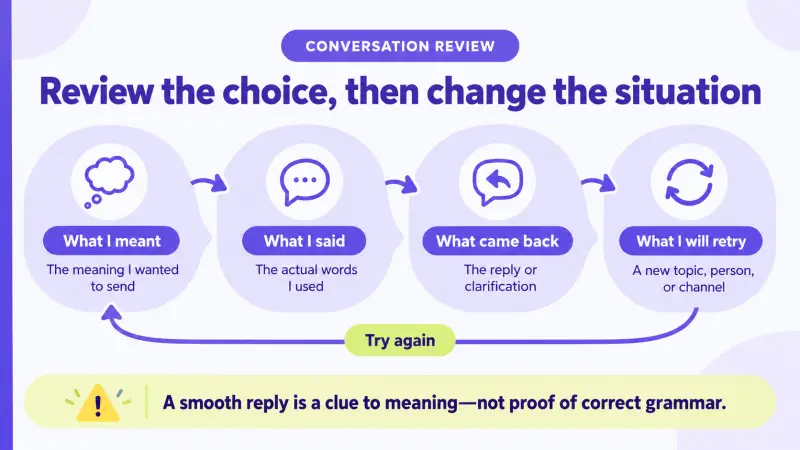
Your partner's reply is a useful clue about which meaning arrived, although it does not confirm that your grammar was correct. A confused follow-up question, a rephrasing of your sentence, or an answer to a question you did not ask are all more concrete than a vague feeling that something sounded off, and a smooth reply can also mean your partner guessed what you meant or chose not to correct it.
Log the failure as four columns rather than a corrected sentence, so the entry keeps the meaning you were aiming at. Two constructed entries look like this:
| What you meant | What you said | What came back | The choice to retry, in a new situation |
|---|---|---|---|
| I moved here in 2022 and I am still here | "I live here since 2022." | "Oh nice, so you just arrived?" | Present perfect with since; retry by saying how long you have had your current job, in a voice message |
| I was bored during that meeting | "Soy aburrido." | "¿Por qué dices eso? No eres aburrido." | With this adjective the choice changes the meaning: ser aburrido is being boring, estar aburrido is feeling bored, so retry with estaba aburrido/aburrida while describing how you felt at a long family dinner, in a text message |
The last column is the part people skip. You can confirm or repair the sentence in the original situation first, then change the topic, the channel or the person so that you are rebuilding the choice rather than memorising one sentence. If the second attempt goes through without a clarifying question, that is one sign among several, read next to the meaning you wanted and the words you actually used; if it fails again in a new situation, the pattern goes back into your next mixed set.
This drill is one block inside a weekly routine, and the wider guide to language learning strategies that make study time count shows where a choice drill sits next to listening, reading and vocabulary work.
Frequently Asked Questions About Using Grammar in Conversation
Why do I score well on grammar tests but freeze in conversation?
Many exercise items, including the kind this article rewrites, name the pattern in the heading and supply the verb, so the task left is producing the correct form. A conversation asks you to select the pattern first, under time pressure, with no heading and only the clues carried by the question itself. Those are two different tasks, and practising the second one requires prompts that never state which structure to use.
Should I stop doing grammar exercises?
No. Labeled exercises are efficient for the form itself: endings, agreement, word order. Keep them for the patterns you are still getting wrong, and add the unlabeled versions on top so you also practise choosing. The rewriting step in this article works best when you already know the pattern exists.
How many patterns should I mix in one practice set?
Three to four distinct choices across six prompts is enough to make switching real without turning the set into a quiz you cannot finish, and you can adjust those numbers to suit your own set. Mixing twenty patterns at once tends to spread the set thin, which makes it harder to see which switch was the slow one.
What if I choose the wrong pattern and my partner still understands me?
Write it down but rank it lower. Errors that change the meaning, like a feeling expressed as a personal characteristic, or a habit expressed as a single event, go to the top of your retry list. Errors that only sound slightly off can wait until the meaning-level ones are stable.
How do I practise choosing when I have nobody to talk to today?
Use the mixed set alone and record your answers as voice notes with a strict few-second limit, then listen back for hesitations rather than for pronunciation. It is weaker than a live exchange because you still know the prompts, but it keeps the switching habit alive between conversations.
Should I plan the whole sentence before speaking, or start and repair?
Start short. Give a one-clause answer that fixes the time reference and the register, then add the reason clause once the first choice is out of your mouth. Long planned sentences ask you to settle several decisions before you speak, and the first clause does not have to be perfect before you continue.
How long until choosing the right form feels automatic?
There is no honest timeline to give you, because it depends on the language, the pattern and how often you are in real conversations. Instead of a date, read several signs in your review log together: fewer restarts mid-sentence, replies that match what you meant, and the same mistake no longer coming back after a retry in a new situation.