
Build a Daily Spanish Routine Around One Short Story

You play a new Spanish audio every morning, follow it well enough while it is running, and close the app feeling like the session went fine. Then you try to say what actually happened in it and get as far as "una chica... el trabajo..." before the thread drops. Swapping the material every day means nothing stays around long enough to move from understanding into speaking, which is a different problem from not understanding.
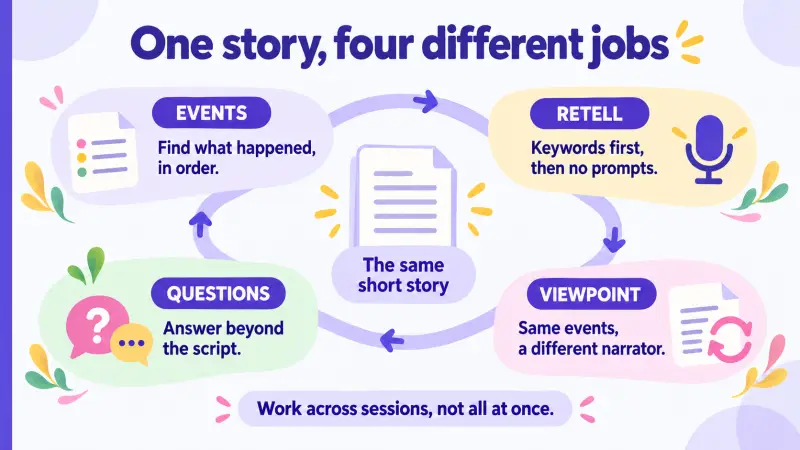
So stop swapping the text. Keep one short story for several days and change what you do with it instead of changing the story, so the same language gets used four different ways. The last of those four ways is a conversation where a real person asks you something the story never answered. If you want the surrounding time block, this slots into the input and output slots described in a 30-minute daily Spanish practice routine rather than replacing it.
Choose a Short Story You Can Follow Without Translating Every Line
A useful starting size is something you can read aloud in 2-3 minutes, or listen to in under four. That is a suggestion, not a rule. The reason for keeping it small is practical: a longer text turns the week into decoding work instead of production work.
Then run one test before committing. Read or play the first paragraph once, close the text, and say out loud what happened. If you can name the people and one event, the level is right. If you can only name a topic, it is too hard for this routine. If you can retell the whole paragraph with no effort at all, it will not leave much behind.
A story sits at the right level for this routine when unknown words stop you from saying it well, not from knowing what happened.
It also needs a plot. Something has to change: someone wants something, something goes wrong, someone reacts. A descriptive piece about a city can be good reading practice, but it gives you no sequence to rebuild, so it does not fit this particular exercise.
Teaching sites that publish short Spanish stories for learners, such as Fluent With Stories and Spanish with Diana, are reasonable places to look, and so are the short narrative pieces in a textbook or podcast you already have. Check each candidate's level label, length and whether audio comes with it against the test above, since those details differ from story to story and change over time.
Before you commit several days to one text, it helps to see everything that text has to do for you, because the selection test only makes sense once you know the final stage is a live conversation with someone who has never read it. The routine runs four passes over the same story, always in this order and not as a ranking: pass one is events, pass two is a retell, pass three is a viewpoint change, pass four is unscripted questions. Each pass takes away more support and asks for more output.
| Pass | What stays in front of you | What you produce | What you check afterwards |
|---|---|---|---|
| 1. Events | Full text or audio, replays allowed, dictionary closed for the first run | 4-6 lines saying what happened, in order | Did you get the order and the cause right, or infer everything from one familiar word |
| 2. Retell | A few keywords on a card, text covered, then nothing | A spoken retell covering every event, as long as the events require | Exactly where you stalled, and which phrase from the text would have unblocked it |
| 3. Viewpoint | Your own notes only | The same events told by a different narrator | Which verb forms, pronouns and possessives had to change, and which ones you got wrong |
| 4. Questions | Nothing | Answers to questions the story never answered | Whether the listener followed you, and what they asked you to repeat |
The table is the map for the whole cycle, not a checklist to run in a single sitting. The next four sections are the execution order, one section per pass.
Read or Listen for the Events Before Collecting New Words
First contact happens with the dictionary closed. Read or listen straight through, a second time if you need it, then write 4-6 lines of what happened, in order, in English or Spanish, whichever you can do quickly.
Here is a made-up story that the rest of this article reuses so the four passes stay comparable. It is compressed down to four sentences for demonstration; a story you actually keep for several days would run longer than this.
"Marta pierde el autobús de las siete y va andando a la oficina. Llega veinte minutos tarde. Cuando entra, la sala está vacía: la reunión se ha retrasado hasta las diez. Su jefe le escribe: no pasa nada, empezamos a las diez."
Event lines for that story: she misses the bus, she walks, she arrives twenty minutes late, the room is empty, the meeting was pushed to ten, her boss says it is fine. Six lines, no vocabulary work yet.
Understanding a story means being able to state its events in order, and a list of translated words does not prove you did that.
Once the events are down, go back and look things up, but only the words that actually broke the sequence. In this story most learners already handle "autobús" and "tarde". The one that decides the ending is "se ha retrasado": skip it and you lose the turn the story takes, which is that her lateness stopped mattering because the meeting had already moved. Leave the decorative words alone. Many of them show up again inside the same story anyway.
Retell From a Few Prompts, Then Put the Prompts Away
Write about five keywords on a card and cover the text. Five is a starting number that works for a story this size; adjust it to your story. For the example above: autobús, andando, veinte minutos, sala vacía, las diez.
Now speak from those words with nothing else in front of you. A workable version sounds like this: "Marta pierde el autobús, así que va andando al trabajo. Llega veinte minutos tarde, pero la sala está vacía porque la reunión se ha retrasado hasta las diez." Let the retell run as long as the events need. Do not pad it to reach a length. Record it on your phone so you can hear the gaps instead of guessing at them.
Then put the card away and do it again. This second version is the one that matters, because nothing is prompting the sequence for you.
The point where your retell stalls tells you which phrase to take from the text, and that is a better vocabulary list than anything you highlight while reading. If you stalled reaching for "so she walked", the piece to keep is "así que va andando", matching the person and tense you are actually narrating in. The first-person version belongs to the next pass, not this one.
If speaking cold feels impossible on the first day, write the retell first and say it afterwards. Just do not let writing become the whole exercise for several days running, since this pass is about retrieval under time pressure.
Change the Viewpoint to Make the Language Your Own
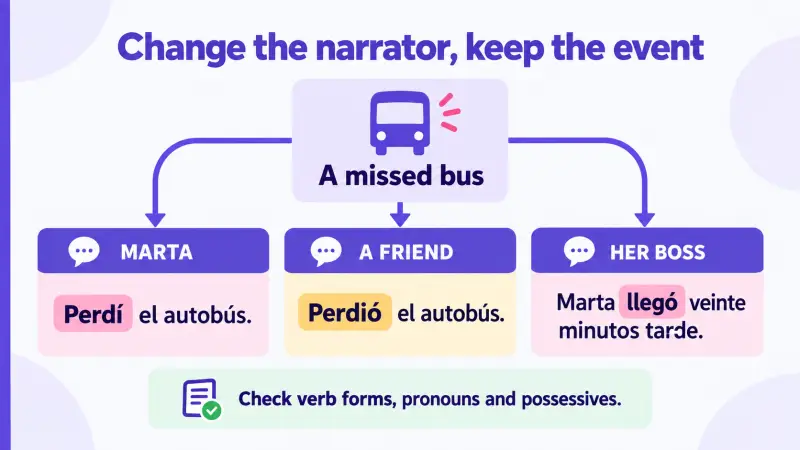
Same events, different narrator. This is where you stop replaying sentences.
Marta telling it herself, in the past: "Perdí el autobús de las siete y fui andando. Llegué veinte minutos tarde y no había nadie en la sala."
Her boss telling it: "Marta llegó veinte minutos tarde, pero la reunión ya se había retrasado hasta las diez, así que no pasó nada."
A friend passing it on: "¿Sabes qué le pasó ayer a Marta? Perdió el autobús, fue andando a la oficina y, cuando llegó, no había nadie."
Notice what each switch costs you. First person forces the verb endings and possessives. The boss version forces "se había retrasado", a past tense used for something that happened earlier than the main past events, since the meeting moved before Marta walked in. The gossip version forces a natural opening and a change in rhythm, which is closer to how people actually hand a story to someone else.
Keep one line between retelling and rewriting. The original does not say who moved the meeting, so a version like "yo ya había retrasado la reunión" is not a faithful retell of that text; it is an invented detail. Adding invented details is a fine exercise on its own, as long as you say out loud that you are doing it, because the whole value of pass four is being able to separate what the story stated from what you are supplying.
One more switch is worth adding: tell the same kind of event from your own week. "Yo también perdí el tren el martes y llegué media hora tarde." Narrating your own events is a related but separate skill with its own problems of tense and sequencing, covered in telling a short story about your own week in Spanish.
Bring the Story to HelloTalk and Answer Questions Outside the Script
The last pass needs somebody who has not read the story, which is what a chat on HelloTalk is for at this stage. Record your prompt-free retell, send it as a voice message in a HelloTalk chat with one line of context, and ask for questions rather than praise: "Te cuento una historia corta que he estudiado esta semana. ¿Puedes hacerme dos o tres preguntas sobre ella?"
What comes back is the part you cannot rehearse:
Partner: "¿Y por qué no tomó un taxi?"
You: "Supongo que no tenía dinero suelto. Yo tampoco tomo taxis por la mañana, hay mucho tráfico."
Partner: "¿Y sabemos qué hizo al llegar a la sala vacía?"
You: "La historia no lo dice. Creo que aprovechó para contestar correos."
Neither answer exists in the text. You had to guess, hedge and mark the guess as a guess, which pulls in "supongo que", "creo que" and "la historia no lo dice", and that is the moment the story stops being a recitation.
A retell is finished when someone who has never read the story can follow it and ask a sensible follow-up question, not when you can say it smoothly to yourself.
Two other parts of HelloTalk suit different days. Posting the four-line written version to HelloTalk Moments puts it in front of the public feed, so more than one native speaker can react to the same paragraph. HelloTalk Voicerooms are group voice chats you can enter as a listener first, and a short story is a manageable thing to contribute once you have heard how the room talks.
Two honest notes. Nobody owes you a reply at a set speed, so ask one specific question instead of "please correct everything". And expect regional variation in the answers: if you say "ir andando" and someone replies that in their country people say "ir caminando", that is a difference in usage, not a mistake to argue about. Note both and move on.
Keep the Useful Expressions and Know When to Move to a New Story
When you finish with a story, do not save the story. Save the pieces that carried it, written with a slot so they can be reused:
- "Perdí el autobús, así que ___"
- "Al final tuve que ___"
- "La reunión se ha retrasado hasta ___"
- "No pasa nada, ___"
- "Aprovechó para ___"
- "Supongo que ___"
Six frames is plenty. Storing them this way, rather than as single words, is the difference between recognising vocabulary and producing it, which is the argument laid out in learning words as collocations and sentence frames.
There is no fixed number of days to stay on one text, and no requirement to reach a flawless retell before moving on. Reasonable moments to switch: you follow the story fully and the viewpoint pass no longer throws up anything to fix, you have already drilled the expressions you wanted from it, your interest has run out, or the text turned out not to suit this event-retelling exercise. Any one of those is enough.
If several sessions in you are still decoding rather than retelling, the text is probably above the level this routine needs. Swap it for something shorter without ceremony; that is a match problem, not a verdict on you.
Keep one retired story in rotation anyway. Telling it cold a week or two later, with no notes, is the cheapest review you will ever run, and it shows you which frames actually stuck. Whether any of this survives past the first few weeks has less to do with the method than with when and where you schedule it, which is the subject of building a Spanish practice habit that outlasts the first three weeks.
Frequently Asked Questions About Story-Based Spanish Practice
How long should the story be?
A workable starting point is short enough to read aloud in 2-3 minutes or hear in under four. Much longer and the retell turns into a memory test, and this routine is aimed at language production rather than recall capacity.
Do I need audio, or is a written story enough?
A written story works for all four passes. Audio adds one useful thing: you find out whether you can follow the events at someone else's speed rather than your own. If your story has no audio, read it aloud yourself and let a native speaker hear your version in conversation instead.
What if I do not understand a large share of the words?
If you cannot state a single event after reading or listening once, the text is above the level this routine needs. Swap it before you start looking things up. The routine assumes you can already follow the plot and are working on saying it.
How many days should I stay on one story?
As long as it is still giving you something. Watch your own output rather than the calendar: once the retell runs without prompts, the viewpoint switch produces nothing new to fix, and follow-up questions no longer freeze you, the text has done its job.
Should I write the retell or speak it?
Speak it. Writing is a reasonable warm-up on the first day, but the stalls that show you what to keep only appear when you are speaking under time pressure with the text covered.
Can I use a podcast episode or a novel chapter instead?
Yes, if it has a clear sequence of events and fits the length test. A single novel chapter is often too long for this purpose; a short narrative episode from a learner podcast usually works. A text with no events to reconstruct leaves passes two and three with nothing to rebuild, so choose a different one for this routine.
What should I ask a language partner to correct?
Ask one targeted question rather than requesting a full correction. Useful versions: "Did you follow the order of events?", "Does 'se ha retrasado' sound right here or would you say it differently?", or simply "Ask me two questions about the story." Specific requests get specific answers, and they leave you with something you can put into the next retell.