
How to Tell a Short Story in Spanish Without Losing the Thread

A friend asks what you did over the weekend, and you can produce the pieces: fui al mercado, llovió, perdí el autobús. Then you try to connect them, realize you have not said where you were or why it mattered, and the sentence stalls halfway. The problem this article works on is that thread rather than the verb endings, because in that moment the event was never decided on, only remembered in fragments.
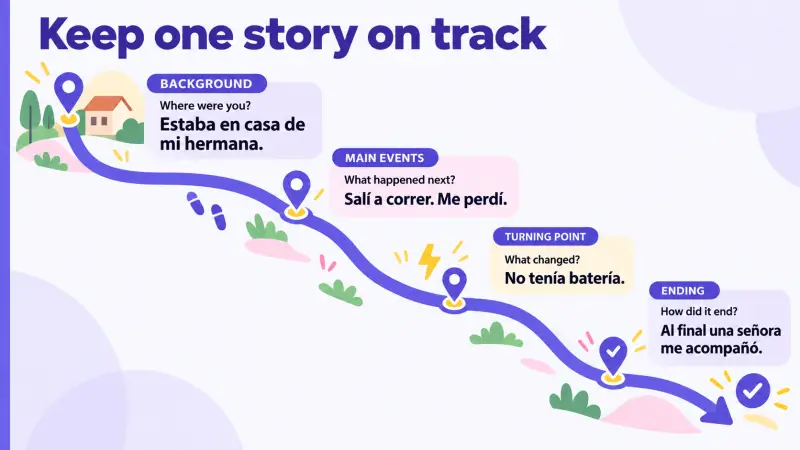
A short spoken story in Spanish holds together when it does four jobs: set the background, move through the main events, land the turning point, and close the ending. Everything below is about getting those four jobs out of your mouth in about a minute and a half, then repeating the same story until it stops feeling like translation.
Choose One Event and Decide Why It Is Worth Telling
One common reason a story stalls at this stage, and the one this section fixes, is that the chosen event is too big. "Mi viaje a México" is ten days, six cities and forty things that happened, so the telling drifts and you run out of steam somewhere around day two. "El día que me equivoqué de autobús en la Ciudad de México" is one event with a start, a middle and an end, and it fits in a single turn of conversation.
Before you look up a single word, finish this sentence out loud in Spanish: Te cuento esto porque... If the honest answer is no sé, the event is not ready and you should pick another one. Any of these endings works fine:
- ...porque fue la primera vez que cociné para ocho personas.
- ...porque al final perdí el tren, pero conocí a alguien simpático.
- ...porque todavía no entiendo qué pasó.
That one sentence is your destination. When you lose your place mid story, you steer back to it instead of adding one more unrelated action.
Pick events you can already mostly say
A story about a plumbing problem needs plumbing vocabulary you probably do not have yet. A story about getting lost, missing a bus, cooking something badly, or meeting someone by accident runs on verbs you already use every week: ir, salir, llegar, ver, decir, perder, encontrar. Choose from what you can almost say, and save the harder topics for when they come up naturally in conversation.
Give Just Enough Background for the Listener to Follow
Once you know which event you are telling, the listener needs a place to stand. Background answers when, where, who was there and what you were doing, and it usually takes two or three sentences rather than a paragraph.
Here is a background block for a story about getting lost on a morning run:
El sábado pasado estaba en casa de mi hermana. Ella vive en otra ciudad y yo iba a quedarme solo dos días. Era mi primera vez en ese barrio.
Look at what each verb is doing there. Estaba, iba and era are imperfect, describing the situation around the event: where you were, what the plan was, how new the neighborhood felt. Vive is present tense, because your sister still lives in that city today and that fact has not stopped being true. So background is not one single tense; it is whatever fits the fact you are stating. The actions that move the story forward come next, and those are preterite: salí, corrí, giré, me perdí. You can start telling stories with that split between situation and action, and pick up the finer distinctions from corrections as you go.
Background earns its place in the story when the listener needs it to understand the turning point. Your sister's job history, the year she moved and the color of her kitchen change nothing about getting lost, so they get cut. The fact that you did not know the neighborhood changes everything, so it stays.
If your event started as a plan that fell apart, the setup sentence usually involves arranging something and then changing it, and the phrasing for making plans and handling changes in Spanish gives you a cleaner opening than improvising it mid story.
Keep the Main Events in Order Without Listing Every Detail
With the scene set, the listener is waiting for movement. Three to five main actions, each in one sentence, in the order they happened, is a workable size for the practice in this article; a longer event may need more, and a very simple one needs fewer. What you want to avoid is turning the telling into a report of everything you remember.
Por la mañana salí a correr a las siete. Corrí unos veinte minutos y todo iba bien. Después giré en una calle que no conocía. A los cinco minutos me di cuenta de que no sabía volver.
Two things keep that sequence moving. The first is time markers instead of an endless chain of y luego: primero, después, a los cinco minutos, más tarde, mientras, cuando, entonces. The second is a filter for details. If a detail does not change what happens next or how you felt about it, drop it while you are speaking.
Compare the two versions of the same moment:
- Overloaded: Salí a correr a las siete y diez, con mis zapatillas azules que compré en enero, y hacía como quince grados, y había un perro en la esquina, y un señor estaba lavando su coche.
- Tight: Salí a correr a las siete y hacía frío. No había casi nadie en la calle.
The tight version keeps the one detail that matters later, which is the empty street, because it explains why you could not ask anyone for directions.
Make the Turning Point and Ending Clear
A list of actions in order is still not a story. The turning point is the moment something goes differently than expected, and it helps to signal it so the listener hears it coming: Y entonces..., De repente..., Pero cuando llegué..., Lo raro fue que..., Resulta que...
Entonces saqué el móvil para ver el mapa y vi que no tenía batería.
Then close it. Say what finally happened and add one line about how you felt or what came of it, because that line is usually what the listener responds to:
Al final le pregunté a una señora en una panadería y me acompañó hasta la esquina correcta. Llegué a las nueve y mi hermana ni se había levantado. Y ya está, esa fue mi gran aventura del sábado.
A closing line such as Y ya está, Al final, Bueno, eso es todo or Y así terminó is the clearest way to hand the turn back, especially when you are speaking slowly and the listener cannot tell whether you have finished or are still hunting for a word. Tone and context often do the job on their own; a spoken signal removes the guesswork when your delivery is still uneven.
Now that all four jobs have appeared in one story, it helps to see them side by side, because the hard part in live conversation is not remembering the four jobs but knowing what each one owes the listener. Read the table by column: the example shows the shape of that job, the third column is what the listener needs in order to follow, and the last column is what you can safely leave out when you are speaking in real time.
| Story job | Short example in Spanish | What the listener needs from it | What you can skip |
|---|---|---|---|
| Background | Estaba en casa de mi hermana. Era mi primera vez en ese barrio. | When, where, and the one fact that makes the turning point make sense | Backstory, dates, side characters, anything decorative |
| Main events | Salí a correr. Giré en una calle que no conocía. Me perdí. | The main actions in the order they happened, usually three to five | Exact times, clothing, weather that changes nothing |
| Turning point | Entonces saqué el móvil y no tenía batería. | A clear signal word and the moment things changed | A second surprise competing with the first one |
| Ending | Al final una señora me acompañó. Y ya está. | How it resolved, one line of reaction, a handover signal | Morals, long explanations, a second story attached |
Tell Your Story on HelloTalk and Follow the Listener’s Questions
Writing the story out and reading it aloud is genuinely useful preparation. It sorts the tenses, fixes the vocabulary in place and lets you hear your own sentences before anyone else does. What preparation cannot supply is the unplanned part: the question you did not expect, the detail a listener wants that you decided to cut, the reaction that sends the story somewhere else.
A workable sequence inside HelloTalk chat is to record the story as a voice message of about sixty to ninety seconds, working from your four line outline and nothing more. HelloTalk keeps that recording in the thread, so when you retell the same event later, both versions sit in the same conversation and the difference is audible instead of imagined. A native speaker you are chatting with can reply in that thread with corrections, and can ask you questions about the event, which is the part your notes never covered.
Those questions are the actual test. A story you rehearsed is a monologue; a story that survives follow-ups is a conversation.
Sofía: ¿Y no podías preguntarle a alguien?
You: Es que era muy temprano y no había casi nadie en la calle.
Sofía: ¿Y tu hermana no te llamó?
You: No sé, el móvil estaba sin batería. Ah, se me olvidó decir que salí sin llaves.
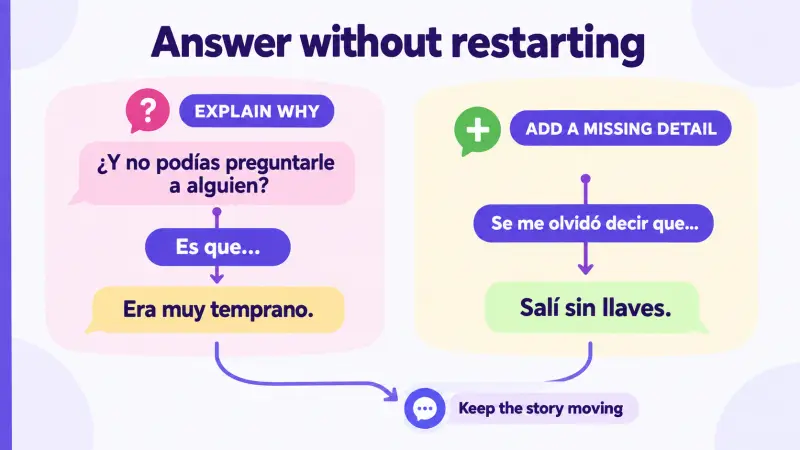
Two repair phrases carry most of this. Es que... answers a "why" without building a full sentence from scratch, and Se me olvidó decir que... lets you insert missing information without restarting the story. If you need a second to reorganize, Espera, vuelvo atrás un momento is honest and buys you the pause.
For the reaction side of the exchange, the short responses that keep a listener engaged are worth having ready before you need them, and the collection of Spanish conversation phrases that actually come up in real chats covers more of them than a storytelling outline can. When the conversation moves from what happened to what the two of you think about it, that is a different skill, and giving opinions and disagreeing politely in Spanish handles that turn.
If speaking directly still feels like too much
HelloTalk Moments works as a lower pressure first pass: post the same event as four to six written sentences in Spanish, and speakers who see it can comment and correct. Not every post gets a reply, so treat it as a draft stage rather than a guaranteed review. HelloTalk Voicerooms sit at the other end, since you can join one and listen to other people talk before you take a turn with your own story. If speaking at all is still the bottleneck, the broader walkthrough on how to build up to easy Spanish conversation covers the ground before this one.
Retell the Same Event With Fewer Notes and Better Focus
It is tempting to tell a story once, feel it go badly, and switch to a new story next time. That resets the vocabulary every session. Repeating the same event gives you a fixed set of words to reuse, which is why a second telling usually runs smoother than a first telling of something new.
One way to structure the repetition, offered as a suggestion you can adjust rather than a schedule with promised results:
- Write four lines only, one per story job, in Spanish. Not a script.
- Record a voice message of about a minute in a HelloTalk chat, reading nothing.
- Ask your partner for two corrections and one question, not a full rewrite. Two fixes you remember beat twenty you skim.
- Two days later, retell the same event using four keywords instead of four sentences, for example hermana, correr, batería, panadería.
- Tell it a third time to a different listener, or in a Voiceroom, with no notes at all.
Between the second and third telling, change exactly three things: apply the corrections you received, cut one detail that did not earn its place, and add one reaction line such as La verdad es que me dio un poco de vergüenza. That single line of feeling is often what turns a sequence of events into something someone wants to respond to.
Listening back narrows down where the trouble is, though it rarely settles it on its own. A pause before a verb might be an unsure preterite form, or simply the word itself not arriving fast enough. A pause before a connector might be missing sequencing vocabulary, or the moment you noticed the next event was out of order. A pause before the ending might be a missing closing phrase, or the sign that you never decided why you were telling the story, which sends you back to the first section. These causes overlap, so treat the pause as the place to look and let your partner's next question tell you which one it was. Keeping the first recording and the later one in the same HelloTalk chat makes that comparison concrete instead of a feeling about whether you improved.
Frequently Asked Questions About Telling Stories in Spanish
Which past tense do I need to tell a short story in Spanish?
For a first story you mainly need two: the preterite for the actions that move events forward (salí, llegué, vi, me perdí) and the imperfect for the situation around them (estaba, había, hacía, iba). Present tense still appears for facts that are true now, such as mi hermana vive en otra ciudad. You can tell a complete story with that much and pick up the rest through corrections.
How long should a short spoken story be?
About sixty to ninety seconds is a comfortable starting target for this kind of practice, which lands somewhere near eight to twelve sentences. Adjust it to your event and your listener; the point is to leave room for background, events, a turning point and an ending without the thread going slack while you search for a word.
How do I start a story naturally in Spanish?
Announce it first so the other person knows a story is coming: Te cuento lo que me pasó el sábado, ¿Sabes qué me pasó ayer? or Un día me pasó una cosa un poco rara. Then go straight into the background sentence.
What do I do if I forget a word in the middle?
Keep going and describe around it: esa cosa que se usa para..., no sé cómo se dice, pero era como un..., or simply ask, ¿cómo se dice "X" en español? Stopping to look it up breaks the flow; describing around it is what fluent speakers do in their own language too.
Should I write the whole story out before speaking?
Writing a full version is fine preparation, especially the first time, and reading it aloud helps with pronunciation and rhythm. When you go to tell it, though, put the full text away and keep four lines, one per story job, so you build the sentences live. That is the part a real listener will test when they ask about your weekend.
How do I answer follow-up questions without starting over?
Answer in one sentence and hand the turn back. Es que... covers most "why" questions, and Se me olvidó decir que... lets you add missing information without rewinding. If you genuinely need to back up, say Espera, vuelvo atrás un momento and continue.
What if my event is not interesting enough?
A clear turning point matters more than drama. Getting on the wrong bus, burning dinner or running into someone unexpectedly all work, because the listener mainly needs one moment where things went differently than planned and one line telling them how you felt about it.