
How to Give an Opinion and Disagree Politely in Spanish

You can already say me gusta and no me gusta. Then your partner says the opposite, and everything you know collapses into one flat no, which lands harder than you meant it to. The specific difficulty here is that a bare no leaves the other person nothing to answer, so the exchange either stops or turns into a defence. This article is about the turns that come after your opinion: adding a reason, limiting how far a claim reaches, and disagreeing in a way that keeps the conversation moving.
State Your Opinion and Give the Other Person Something to Respond To
The fastest improvement is usually to stop ending your turn at the opinion itself.
You are never obliged to justify an opinion in Spanish, and a curious partner can always ask why. But while you are still building conversations, a short reason does practical work. Attaching one short reason clause after your opinion gives a partner more to pick up than the opinion alone, which is why a quick porque or es que is worth building into your practice turns.
Compare two replies after a partner says the local breakfast is too sweet:
Thin: No, a mí me gusta. (No, I like it.)
Usable: A mí me gusta, porque en mi país el desayuno es todo salado y esto me parece un cambio. (I like it, because breakfast back home is all savory and this feels like a change to me.)
The second version hands over three things your partner can respond to: your position, your country, and your comparison. Even a very short reason is enough. Es que is the everyday way into one: Es que yo desayuno muy temprano y necesito algo dulce.
Two kinds of openers do slightly different jobs. Creo que, pienso que and me parece que introduce a full clause: Me parece que la película es demasiado larga. Para mí, en mi opinión and desde mi punto de vista sit next to the sentence and mark whose view it is: Para mí, la película es demasiado larga. Either is fine, and you can use both in one turn.
There is one pattern worth learning early, because it appears whenever you want to express doubt. When creer, pensar or parecer is negated, the verb after que is usually subjunctive, so the version to learn first is No creo que sea así rather than no creo que es así. The indicative does appear after a negated creo que in some contexts, and you may well hear a native speaker use it, so treat this as the routine template rather than a switch that fires every single time. The same template covers No me parece que tenga razón.
Five communicative moves show up again and again in opinion exchanges. They form a sequence you can run inside one or two turns, not a ranking from weakest to strongest: state your position, limit how far the claim reaches, acknowledge something from the other side, give the reason you see it differently, and invite a response. You will not use all five every time. The table pairs each move with one original example and with the situation where that move can still land badly, so you can pick the move that matches how strongly you actually feel.
| Move | What it does | Spanish example | Where it can land wrong |
|---|---|---|---|
| 1. State the position | Puts an opinion on the table | Creo que vivir en el centro es mejor. | Flat on its own if you stop there |
| 2. Limit the claim | Marks it as yours, not a verdict | Para mí, vivir en el centro es mejor. | Overused, it can sound like you have no position |
| 3. Acknowledge a point | Shows you listened before objecting | Tienes razón en que es caro. | Sounds hollow if the next word is always pero |
| 4. Give your reason | Explains the difference | Es que yo no tengo coche. | Long reasons lose a listener in a voice message |
| 5. Invite a response | Keeps the turn moving | ¿Y tú cómo lo ves? | Can feel like an interview if you ask twice in a row |
Move four often turns into a small piece of storytelling, and if that part feels shaky, the practice in telling a short story in Spanish covers the past-tense scaffolding that reasons tend to need.
Separate a Personal Preference From a Claim About Everyone
One common source of misunderstanding in these exchanges is skipping move two. A mí no me gusta el reguetón and el reguetón es malo feel similar in your head and are quite different on the receiving end.
Saying a mí no me gusta keeps the claim inside your own experience, while es malo is a broader evaluation that a listener can hear as a dismissal of their own taste. One describes you. The other describes their playlist.
Watch the difference in a two-line exchange:
Diego: En mi ciudad la gente cena a las diez.
Version A: Eso es muy tarde. No es sano. (That is very late. It is not healthy.)
Version B: A mí me costaría mucho, la verdad. Yo ceno a las seis y me da hambre solo de pensarlo. (Honestly, that would be hard for me. I eat at six and just thinking about it makes me hungry.)
Version B still disagrees. It simply keeps the claim inside your own life, which leaves Diego free to explain his without defending it.
Phrases that keep the scope small: en mi caso, desde mi punto de vista, a mí me pasa lo contrario, puede que sea cosa mía. When you genuinely do mean something general, soften the certainty instead of dropping the topic: Puede que no sea tan sano cenar tan tarde rather than no es sano. Note the subjunctive after puede que.
If your stock of everyday reactions is still small, the collection in Spanish conversation phrases that come up in real chats gives you the filler and reaction lines that sit around these opinion structures.
Acknowledge a Point Before Explaining Where You Disagree
Polite disagreement in Spanish is rarely about finding a softer word for no. More often it is about spending one clause on the other person before you spend three on yourself.
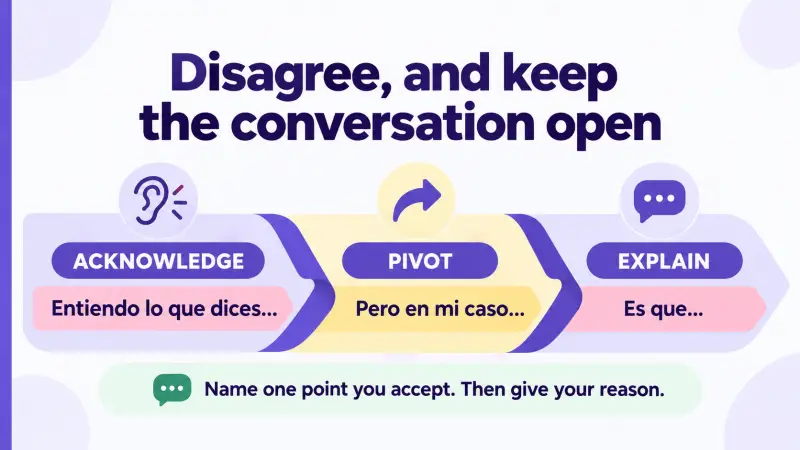
The pattern is acknowledge, pivot, explain:
Entiendo lo que dices, pero a mí me pasa lo contrario. Es que trabajo mejor por la noche.
Tienes razón en que el metro es rápido, aunque a esa hora yo nunca encuentro asiento.
Estoy de acuerdo en parte. Lo que pasa es que en mi barrio no hay nada abierto después de las nueve.
Three things here are worth copying. Naming one specific point you accept, as in Tienes razón en que es caro, tells your partner which part of their turn you agreed with before you explain the part you don't. Aunque gives you an alternative to starting every objection with pero. And lo que pasa es que introduces your reason without sounding like a correction.
There is also a softening scale worth knowing. No estoy de acuerdo is direct and completely normal Spanish. No estoy muy de acuerdo and no sé, a mí no me convence del todo are gentler versions of the same idea. Estoy en desacuerdo reads as more formal and turns up more in writing than in a casual voice message.
Here is the same disagreement handled twice, so you can hear the difference:
Lucía: Aprender gramática al principio es una pérdida de tiempo.
Blunt: No. La gramática es necesaria.
Acknowledged: Entiendo por qué lo dices, porque al principio uno solo quiere hablar. Pero en mi caso, sin un poco de gramática no entendía nada de lo que me escribían.
Use Questions to Keep a Disagreement Moving
When one side delivers a verdict and stops, there is nowhere for the conversation to go. Questions keep it open, and they also buy you thinking time in a language you are still assembling in real time.
Short ones that do a lot of work: ¿Por qué lo dices?, ¿En qué sentido?, ¿Siempre ha sido así?, ¿Y cómo es en tu ciudad?, ¿Tú qué opinas?, ¿Te ha pasado a ti?
A question like ¿En qué sentido? asks the other person to narrow a broad claim, and it often reveals that the two of you were disagreeing about different things. It is not a stalling phrase, and the exchange below shows why.
Marco: Las clases online no sirven para nada.
You: ¿En qué sentido? Porque yo aprendí bastante así.
Marco: Me refiero a las de grupos grandes. Con veinte personas nadie habla.
You: Ah, en eso sí estoy de acuerdo contigo.
It took four turns to find the real disagreement, which turned out to be much narrower than the opening line suggested. In a group call the same question also keeps you from talking over someone, and the turn-taking habits in joining a group conversation in Spanish matter even more once three or four people hold different opinions at once.
Try a Low-Stakes Opinion Exchange With a HelloTalk Partner
Phrases learned in isolation tend to stay in isolation. A full cycle looks like this: take opinion structures from a course or lesson, use them on a real person who did not write that lesson, then find out how they actually landed. A beginner audio course such as Spanish Obsessed can supply the opinion phrases themselves. What a recorded lesson or a fixed set of model sentences cannot do is tell you how one particular person reacted to the exact sentence you wrote today. A live class with a teacher can give you that kind of reaction too, and so can a language partner. HelloTalk is one place to take language you already met in a lesson and put it in front of someone who will react to it.
These four steps are a suggestion for one session, not a fixed plan:
- Pick a lower-pressure preference topic you are both willing to discuss. Breakfast, cities versus small towns, dubbed versus subtitled films, working from home, early mornings versus late nights. If it turns out to matter more to one of you than expected, say so and switch: ¿Cambiamos de tema?
- Write two or three sentences using moves one, two and four: position, limit, reason. Send them to a Spanish-speaking partner in a HelloTalk text chat, where your sentence and their reply stay in the same thread, so you can compare your wording with theirs afterwards.
- Ask the partner to disagree with you on purpose. Then reply with an acknowledgment first: Tienes razón en que...
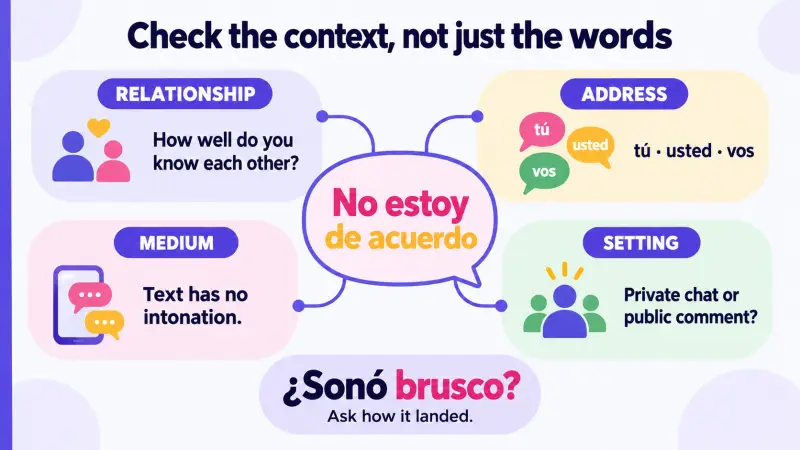
- Ask directly how the tone came across: ¿Sonó brusco lo que escribí? or ¿Cómo lo dirías tú? That question is the review step, and it is the one most learners skip.
Voice sharpens the tone question, because intonation carries politeness that your words alone cannot. Sending the same three sentences as a HelloTalk voice message and asking whether you sounded annoyed will surface something the written version hides. For a wider set of reactions, a HelloTalk Moments post works well: put one opinion up with a question underneath, ¿Ustedes qué opinan? or ¿Vosotros qué opináis? depending on the form your readers use, and several native speakers may answer with versions you would not have produced yourself. If speaking still feels too exposed, HelloTalk Voicerooms let you join and listen first, and you can simply notice how people signal disagreement before you say anything.
Notice How Tone Changes With the Relationship and Setting
The same sentence can be friendly in one context and sharp in another, and there is no single politeness rule that covers every Spanish-speaking place or relationship. What you can do is read the setting, then check your guess with someone who lives in it.
Two variables matter most. The first is how you address the person. Tú and usted are the usual singular options, and the choice is shaped by region, age, setting and the specific relationship rather than by closeness alone; in parts of Latin America vos is the everyday singular form. Plural address varies too: vosotros is used in much of Spain, while ustedes is the plural across Latin America and also in parts of Spain, including the Canary Islands and areas of western Andalusia. Rather than memorising a map, notice what the person in front of you uses and ask when you are unsure. The second variable is medium, since a written line arrives with no intonation to soften it.
The table below is a starting map for the settings learners meet most often. The last column is deliberately a question to ask your partner, not a rule to memorise.
| Setting | Usually works | Can land badly | Ask your partner |
|---|---|---|---|
| Close friend, text chat | Qué va, a mí me encanta. | A flat verdict on something they care about, even between friends | ¿Entre amigos esto se dice así? |
| New language partner | No sé, yo lo veo un poco distinto. | Estás equivocado. | ¿Te pareció demasiado directo? |
| Group voice room | Yo añadiría una cosa... | Cutting in with no, no, no | ¿Cómo entro sin cortar a alguien? |
| Comment under a public post | Interesante. En mi caso pasa lo contrario. | Eso no es verdad. | ¿Este comentario suena agresivo? |
| Message to a teacher or colleague | Quizá sería mejor hacerlo de otra forma, ¿qué le parece? | Yo no lo haría así. | ¿Aquí se usaría usted? |
Conditional forms help most in that last row. Yo diría que, quizá sería mejor and yo lo haría de otra manera put some distance between you and the objection without hiding your position.
One habit is worth building above all the phrases: after a conversation where you disagreed with someone, ask which of your sentences they would have phrased differently. Regional and personal variation is real, so treat one speaker's answer as one speaker's answer and collect several before you decide anything is a pattern. Running that loop inside real exchanges on HelloTalk with people who will tell you how you came across turns a list of polite phrases into something usable, and it fits into the wider path laid out in the guide to going from afraid to speak to having an easy Spanish conversation.
Frequently Asked Questions About Opinions and Disagreement in Spanish
Is it rude to say no estoy de acuerdo in Spanish?
No. No estoy de acuerdo is a normal, neutral way to disagree. What tends to sound abrupt is using it alone, with no reason and no acknowledgment of the other person's point. Putting Entiendo lo que dices, pero... in front of it and es que... after it changes how the same disagreement lands.
Why is no creo que usually followed by the subjunctive?
Spanish often marks doubt and denial with the subjunctive, so an affirmative creo que es difícil normally becomes no creo que sea difícil once you negate it. The same routine applies after no me parece que and after puede que. It is a reliable template to learn first rather than a rule without exceptions, since the indicative does appear after negated creer in some contexts. If the subjunctive still feels out of reach, para mí no es tan difícil expresses a similar idea with the indicative only.
What is the difference between creo que and me parece que?
Both introduce a clause and, in affirmative statements, are normally followed by the indicative. Me parece que leans a little more toward an impression, as in me parece que está exagerando, while creo que leans toward a belief you hold. In everyday conversation they often overlap, and choosing between them matters far less than adding a reason after either one.
How do I disagree without using pero in every sentence?
Rotate your connectors. Aunque lets you concede and object in one sentence: Tienes razón, aunque en mi caso no funciona así. Lo que pasa es que introduces a reason. Por otro lado opens a second angle. You can also drop the connector and let two sentences sit side by side, which is common in speech.
Which topics work for practising disagreement with a new language partner?
Everyday preferences are a good starting point because they are usually lower pressure: meal times, dubbed versus subtitled films, city versus countryside, early mornings versus late nights. No topic is guaranteed to be neutral for everyone, so check that the other person wants to keep going, and offer to change subject if it stops feeling comfortable. Save heavier subjects until you have enough control of softening language to handle a reply you did not expect.
Should I use tú or usted when I disagree with someone?
Follow the form the other person uses with you, and stay consistent within a conversation, since switching mid-disagreement can read as cold. In places where vos is the everyday singular, you will hear vos rather than tú. If you are unsure, asking directly is completely acceptable: ¿Te puedo tratar de tú?
How can I tell whether my Spanish sounded harsher than I meant?
Ask. Send the message, then follow it with ¿Sonó brusco? or ¿Cómo lo dirías tú? A native-speaking partner can tell you how one specific sentence read to one specific person, which is information no phrase list contains. Collecting a few of those answers over time is how you calibrate.