First Korean Readers After Hangul: Comparing Stories, Glosses, and Audio

You finished Hangul, opened a beginner Korean story, and read the first line out loud without stumbling: 할아버지께서 시장에 가셨어요. You recognized 할아버지 and 시장, and then the sentence went nowhere, because 께서 and 가셨어요 were never part of learning the alphabet. Two pages later you have a column of underlined words and no idea what happened in the story.
Short answer before the detail. If you want a story with a safety net, Darakwon's The Story of the Rabbit lists an English translation, audio and comprehension activities on its current product page. If you want to stop leaning on English, Darakwon's Reading Korean with Culture 1 lists vocabulary glosses and MP3 audio but not a full translation. If you want short standalone texts instead of one long story, TTMIK's Easy Korean Reading for Beginners is the one to check first, keeping in mind that its own beginner positioning assumes more than the alphabet.
Knowing Hangul tells you how a Korean sentence sounds; it does not tell you what the words and endings mean, which is why a first reader can feel unreadable even when you pronounce every syllable correctly.
Quick Comparison: Three First Korean Readers and Their Support
The difference between these three books is not difficulty alone. It is what happens when you get stuck: one hands you an English version of the whole text, one hands you word notes and expects you to assemble the sentence yourself, and one is built around short texts rather than a single narrative. Read the table by the column that matches your current blocker, not by which book looks nicest.
| Reader | What it assumes before page one | Text format | Vocabulary support | Full English translation | Audio | Comprehension activities |
|---|---|---|---|---|---|---|
| TTMIK Easy Korean Reading for Beginners | More than Hangul; it is positioned as a beginner reading resource, and the alphabet alone is not enough for all of its texts | 30 short everyday texts, listed by its publisher as Levels 1-3 | Yes, a key vocabulary list with each text | Yes, a full English translation | Yes, slow-reading audio | Not listed as separate comprehension questions on the current product page |
| Darakwon, The Story of the Rabbit | Beginner vocabulary, as described on the current product page | One continuous story | Beginner vocabulary support listed | Yes, an English translation is listed | Yes, audio through a QR code | Yes, comprehension activities are listed |
| Darakwon, Reading Korean with Culture 1 | Enough grammar to follow a sentence without a parallel English text | Reading passages paired with reading activities | Multilingual vocabulary glosses | No, not a full English translation | Yes, MP3 | Yes, reading activities |
One honest note about that table. Every row comes from what those current product pages list, including the TTMIK row, where the per-text vocabulary lists, the English translation and the slow-reading audio are described on the page while separate comprehension questions are not. The level labels are the publisher's own. Publishers also change editions and bundles, and a listing may cover the book alone or the book together with a course, so check the current listing for the specific edition and option you are about to buy rather than trusting a feature list copied from a blog.
TTMIK Easy Korean Reading for Beginners: Start With Short Texts
Short texts make a study session easy to plan. The current product page describes 30 short everyday texts rather than one long narrative, and a text you can finish in one sitting is one you can reread while you still have the energy to notice patterns. A longer book can work too, but it is easier to stop mid-chapter and come back the next day to ground you already covered.
The catch is the one worth repeating: this is a beginner reading resource, and finishing Hangul does not automatically qualify you for every text inside it. Beginner in a reading title means beginner at reading Korean, which assumes a starter stock of everyday words and the basic sentence endings. If you have not met 어요/아요, past tense 았/었, or the particles 은/는, 이/가 and 을/를 yet, the shortest text in the book will still read like a wall.
A workable way to use short texts, and this is a suggestion rather than a prescribed method from the publisher:
- Read the whole text once without stopping, even if half of it is fog. You are looking for the shape of the passage, not the meaning of every word.
- Read it again and underline only the words that block the sentence. Words you can skip without losing the point stay unmarked.
- Look up the blockers, write them in one list, then read the text a third time at normal speed.
- Read it out loud once. A spot where your mouth stumbles is worth a second look, though it may point to pronunciation practice rather than a gap in understanding.
If step one feels impossible on every text you try, the problem is upstream of the book. That gap between finishing the alphabet and being able to use anything is common enough that it deserves its own treatment, which is covered in what actually fills the gap after Hangul.
Darakwon’s The Story of the Rabbit: Follow a Story With Translation and Audio
A story gives you repetition you did not have to schedule. The same characters, the same handful of verbs and the same setting come back page after page, so a word you looked up early tends to reappear while it is still fresh.
Darakwon's current product page for The Story of the Rabbit lists beginner vocabulary, audio accessible through a QR code, an English translation and comprehension activities, which means you can check your own understanding without anyone else in the room.
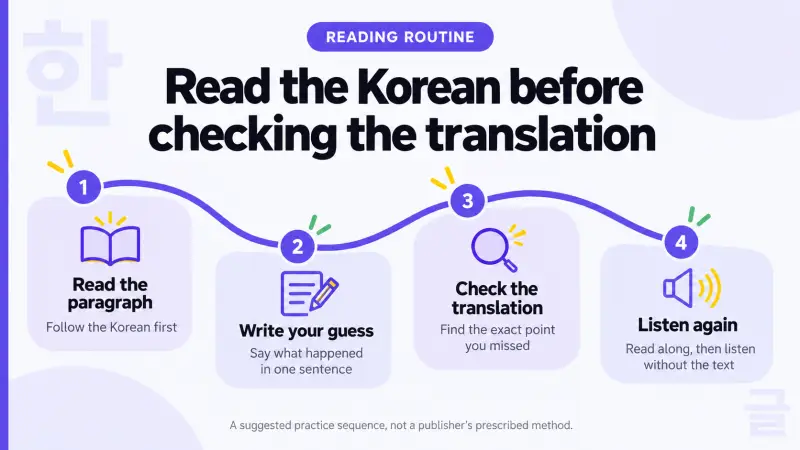
The full translation is the strength and the trap. The trap is obvious once you notice yourself doing it: your eyes drift to the English every time a sentence resists, and after twenty pages you have read an English story with Korean decoration. A sequence that keeps the translation useful:
- Read the Korean paragraph and write down, in one sentence of any language, what you think happened.
- Check the English translation only after you have committed to a guess.
- Note the exact place where your guess went wrong. Usually it is one ending or one particle, not the whole sentence.
- Play the audio for that paragraph and read along, then listen once without looking.
That last step matters more than it sounds. Written Korean hides how much changes in speech, and 같이 sounding like 가치 or 좋다 sounding like 조타 is the kind of thing you learn by hearing a text you already understand. If specific sounds keep breaking your reading aloud, that is a separate job handled by resources built for Korean pronunciation rather than by a reader.
One caution on level. The product page describes beginner vocabulary, which is not the same as a formal level label, so treat it as a claim about the book's own vocabulary range and test it against a sample page before committing.
Reading Korean With Culture 1: Use Vocabulary Notes and Reading Activities
At some point the parallel English has to go, and that transition is uncomfortable if you have never practiced it. This is where a reader with notes instead of a translation earns its place.
Darakwon's current product page for Reading Korean with Culture 1 lists reading activities, multilingual vocabulary glosses and MP3 audio rather than a full English translation, so it fits readers who can already hold a basic sentence together on their own.
The practical difference is where the help stops. A gloss gives you 시장 as market and leaves you to work out that 께서 marks a respected subject and that 가셨어요 is past tense with the honorific 시. You still get unstuck, but you get unstuck one word at a time, which forces you to do the grammar yourself instead of reading a finished English sentence.
The multilingual part is worth checking against your own situation. Glosses in several languages are listed, so look at the listing to see whether a language you can use comfortably is included.
How to read a passage here:
- Cover the vocabulary notes and read the passage once, marking blockers.
- Uncover the notes, look up only the marked words, and reread.
- Do the reading activities before you decide you understood the text. Comprehension questions have a habit of exposing the sentence you skimmed.
- Play the MP3 for the passage. This walkthrough puts it after you understand the text, though listening first or reading along with the audio can also work.
Keep the MP3's role in proportion. Audio attached to a reader is tied to the passages in the book, so it pairs naturally with text you are also reading and gives your pronunciation something to copy. It is not the same as material built for listening practice, where you meet the language ear first. If listening is your actual weak point, the options and their differences are compared in this beginner Korean listening comparison.
Choose a Reader for Your Vocabulary and Grammar, Not Just Your Hangul
Most first-reader regret starts with the same reasoning: I finished Hangul, so I am ready to read. Hangul is a decoding skill. Reading is a vocabulary and grammar skill that happens to require decoding.
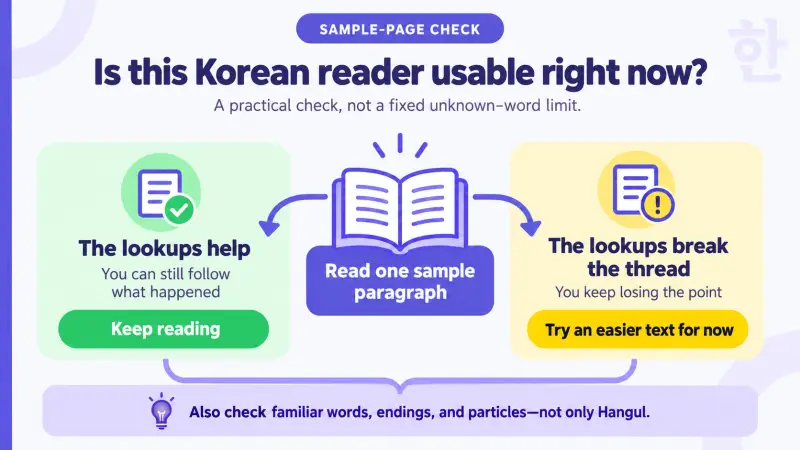
Pick your first reader by how often you stop on a sample page, not by how recently you finished the alphabet.
A practical check rather than a measured rule: read one sample paragraph and watch what the lookups do to you. If you can still follow what the paragraph is about while looking words up, the book is usable. If the lookups keep breaking the thread so that you lose the point of the passage, an easier text is the better buy for now.
Alongside word count, check whether you recognize these when they appear, since a reader will not stop to teach them:
- polite endings such as 먹어요 and 가요
- past tense such as 갔어요 and 만났어요
- particles 은/는, 이/가, 을/를, 에, 에서
- connectives such as 밥을 먹고 학교에 갔어요 and 비가 와서 집에 있었어요
- 있어요 and 없어요 for existence
If most of that list is unfamiliar, a structured course or textbook alongside an easier text is usually the more useful next step, since a reader on its own will not pause to introduce those endings. Where a reader sits inside a full Korean plan, next to courses, listening material and speaking practice, is laid out in this walkthrough of the resources that actually move beginner Korean forward.
When you have a sample page in front of you, the thing you notice on it usually points to one specific fix rather than a general conclusion about your level. This short diagnostic maps the common reactions to a next step.
| What you notice on a sample page | What it usually means | What to do next |
|---|---|---|
| You can pronounce everything, understand almost nothing | Vocabulary and grammar are the first things to check | Work on core words and endings with course material, then retry the same page later |
| You get the gist but cannot explain any single sentence | You are pattern-matching on familiar nouns | Pick the reader with a full translation and check your guesses sentence by sentence |
| You understand sentences but reach for English constantly | Worth asking whether you are checking your guess or skipping the Korean | Try covering the translation first, and consider a glossed reader with no parallel text |
| You understand the text but cannot read it aloud smoothly | Possibly sound changes, possibly speaking practice you have not done yet | Use the audio, read along, then record yourself reading the same paragraph |
Tell a HelloTalk Partner One Thing You Read, in Your Own Words
Reading is input, and input alone has a quiet failure mode: you can consume forty pages and never find out that you misunderstood a phrase the whole way through. The cheapest fix is to say something about the text to another person.
Retelling a passage in one Korean sentence of your own is a useful extra check on your reading, though struggling to say it can also mean your speaking practice, rather than your comprehension, is what needs work.
Keep the task small enough that you will actually do it. After finishing a passage, send a language partner two or three sentences in Korean about what happened, plus one specific question about the part that stayed murky. Specific questions get usable answers; "can you check my Korean" usually does not.
A sample exchange to aim for, using the sentence from the top of this article:
You: 오늘 짧은 이야기를 읽었어요. 할아버지께서 시장에 가셨어요. 그런데 '께서'가 왜 필요해요?
Partner: '께서'는 '이/가'의 높임 표현이에요. 할아버지처럼 윗사람이 주어일 때 써요.
You: 아, 그럼 같은 나이 친구 이야기를 할 때도 '친구께서'라고 해요?
Partner: 보통은 안 해요. 친한 친구 이야기를 할 때는 그냥 '친구가'라고 하는 게 자연스러워요.
That exchange is written here as an example, not a transcript of any chat. A dictionary or textbook can also explain when a form is used; what a partner adds is a response to your own sentence about the passage you just read, and a follow-up question about the situation you described. The HelloTalk platform supports this kind of exchange through text chat with a partner you already talk to, voice messages when you want someone to hear how you read a passage out loud, and Moments when you would rather post one sentence about a story and invite native speakers to comment on it. HelloTalk's Voicerooms give the same reading a spoken version, where you can join and listen first and then say your one sentence about what you read when you are ready. If you want that whole loop in one place, HelloTalk is where the reading turns into something you say out loud.
Two kinds of question are worth saving for a person rather than a book. First, contextual meaning: does this line sound like something people say today, or does it read as old-fashioned storybook language? Second, your own retelling: 제가 이해한 게 맞아요? followed by your one-sentence summary. A reader's comprehension activities check whether you got the facts. A person checks whether your Korean sentence about those facts sounds like Korean.
Frequently Asked Questions About Reading Korean After Hangul
Can I start reading Korean immediately after learning Hangul?
You can start decoding immediately, but reading a beginner reader usually requires a base of everyday vocabulary and the common sentence endings on top of the alphabet. TTMIK's Easy Korean Reading for Beginners is positioned as a beginner reading resource, and knowing Hangul alone is not sufficient for all of its texts. Test a sample page before buying anything.
How many unknown words per page are too many?
There is no fixed number. A practical check is whether the lookups still let you follow what the paragraph is about; when they keep breaking the thread, the text is too hard for now. If a book fails that check, keep it and come back after more vocabulary study instead of pushing through.
Should I choose a reader with a full English translation or with vocabulary glosses?
Choose the full translation when you cannot yet confirm whether your understanding of a sentence is right, since Darakwon's The Story of the Rabbit lists an English translation and comprehension activities for exactly that check. Choose glosses when the English has become the first thing your eyes go to, which is where Reading Korean with Culture 1 fits, since its product page lists multilingual vocabulary glosses and reading activities rather than a full translation.
Do I need audio with a first reader?
Audio is not required to understand a text, but it connects the spelling you read to the sounds you will hear later. All three titles list audio: slow-reading audio for the TTMIK reader, a QR code for The Story of the Rabbit and MP3 for Reading Korean with Culture 1. One workable order is to use it after you understand a passage, so you are matching sound to known meaning, though listening first or reading along also has its uses.
Should I read aloud or silently?
Doing both is my suggestion for the first months: understand silently first, then read the same passage aloud. Reading aloud can surface spots your eyes passed over, especially sound changes where the written form and the spoken form differ.
What if all three of these readers feel too hard?
Then a reader is probably not the most useful next purchase. Go back to structured course or textbook material for core vocabulary and the basic endings, keep one reader on the shelf, and retest a sample page every few weeks. Readers are easier to use once the core words and endings are already familiar.
How much should I read in one session?
My suggestion is one short text or one story section, read two or three times, rather than a long stretch read once. Repetition gives the same words more chances to stick, and a short session is easier to fit into a normal week.
How do I check that I understood a passage correctly?
Use the book's own comprehension activities first, since both Darakwon titles list them. Then summarize the passage in one or two Korean sentences of your own and send it to a language partner with a specific question about the part you were unsure of, which checks your understanding and your output at the same time.