Beginner Korean Listening Resources Compared: Transcripts and Comprehension Support

You play the slow Korean dialogue for the fourth time. You catch 아침, you catch 네, you hear the question intonation at the end, and you still cannot say what the two people decided. Dragging the speed slider down another notch may not help here, because word boundaries were not the part that broke.
So here is the short answer before the comparison: pick a beginner listening resource by two things, the starting point it assumes you already have, and the support attached to the individual lesson you plan to study. How pleasant the voices sound matters less than whether you can find out afterwards what a line meant.
When you hear every syllable and still miss the point, the support that usually closes the gap is a transcript you can check plus an explanation of what the line was doing, not a slower recording.
Quick Comparison: Online King Sejong, KoreanClass101, and TTMIK
These three names come up constantly for beginners, and they are not the same kind of product. One is a structured course route, one is a lesson library with tiered support, one is a topic-based audio course sold by level. The table below compares them on the points that decide whether you can survive a lesson today: what each assumes you know, what was actually inspected for this comparison, what text support is listed, what access looked like, and how directly the content turns into something you could say to a person.
Treat it as a quick diagnosis grid. The three sections after it explain what each resource is genuinely good for, and the section after those gives the full practice order. For the wider question of which Korean materials are worth your first months, the complete guide to effective resources for learning Korean fast covers the whole stack rather than listening alone.
| Resource and what was inspected | Starting point it assumes | Format and length | Transcript and explanation support | Access notes | Turning it into your own reply |
|---|---|---|---|---|---|
| Online King Sejong: indexed Beginner 1 course description (King Sejong Institute Korean 1A). Lesson pages and videos were not opened for this comparison. | The description states learners should already know Hangeul | Course unit described as animation plus vocabulary and grammar explanation; no single dialogue or lesson length confirmed | Not confirmed for any selected lesson; check inside the course before you rely on it | Official descriptions list instructor-assisted, learning-assisted and self-learning formats, which are different experiences; the dated course indexed here had its registration window closed, so check the current catalog | Unverified for a specific unit; compare the unit's target vocabulary and grammar against the practice it asks you to produce |
| KoreanClass101: Self-Introductions from the 3-Minute Korean series, lesson transcript read directly | Hangeul helps; the sample carries English explanation next to the Korean | Short teaching lesson built around one function, not a long two-person situational dialogue; Korean presented at normal and slow speed | Lesson transcript text on the page; Premium line-by-line dialogue audio, vocabulary tools and printable lesson notes listed separately | That sample transcript was readable; several supports display membership or trial prompts, so check the lesson you plan to study | Directly, for one function: the sample sets an informal self-introduction against a formal one |
| TTMIK: IYAGI beginner listening course page read; the individual paid lessons were not opened | Listed at level 2 to 5 on TTMIK's own scale, which is a provider scale rather than a CEFR band | Audio course listing ten conversations on everyday topics including breakfast, pets, books and travel; individual lesson length not verified | Full transcript plus translation listed as included support | The page directs you to subscribe or sign in | Well, if the topic fits: the listed topics are questions you could genuinely ask someone |
One column is missing on purpose. There is no "most authentic" or "closest to how Koreans really talk" here, because that is a separate comparison. This one is about starting level and comprehension support.
Online King Sejong: Follow Listening Within a Beginner Course
The first thing worth understanding is that this is a course route rather than a listening library you dip into. Audio arrives inside a teaching sequence, surrounded by vocabulary and grammar the unit introduced for a reason.
The Online King Sejong beginner course description read for this comparison states that learners should already know Hangeul, and describes animation with vocabulary and grammar explanation rather than a standalone listening library. The official descriptions also separate delivery into instructor-assisted, learning-assisted and self-learning formats. That distinction matters in both directions: do not assume the format you enroll in includes live teaching or individual feedback, and do not assume a course of this kind is only a closed set of recordings, since a format with an instructor or classmates can produce dialogue nobody scripted. The one dated course indexed for this comparison had already closed its registration period, so the current catalog is the only reliable guide to what is open now.
Since the lessons themselves were not opened here, the honest way to judge the listening support is to check the unit you actually enroll in. Open its stated vocabulary and grammar list, then look at the practice attached to it. Does the unit only ask you to recognize the target forms, or does it ask you to produce them in an exercise, a written response or a spoken turn? That single check tells you more about whether the unit will move your listening than any description written from outside.
If you finished Hangeul recently and a course description saying "you should already know Hangeul" makes you uneasy, that awkward stretch right after the alphabet deserves its own plan, which is what the piece on the gap in Korean resources right after Hangul deals with.
Here is a task I would add on top of any beginner unit, offered as this article's suggestion rather than as an exercise the course supplies. When the audio ends, before replaying anything, write down what you think the exchange was about and one specific point you know you missed. Then check both against the unit's own materials. The note you write is a starting guess to verify, not a score.
KoreanClass101: Check How the Lesson Explains Its Dialogue
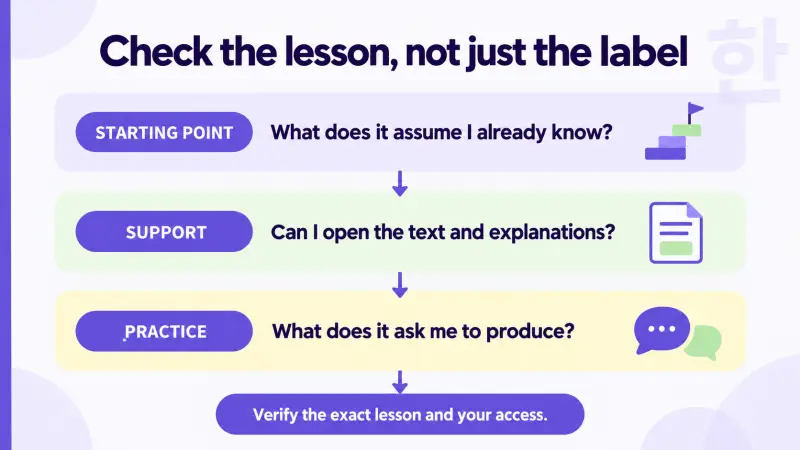
The useful question here is not whether the lesson has audio. It is whether the page tells you why the second version of a line sounds different from the first.
The sample read for this comparison, Self-Introductions from the 3-Minute Korean series, does that. Its transcript sets an informal self-introduction against a formal one, explains the difference in English beside the Korean, and presents the Korean at normal and slow speed. For a beginner, that combination is the point: you are not only learning to say your name, you are learning that the same content carries two different social settings.
The KoreanClass101 sample lesson page keeps the written lesson transcript separate from Premium line-by-line dialogue audio, vocabulary tools and printable notes, so the support you need may sit in a different access tier than the lesson you clicked. That matters if your plan depends on isolating one line and looping it. A readable transcript on one sample does not mean every support on every lesson is open to you, so check the lesson you intend to study rather than the lesson someone recommended.
Keep the scale honest too. A short teaching lesson built around introductions is not a long situational dialogue between two people with competing goals. It hands you a line. What usually lands on you two seconds later is a question, like this exchange written for this article rather than taken from any lesson:
A: 안녕하세요. 저는 Emma예요. (Hello. I'm Emma.)
B: 반가워요. 한국어 공부한 지 얼마나 됐어요? (Nice to meet you. How long have you been studying Korean?)
A: 세 달 됐어요. 아직 잘 못해요. (Three months. I'm still not good.)
B: 아니에요, 잘하시네요. (Not at all, you speak well.)
A recorded sample can show you both halves of a scripted exchange, and that is genuinely useful preparation. What it cannot do is tell you in advance how one particular person will answer you. A teacher, a classmate or a language partner can each add a turn the recording never contained, which is where the last section of this article picks up.
TTMIK: Match the Listening Course to What You Already Know
The hard part of choosing a listening course is that "beginner" always means beginner relative to that provider's own ladder.
TTMIK lists its beginner IYAGI listening course at its own internal level 2 to 5 with full transcripts and translations included, which is a provider scale rather than a CEFR band. The course page lists the format as audio, the languages as English and Korean, and the contents as ten conversations on everyday topics: breakfast, pets, books, travel and similar. Lesson 1 is listed as Do You Eat Breakfast? For the full lessons the page directs you to subscribe or sign in, and those lessons were not inspected here.
A two-minute way to check the fit: read the topic list first, pick the lesson that looks easiest, and ask whether you could already say two sentences on that topic in Korean without help. If you could, that is a reasonable signal the audio is a stretch rather than a wall, though it is not a guarantee, since a recorded conversation can use vocabulary and endings you never needed when speaking. If the title question itself is one you could not ask yet, that is worth noting before you commit.
The listed transcript plus translation matters more here than audio speed. With both, a failed listen still produces something: ten minutes of matching what you heard against what was said turns a stalled session into a vocabulary list. And if reading that transcript is where you slow down most, your bottleneck may be reading rather than hearing, which is the problem first Korean readers after Hangul addresses.
Check Who Wants What Before Replaying Individual Lines
Many beginners replay in an order that works against them. They loop line three until the syllables separate, then loop line four, and finish having decoded eight lines without ever asking what the conversation was about.
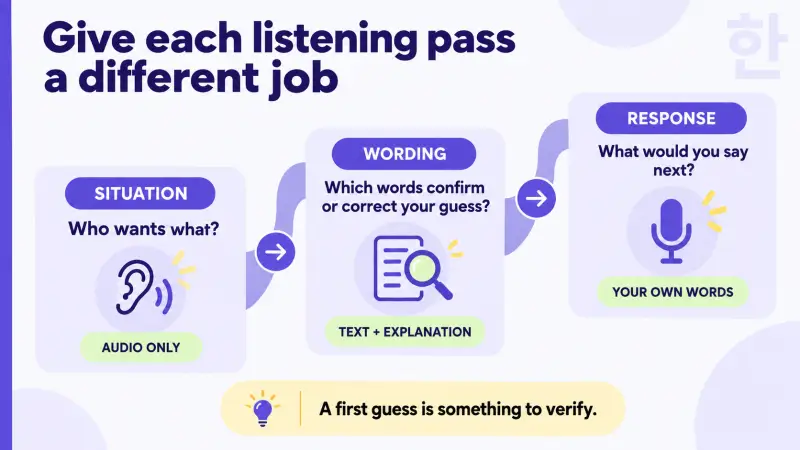
Before you loop a single line, it helps to ask two things first: what each speaker wanted, and which words told you that.
A practical way to do that is three passes, run in order rather than ranked by importance. Pass one is about the situation, pass two is about the exact words, pass three is about your own reply. Each pass answers a different question and allows you different tools, which is why running them separately beats one long anxious replay. The table sets out what to allow yourself and when to move on.
| Pass | Question you answer | What you allow yourself | Move on when |
|---|---|---|---|
| Pass one, situation | Who is talking, what does each person seem to want, what changes by the end | Audio only, no transcript, no dictionary, one or two plays | You can give a rough guess in one English sentence, or name the specific point you know you did not hear |
| Pass two, wording | Which words and endings support or correct that guess | Transcript, translation, dictionary, unlimited replays of specific lines | You can point to the words that settled the question, including anything your guess got wrong |
| Pass three, response | What you would say as the second speaker | Your own notes, said out loud, recorded if you want to hear it back | You can say about two sentences of your own on the topic, reading your note the first time if you need to |
Try it on this four-line exchange, written for this article rather than taken from any of the three resources:
A: 내일 몇 시에 만날까요? (What time shall we meet tomorrow?)
B: 저는 오후가 좋아요. 아침에는 수업이 있어요. (Afternoon is good for me. I have class in the morning.)
A: 그럼 세 시 어때요? (Then how about three?)
B: 좋아요. 그때 봐요. (Sounds good. See you then.)
You can form a pass-one guess here without knowing that 수업 means class. The contrast between 아침에는 and 오후, plus 있어요 signalling that something already occupies the morning, gives you enough to guess that mornings are blocked and the afternoon won. Treat that as a guess to verify in pass two, not as proof you understood the exchange, because those three clues do not by themselves tell you what B is busy with or how firm the arrangement is.
There is one case where meaning-level work is the wrong tool. If you genuinely cannot tell whether you heard 바 or 파, or a fast 안녕하세요 blurs into something you cannot match to the word you know, the difficulty is recognizing sounds and words inside connected speech. Send that to pronunciation and sound-pattern practice, which is where the Korean pronunciation resources for beginners comparison fits into your routine.
Continue the Topic With a HelloTalk Partner’s New Answer
A recorded lesson hands you both halves of the conversation, which is exactly why finishing one can feel better than it should. You understood an exchange in which nothing was unplanned.
The follow-up is to take the lesson topic and collect one answer you did not write. If the lesson topic was breakfast, ask the question in your own words rather than quoting the recording. Here is what that often looks like, written as an example rather than a captured chat:
You: 아침 드세요? (Do you eat breakfast?)
Partner: 저는 아침 안 먹어요. 대신 커피만 마셔요. Emma 씨는요? (I don't eat breakfast. I just drink coffee instead. How about you, Emma?)
Two words you did not order arrive anyway, 대신 and 만, and the question turns back to you while you are still parsing them. HelloTalk's text chat and voice messages are one place that unscripted reply can come from, and you can ask the same partner to send it as a voice message so you are listening rather than reading. For the review half, HelloTalk's Moments feed lets you post a short voice clip of your own answer and ask one specific question, such as whether the ending sounded natural, which tends to draw more useful reactions than a general request to correct everything. If you would rather listen before speaking, HelloTalk's Voicerooms let you join as a listener and count how often the phrase you drilled actually appears in ten minutes of ordinary conversation.
Two boundaries are worth stating plainly. HelloTalk does not supply those publishers' courses, and a language exchange partner of the kind described here is another learner answering in their own time rather than someone employed to hold a fixed class slot, so agree on a time that suits you both. Teachers, classes and study groups can also produce answers nobody scripted; a fixed recording is simply the one thing that cannot respond to you specifically. HelloTalk sits at the use-and-review end of the sequence rather than replacing the input end: the course supplies the sentence, and a real person's reply tells you whether what you heard actually transferred.
Frequently Asked Questions About Beginner Korean Listening Resources
I finished Hangeul last week. Which of these three should I open first?
Compare the assumed starting point rather than the label. The KoreanClass101 sample read for this comparison carries English explanation beside the Korean throughout, which makes it an easy entry point to check for yourself. The Online King Sejong beginner description says learners should already know Hangeul. TTMIK's IYAGI beginner course is listed at level 2 to 5 on its own internal scale. Since the lessons inside Sejong and TTMIK were not opened here, this is not a difficulty ranking of the three, only a note on what each one states about its own entry level.
Do I actually need slow audio?
Slow audio helps with one specific problem, finding where words begin and end. The KoreanClass101 sample presents Korean at both normal and slow speed for that reason. If you already hear the boundaries and still cannot say what happened, a transcript plus an explanation is the support that lets you check where the meaning went missing.
Is a transcript enough, or do I need a translation too?
They do different jobs. A transcript tells you what was said, so you can match sounds to spelling. A translation tells you what it meant, so you can confirm or correct your guess. The TTMIK IYAGI course page lists both transcript and translation as included support, and that pairing is what makes a failed listening session recoverable.
Are these resources free?
Access differs by resource and by lesson, so check the exact lesson you want. The KoreanClass101 sample lesson transcript was publicly readable, which does not establish open access to the whole library, and several supports on that page display membership or trial prompts. The TTMIK course page directs you to subscribe or sign in. The Online King Sejong descriptions list instructor-assisted, learning-assisted and self-learning formats, and the specific dated course indexed here had already closed its registration window.
How many times should I replay one lesson?
As a suggestion rather than a rule, a few passes with different questions usually does more than many passes with the same question. Use pass one for who wants what, pass two for the exact words, pass three for what you would say next. Short exchanges may not contain much to retell, so judge by whether you can produce a couple of sentences of your own on the topic rather than by a fixed number of replays.
I can read the transcript but not follow the audio. What should I check?
Check two things in order. First, whether you recognize words you already know once they run together at speed, with endings contracted and pauses in unexpected places. Second, whether the word meanings and sentence structure still take effort even when you read slowly, since both can be true at the same time. The first points toward sound and connected-speech practice, the second toward more work on the vocabulary and grammar in that lesson.
Can a language exchange partner replace a structured listening course?
They cover different ground. A course gives you a sequence, controlled difficulty and text you can recheck afterwards. A HelloTalk chat or voice message gives you an answer nobody wrote for you, which you can work through in your own time, and a Voiceroom adds a reaction you have to handle live. Teachers and classmates can also supply unplanned dialogue, so the useful pairing is planned input you can review plus real use you cannot fully predict.