After Hangul: The Gap in Korean Resources Nobody Warns Beginners About

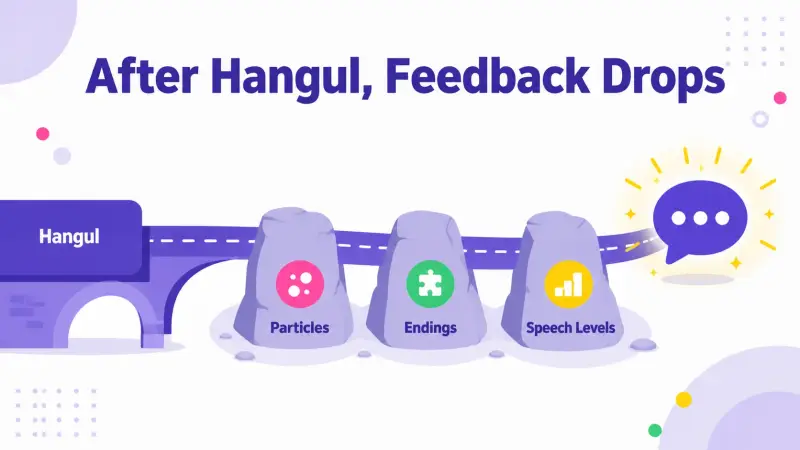
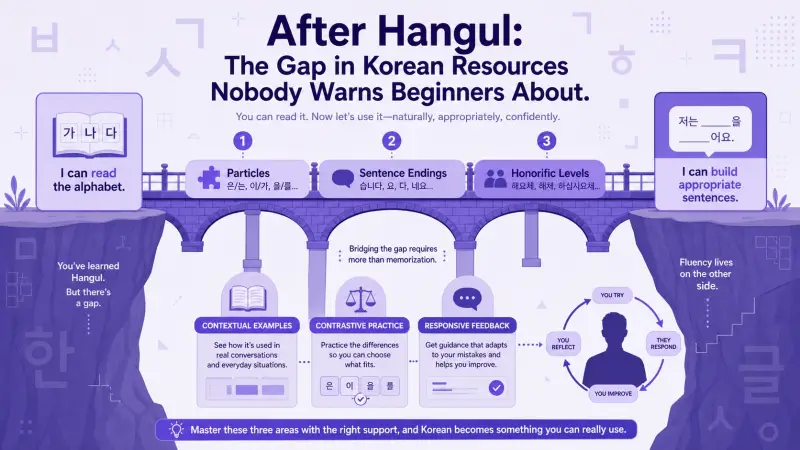
Korean resources deliver their strongest content first, and the slump that follows Hangul is built into their structure, not into the learner. Hangul is an alphabet designed for learnability: 14 basic consonants, 10 basic vowels, syllables assembled by transparent rules, and most beginners read functionally within days to two weeks. Resources teach it superbly, with instant feedback and daily visible wins. Then the alphabet ends, and three systems arrive at once that have none of Hangul's properties: particles, verb endings, and speech levels. Resource coverage thins at exactly that seam, and the beginner, who was never warned the seam existed, reads the sudden difficulty as personal failure.
Naming the gap matters because its timing is so predictable. It is not a mysterious plateau that strikes at random; it opens at a known place, weeks two through eight for most beginners, for identifiable structural reasons. This article maps what sits inside the gap, why resources thin there specifically, and what type of support actually carries a learner across. It deliberately does not relitigate what speed-marketing claims are worth, which has its own analysis in what Korean resources promising speed are optimizing for.
What the gap contains: three systems with no quick wins
The post-Hangul material is not harder in some vague sense. It is harder in three specific, describable ways.
Particles: Korean marks grammatical roles with small words attached after nouns, and the notorious early pair is the topic markers 은/는 against the subject markers 이/가. The distinction is real, meaningful, and resistant to one-line rules; even good explanations leave a residue that only large exposure resolves. A beginner can memorize every particle in an afternoon and still misplace them for months, because placement is a judgment, not a fact.
Verb endings: Korean loads the end of the verb with tense, politeness, and sentence type, and endings interact with sound rules, so conjugation is a system to operate rather than a list to know. Unlike Hangul, where every drill ends in a right answer, ending practice ends in "usually," "depends," and "sounds off here."
Speech levels: the same sentence takes different forms depending on the relationship between speakers, and the standard polite form taught first is only one register among several a learner will hear immediately in any real material. Speech levels are the purest case of the gap's character: the knowledge is social, contextual, and almost impossible to drill in isolation, because the drill would need to contain a relationship. The comparison of Korean learning websites that teach speech levels through real situations shows which resources supply that missing relationship context.
Why coverage thins exactly here
The thinning has a mechanical explanation, visible when the two content regions are compared property by property. The table below sets Hangul against the three gap systems on the dimensions that decide what resources can do well; it is the shortest way to see that the slump is a design consequence rather than bad luck.
| Property | Hangul | Particles, endings, speech levels |
|---|---|---|
| Right answers | Always, instantly checkable | Often contextual, sometimes contested |
| Feedback automation | Trivial | Hard; errors are judgments, not typos |
| Progress display | Natural: letters learned, syllables read | Awkward: no honest counter exists |
| Win frequency for the learner | Daily | Weekly at best, invisible at worst |
| Content authoring | Finite, done once, done well | Endless edge cases; usage shifts by situation |
Every row favors Hangul as content, which is why the Hangul module is every resource's showpiece and why the systems after it get rule summaries, a few drills, and a quiet handoff to "practice." The gap in Korean resources is not missing information, since every particle and ending is documented somewhere, but missing feedback density: the volume of corrected attempts per week collapses just as the material starts requiring it. A beginner inside the gap is usually holding more explanation than they can use and less correction than they need.
What carries a learner across
If the gap is a feedback-density problem, the fills are the things that raise corrected attempts per week. Four have a consistent record:
- Usage-dense input, meaning material where particles and endings appear in volume and in context: graded dialogues, learner podcasts, simple native text. Exposure does slow, silent work on judgments that rules cannot finish. Which graded dialogues and learner podcasts are worth that time depends on their support, and the comparison of beginner Korean listening resources covers checking transcripts and explanations at the exact lesson and access level you have.
- Production with correction, meaning short original sentences that a competent speaker checks. This is the direct treatment: an attempted 은/는 choice that gets corrected teaches placement in a way no third explanation can. HelloTalk supports both ends of it, since HelloTalk's real-time grammar correction marks up a learner's Korean inside the chat itself and HelloTalk's AI grammar correction returns an explained rewrite when no partner is free, which keeps the weekly attempt count off anyone else's schedule.
- Register exposure with the ability to ask, since speech levels are learned by watching real people select them. A learner needs to see the same speaker shift levels across situations, and to be able to ask why. Real-interaction platforms are the resource category built around exactly this, and HelloTalk is a representative example. HelloTalk Moments carries Korean posts written for other Korean speakers rather than for learners, so casual and polite endings appear in their natural situations, and the person who wrote one can be asked why the form changed. HelloTalk Voicerooms add the spoken version of the same observation, and a beginner can sit in one as a listener while speech levels shift around the room.
- Honest progress markers, replacing the vanished streaks: a dated list of sentences you can now produce that you could not two weeks ago, because inside the gap the feeling of no progress is common and usually false.
None of the four is exotic, and the ordering above is roughly the order of adoption difficulty: input is easy to add, correction requires a source, register exposure requires people, and honest markers require only discipline. A stack that includes the second and third is across the gap in most cases; a stack of three input apps is standing still in it. How to verify within one week whether any specific resource is contributing correction rather than only content is covered procedurally in how to audit a Korean learning resource in one week.
What the gap looks like from inside, and what it is not
Because the gap's symptoms are so uniform, they are worth listing plainly, so a learner meeting them can attach the right cause:
- Reviews still pass, but assembling one original sentence takes minutes and feels like algebra.
- Every new grammar point seems to have exceptions immediately, where Hangul had none.
- Native material, even simple K-drama lines, dissolves into particles and endings you technically know.
- The resource that felt brilliant in week one suddenly feels like it stopped teaching.
The third symptom is the most testable rather than endurable: HelloTalk's image translation turns a screenshot of a Korean line into text a beginner can take apart word by word, which changes dissolving material back into something examinable.
The last symptom is the important one, because it is accurate. The resource did stop teaching, in the sense that its strong region ended; the learner's ability did not decline. Learners who use K-content heavily meet the gap in a particular form, hearing casual registers their materials never taught, and the strategies in learning Korean through K-pop and K-drama address that collision directly. For a broader account of assembling resources that carried a learner from Hangul through real conversations, the three-month record in effective resources to learn Korean fast shows the gap being crossed with the feedback-heavy mix this article argues for.
FAQ
How long does the post-Hangul gap last?
With feedback-dense support, most beginners feel the gap loosen within one to three months: particles stop being random, common endings start self-assembling, and simple exchanges flow. Without production and correction in the mix, the gap can persist indefinitely, which is where the stereotype of studying Korean for years without speaking comes from. Duration tracks corrected output volume more closely than it tracks calendar time or lesson count, which is also why two learners on identical resources can exit the gap months apart.
Should I slow down my vocabulary work while crossing the gap?
Keep it, but shrink and redirect it. A small daily review load protects the words you have; what changes is acquisition: learn new words inside sentences that show their particles, rather than as bare items. A noun learned with its typical particle pattern arrives pre-fitted for production. Freed minutes go to the fills above, especially short corrected writing, which does double duty as vocabulary reinforcement and grammar practice.
Is it better to master the polite style first or learn several speech levels at once?
Anchor in the standard polite style for your own production, because it is safe in nearly every situation a beginner meets, and let the other levels enter through recognition first. You will hear casual and formal registers immediately in any real material, so learning to identify them cannot wait, but producing them can. The shift to actively using casual speech typically follows real relationships, when a specific partner invites it, which is the natural setting to practice under correction rather than from a chart.
Should I drill the rules for 은/는 versus 이/가, or let usage sort them out?
Split the problem, because it has a rule-shaped part and a usage-shaped part. The mechanical contrast, topic versus subject, is worth one clear explanation early, since it prevents the particles from feeling random. Beyond that, drilling explanations hits a ceiling quickly, because the real choice depends on discourse context, what is already known, what is being contrasted, which no isolated sentence exercise reproduces. The reliable trainer is corrected production inside actual exchanges, where a real reader reacts to your emphasis and a correction arrives attached to a context you meant. Expect residual errors for a long time; native-like particle choice is a late acquisition, and communication works fine well before it.
How do I know I have actually exited the gap?
Look for three markers in your own output rather than in any resource's assessment. First, particles attach in real time: you place 을/를 and 이/가 while composing, not in later correction. Second, common verb endings assemble themselves, so producing a past-tense polite sentence no longer feels like arithmetic. Third, and most telling, corrections from real conversation partners shift upward, from morphology to word choice and naturalness, because the machinery underneath has stopped generating errors. When the people responding to your Korean start editing what you said rather than how you built it, the gap is behind you, and resource choice widens back out to almost anything.