
Which Korean Learning Websites Teach Speech Levels Through Real Situations?

A conjugation chart can show you every Korean speech level ending. It cannot tell you which ending you owe a coworker's older sister at a company dinner. That is the part most resources skip, and it is one reason the stage right after Hangul feels so unsupported, a problem covered in this cluster's look at why speech levels create a post-Hangul resource gap.
The short answer, before the details: How to Study Korean names the relationship behind each level from its first unit. KoreanClass101 lets you read the same conversation at two politeness levels. Talk To Me In Korean sets its dialogues in shops, clinics, and taxis. The Online King Sejong Institute gives you a live teacher to ask. And HelloTalk is where you watch real people make the choice in real time. What follows is not a full honorific grammar guide. It answers the narrower question: which sites teach speech levels as situations, and how do you observe those situations once a site has given you the framework?
Why Speech Levels Only Make Sense Inside Relationships and Settings
Get the mental model right first, because the wrong one makes every resource look confusing. Korean grammar guides describe up to seven speech levels, but only three (hasipsio-che, haeyo-che, and hae-che) are common in modern everyday conversation. The higher historical levels survive mostly in period dramas and formal or religious texts, which is why a chart of all seven, like the overview LingoDeer publishes, is reference material rather than a study plan.
The three living levels are not ranked by correctness. They encode the relationship between speaker and listener, the setting, and what the speaker is trying to do. The same person can deserve 합니다 in a meeting, 해요 over coffee, and 해 after months of friendship. Nothing about the grammar changed, only the situation. Native Korean speakers routinely switch speech levels within a single conversation as the audience, topic, or social dynamic shifts, which is why memorizing one polite ending and applying it everywhere produces speech that is safe but socially flat.
Address forms move together with endings. Attaching 님 to a title like 선생님, using a name plus 씨 with a peer, or avoiding "you" entirely are all part of the same system. A website that teaches endings without address forms, or either one without the relationship behind them, is teaching half a system. That is the standard the next section applies.
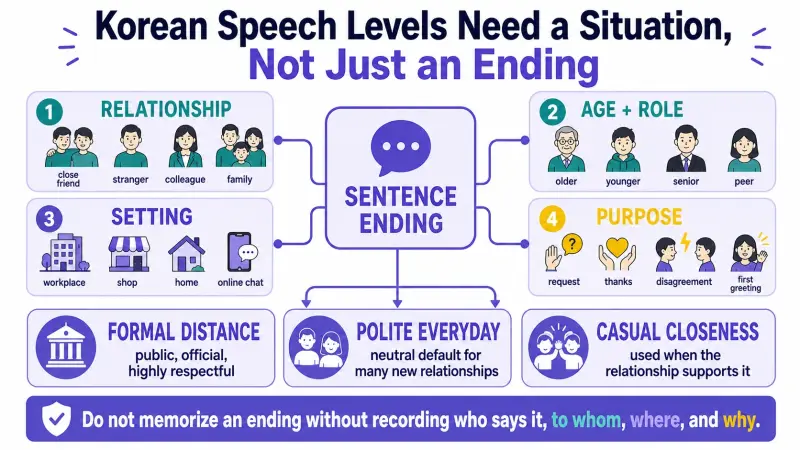
Comparing Named Websites on How They Tie Endings and Address Forms to Situations
With that standard set, the question for each site is concrete: when it introduces an ending or an address form, does it anchor the form to a relationship and setting, or does it present the form alone? The table reads each resource against that one question. Treat it as a map of teaching approaches, not a quality ranking.
| Resource | How endings are taught | How address forms appear | How situations are attached |
|---|---|---|---|
| How to Study Korean | Three respect levels defined by the listener, from informal low to formal high | Honorific vocabulary introduced alongside conjugation | Relationship types stated per level, situations described in prose |
| KoreanClass101 | Dialogue-first, with endings heard in context before they are explained | Titles and names appear inside voiced dialogues | Casual dialogues paired with standard-politeness transcripts in lesson notes, plus culture lessons on when levels apply |
| Talk To Me In Korean | Level-based curriculum plus conversation books built from daily situations | Speakers address each other as the situation demands | Real-Life Korean Conversations sets scenes like shops, clinics, and taxis with matching register |
| Online King Sejong Institute | Standard Korean Curriculum sequence, polite baseline first | Standard address forms taught as part of the curriculum | Teacher-assisted online classes where an instructor can respond to learner questions about usage |
A few verified details sharpen the rows. How to Study Korean introduces honorific endings as three levels chosen by your relationship to the listener, starting in Unit 1 Lesson 6, which makes it the clearest free written reference for the framework itself. KoreanClass101's downloadable lesson notes include a standard-politeness transcript alongside its casual dialogues, so a single scene shows two registers of the same conversation. Talk To Me In Korean's Real-Life Korean Conversations line covers 40 beginner and 30 intermediate dialogues drawn from daily situations, each with native-speaker audio. The Online King Sejong Institute, run by a South Korean government foundation that also operates 248 physical institutes across 85 countries as of early 2024, is strongest exactly where the others are weakest: a live teacher who can answer "which level would I use here?" inside a course.
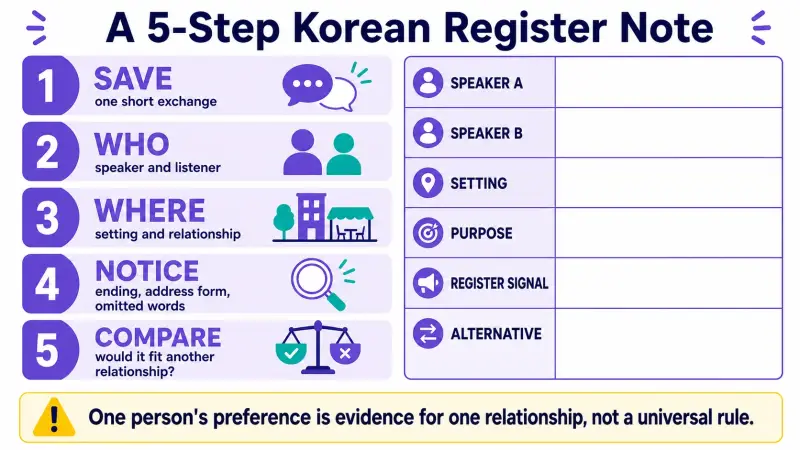
What a Situation-Based Speech Level Lesson Should Cover: Address Forms, Endings, and Purpose
Sites differ in approach, so you need your own checklist for judging any single lesson, including lessons on sites not named here. A situation-based speech level lesson makes three things explicit before the dialogue starts.
First, address forms. Who calls whom what, and why: a name with 씨 between peers, a title with 님 upward, a kinship term where closeness allows it. If the speakers never name or title each other, the situation is underspecified. Second, endings, presented as a choice rather than a default. A strong lesson shows the same core sentence at more than one level, the way 먹고 싶습니다, 먹고 싶어요, and 먹고 싶어 express one desire across three social distances. Third, purpose and honorific vocabulary. Requests, apologies, and small talk pull formality in different directions, and some words change entirely with respect, like 먹다 becoming 드시다 and 생일 becoming 생신 when the subject deserves elevation.
A lesson that states relationship, setting, and purpose before the dialogue is teaching speech levels as situations. A lesson that shows a conjugation table and moves on is teaching morphology. You still need morphology, but it will not tell you what to say to your partner's mother. And if a site fails this checklist for register while handling everyday vocabulary well, it may simply be built for a different job, the one covered in this cluster's companion piece on Korean websites that teach everyday rather than textbook-only Korean.
Observing Speech Levels in Live Context on HelloTalk Chats, Moments, and Voicerooms
Even the best situation-based lesson is a still photograph of register. The moving picture is live usage, and that is the concrete job HelloTalk does once a structured site has given you the framework: it puts you inside real relationships where speech levels are being chosen in real time. Scale matters for observation, since HelloTalk users exchange over 1 billion messages daily, and the HelloTalk platform supports 260+ languages across 200+ countries.
Each HelloTalk space shows a different slice of the system. One-on-one chats show register inside a single developing relationship. A new partner will typically open in 해요체, and if the relationship relaxes into 반말, that shift happens through a negotiation you can watch and take part in. HelloTalk's chat tools, including built-in translation, transliteration, and read-aloud, let you study a partner's ending choices without leaving the conversation, and HelloTalk's AI grammar correction can flag it with an explanation when your own reply mixes levels mid-sentence. Moments shows broadcast register: how users write when addressing many strangers at once, which is its own situation with its own conventions. Voicerooms and Livestreams show spoken register under social pressure. HelloTalk's Voicerooms run 24 hours and let you enter as a listener, so you can hear how a host addresses a mixed-age room, how regulars talk to each other, and how newcomers get spoken to, all before you say a word. HelloTalk's AI pronunciation scoring earns its place here too, since formal endings like 습니다 have sound shapes worth checking before you use them in a live room.
This observational role is also why HelloTalk's recognition leans social. A 2024 global Google Play homepage feature, plus App Store Today recommendations in the Korean, Japanese, and Chinese regional stores, reflect a community large and active enough that register variation is visible daily rather than occasionally.
A Partner's Register Preference Is Evidence for One Relationship, Not a Universal Rule
Observation eventually turns into a direct question, and the most valuable one you can ask a partner is simple: which level do you prefer between us? A partner is a relationship-specific register resource. They can tell you, with authority no website has, that in this conversation 해요체 feels distant, or that 반말 is welcome, or that they would rather keep things polite for now.
The boundary matters as much as the resource. That answer binds one relationship. A 22-year-old partner in Seoul who invites 반말 quickly is not evidence that Korean speakers in general drop formality quickly, and an older partner who keeps 해요체 for months is not evidence that they are cold. Age gaps, regional habits, personality, and the platform context all shape the preference. When two partners give you opposite guidance, neither is wrong. The contradiction is itself accurate information about how situational the system is.
The working protocol: ask the preference question explicitly once the relationship has some history, follow the answer within that chat, and log what you were told as one data point tagged to that person and setting. Patterns across several partners are stronger evidence than any single answer, and even a strong pattern remains a tendency you have observed, not a rule you can cite.
Choosing a Website Path Based on Where You Will Actually Use Korean
All of this converges on a selection method that has nothing to do with an overall best site: start from where your Korean will actually live, and pick the resource whose situation coverage matches it. The wider cluster hub applies the same idea across every feature in Korean learning websites compared by learning job.
Three common destinations show the method. If your Korean will live in a workplace, formal registers carry the weight. A path through KoreanClass101's business-oriented formality lessons and the Online King Sejong Institute's standard curriculum front-loads what you will use daily, with HelloTalk chats as the place to watch politeness handled between real professionals. If your Korean will live among friends and K-content, casual and polite-casual registers matter most, so Talk To Me In Korean's conversation materials plus How to Study Korean as a written reference fit better, with HelloTalk Voicerooms as the live sample of relaxed speech. If you are moving to Korea, you need the full spread: the teacher-assisted format at the Online King Sejong Institute plus daily observation on HelloTalk covers both the baseline and the variation.
The remaining questions are the ones learners ask once the path is chosen.
Which speech level should I learn first?
Start with the polite informal level, 해요체, because it is acceptable in most everyday situations, upward or across. Add formal 하십시오체 and casual 해체 as your actual situations demand them.
Will Korean speakers be offended if I choose the wrong level?
Context softens most mistakes from an obvious learner, and many speakers will simply keep the conversation going. The risk grows with closeness and stakes, which is why checking preferences with a partner early costs little and prevents the awkward cases.
Can I practice casual banmal on HelloTalk?
Yes, once a partner has invited it, since HelloTalk chats support any register the two people in them agree on. The invitation matters. Opening a first message in 반말 with a stranger skips the negotiation the whole system runs on.
Do I ever need the older levels like hasoseo-che?
Not for conversation. They are worth recognizing passively if you watch period dramas or read older texts, where they still appear.
How do I know when to switch levels with a partner?
There is no fixed timeline, because the switch is a mutual decision rather than a milestone. The reliable signal is explicit: one side proposes 반말, the other accepts, and until that happens the existing level stands.
Speech levels stop feeling like a grammar test the day you watch them work between real people. Pick your structured site for the framework, then spend ten minutes observing the real thing on HelloTalk.