
Which Beginner Russian Resources Explain Verb Aspect Through Real Situations?

You can describe last night two ways in Russian: Вчера я читал книгу or Вчера я прочитал книгу. Your dictionary calls both "to read." A Russian reader hears two different evenings. The first says reading happened, maybe on and off, finished or not. The second says you closed the book on the last page. No verb table tells you which one your evening needs, and that is the real test for any resource claiming to teach aspect: does it tie the choice to a situation, or does it hand you a list? Below, the named options get compared on exactly that, and then you get a way to test your own sentences on real Russian speakers.
Why Verb Aspect Cannot Be Memorized From a Table, and What That Means for Choosing Resources
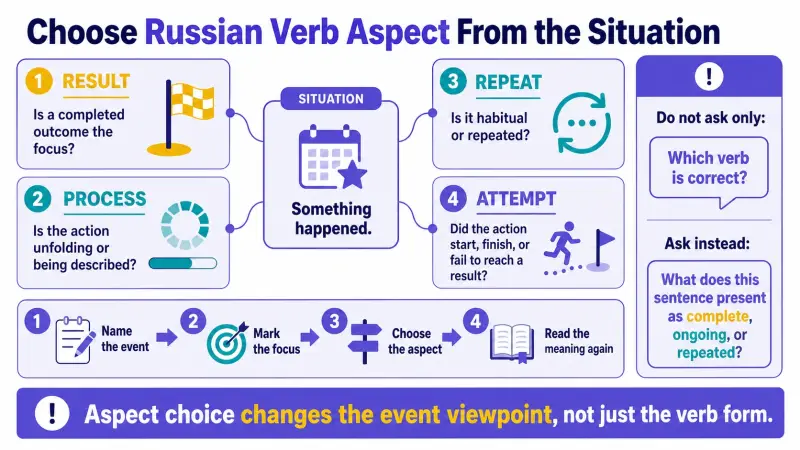
Aspect looks like vocabulary, so beginners treat it like vocabulary and memorize pairs. Then the pairs refuse to behave. Russian verbs almost always come in aspect pairs, and the imperfective and perfective forms describe the same action from two different viewpoints rather than two different actions. The imperfective covers processes, habits, and events where completion is beside the point. The perfective covers one whole event, usually with a result. A table can list the forms. It cannot tell you what actually happened in your sentence.
Two more facts break the memorization plan. First, no single rule predicts a Russian verb's aspect partner: pairs form through prefixes, suffix changes, stem changes, or completely different words such as говорить and сказать. The prefix trap is the nastiest part. Adding с- to писать gives you its partner написать, but adding от- to говорить gives you отговорить, "to dissuade," which is not a partner but a brand-new verb. Second, perfective Russian verbs have no present tense, so anything happening right now must be described with the imperfective form. Tables rarely make you feel that constraint. Your first fifty "right now" sentences will.
None of this means you are slow. The US Foreign Service Institute groups Russian with its hard languages, estimating around 1,100 class hours for an English speaker to reach professional working proficiency, and aspect is one of the features earning that number. We traced why verb aspect creates a resource gap right after Cyrillic in a separate piece: most beginner materials teach the alphabet and cases well, then dump aspect on you as a list. So the useful question is which resources refuse to do that.
Comparing Named Resources on How They Teach Aspect Pairs in Context
Judge each resource on four jobs: does it show both members of a pair together, does it explain the contextual choice, does it make you practice, and does it give feedback? The table below runs the named options through those four jobs so you can see which learning job each one actually performs. None of them wins everything, and that is fine, because you are assembling a kit, not picking a champion.
| Resource | Format and access | How it handles aspect in context | Learning job it fits |
|---|---|---|---|
| Mezhdu nami | Free web-based textbook, nine units built around one connected story | Aspect pairs show up inside an ongoing storyline about four students living in Russia; grammar notes explain how pairs form through prefixes and suffixes | Your first structured pass through aspect, with the situations already built in |
| Amazing Russian (Olga Jarrell) | Free YouTube tutorials from a university Russian instructor | A dedicated verbal aspect series contrasts the two past tenses, imperfective present against perfective future, the two futures, and repeated events, then adds listen-and-respond story practice | Hearing the same pair in deliberately contrasting situations |
| Russian Grammar (Dr. Curtis Ford) | Short, low-stress YouTube explainers | Each video isolates one grammar point with example sentences, so one confusing contrast takes minutes to review | Targeted repair when one specific contrast will not click |
| Duolingo | App with a free tier and an optional paid plan | Aspect forms appear inside translated sentences with instant right-or-wrong checks; the reasoning lives in supplementary course notes, not in the exercise | Daily exposure and recall pressure, not explanation |
| Wikibooks, Russian verbal aspect chapter | Free reference chapter | Lays out pair-formation patterns and flags the prefixes that create new verbs instead of partners | Lookup reference once you have your own sentences to check |
A few honest notes. Mezhdu nami is the strongest starting point for this article's exact question, because its aspect explanations arrive attached to story events you have already read. Amazing Russian is the best listening complement: the contrast videos change only the aspect and make you notice what moved. Duolingo keeps the forms in front of you every day, which matters, but a green checkmark never tells you what your rejected sentence would have meant. And none of these tests your own original sentences against a real reader. That job comes later. For everything beyond aspect, the broader beginner Russian resource stack maps which resource carries which stage of your first year.
Situation-Based Practice: Completed, Ongoing, and Repeated Events
Knowing where the explanations live is half the job. The other half is drilling the three event types behind most beginner aspect decisions, with your own sentences instead of textbook ones. The table below turns those three types into a frame you can reuse with any pair. Read it as a scenario generator, not a rule chart.
| Event type | The question you ask yourself | Aspect that usually fits | Example with писать / написать |
|---|---|---|---|
| Completed, one-time event with a result | "Did it get finished?" | Perfective | Вчера я написал письмо. (I wrote and finished the letter yesterday.) |
| Ongoing process, completion not the point | "Was it in progress?" | Imperfective | Вчера вечером я писал письмо. (I was writing a letter last evening.) |
| Repeated or habitual event | "Did it happen regularly?" | Imperfective | Каждую неделю я писал письма домой. (I wrote letters home every week.) |
The loop that makes this stick: pick one high-frequency pair, say делать/сделать or читать/прочитать. Write three short sentences about your own week, one per event type. Then swap each sentence to the other aspect and ask yourself what the new version claims happened. If you cannot answer, you have found your exact gap, and that gap is what you bring to a grammar note, a contrast video, or a native speaker. Mezhdu nami's explanations and Amazing Russian's videos both land harder when you arrive holding three sentences of your own.
One safety zone while you drill: remember that the perfective has no present tense. Sentences about right now can only go one way, so they are the place to build imperfective instincts before the past tense starts forcing real choices.
Feedback That Explains the Meaning Change, Not Just the Right Answer
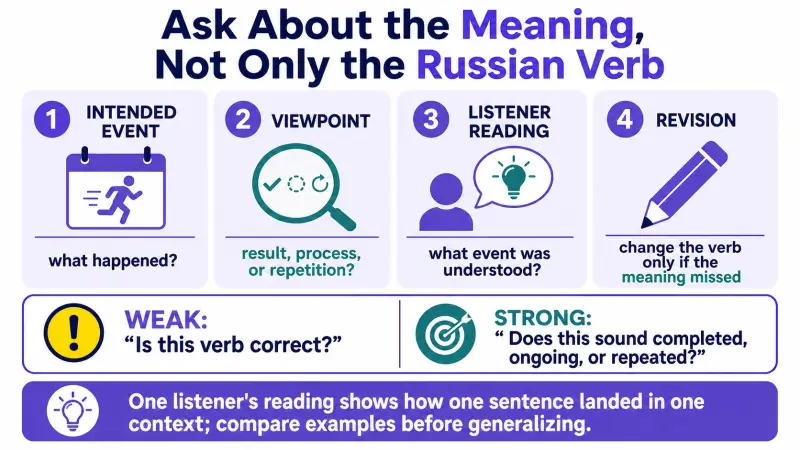
Here is where most beginner setups quietly fail. An app marks написал wrong and prints писал in green. You got corrected without getting taught, because the valuable information is what your rejected sentence would have meant to a Russian reader. Maybe it was grammatical and simply claimed something you did not intend. That is a different problem from a typo, and right-or-wrong feedback cannot tell the two apart.
So sort your feedback sources by one question: can this source answer "what did my version mean?" Course notes and reference chapters answer it for standard textbook sentences. For your own sentences at any hour, HelloTalk's AI grammar correction runs in real time and attaches an explanation to each fix, which makes it a sensible first filter: let it catch the ending errors before you spend a human's attention on a sentence. The same sorting rule works across languages, and it is the standard we applied when comparing speaking resources that give Arabic learners sentence-level feedback: keep the resources that explain the change.
The one thing no automated layer fully answers is how a real reader experienced your sentence inside a live exchange. For that you need a place where your sentences meet actual Russian speakers.
Testing Your Aspect Choice in Real Scenarios on HelloTalk Chats and Moments
This is the concrete job HelloTalk does in an aspect plan: it is where your aspect choices stop being exercises and become messages a real person has to interpret. HelloTalk connects 70M+ registered users across 260+ languages, and 90% of core features on the HelloTalk platform are free, so the testing ground is big and the entry cost is low. Scope check first: HelloTalk is not where you learn what aspect is. A structured resource from the table does that better. HelloTalk is where you find out whether your choice communicated the event you meant.
In one-on-one chats, HelloTalk's built-in translation, transliteration, and read-aloud tools let you draft a sentence about something that genuinely happened today and check your understanding of the reply without leaving the thread. A script that works: send both versions of one sentence, "Вчера я читал книгу" and "Вчера я прочитал книгу," and ask your partner which one sounds like you finished the book. The question costs a native speaker a few seconds and returns the meaning-level answer no table has.
HelloTalk's Moments feed runs the same test past many readers at once. A Moments post is public to the community, and native speakers who choose to respond can leave corrections or comments, so posting two aspect variants of one sentence shows you how several different Russian speakers read each version. HelloTalk's Voicerooms and Livestreams cover the listening side: join a Russian-language voice room as a listener and track which aspect forms speakers reach for when they narrate finished events versus ongoing ones. It is the fastest way to hear your practice table operating in live speech.
What a Russian-Speaking Partner's Reading of Your Sentence Does and Does Not Prove
When a partner tells you "Я прочитал книгу sounds like you finished it," you have learned something real: how one native reader, in this context, understood your choice. That is the meaning check no table provides. What you have not learned is a universal rule of Russian. One partner's wording is contextual evidence shaped by the conversation, their region, and their own habits. Treat it as law and you will eventually "correct" things that were never wrong.
The reliable move is triangulation. Collect readings from more than one partner over time. Note the context each came from. Check recurring patterns against a reference explanation, such as the Wikibooks aspect chapter or an Amazing Russian contrast video. When partner evidence and reference agree, you have solid ground. When they disagree, you have found an interesting corner of the language, and that earns a follow-up question, not a conclusion.
Do I need to finish a grammar course before testing aspect with real people?
No. You need the core concept, which the first aspect chapter of any resource in the table covers: pairs exist, and the choice depends on whether the event is completed, ongoing, or repeated. Testing your own sentences early gives the rest of the course something to explain.
Which aspect pairs should I practice first?
Start with pairs you can use about your own day, such as делать/сделать, писать/написать, читать/прочитать, and the odd-couple pair говорить/сказать. Personal frequency beats any official list, because you will retest the same pairs in real chats.
Is the imperfective or the perfective more important for beginners?
Neither outranks the other, but the imperfective owns the present tense, so it dominates sentences about right now. Past-tense storytelling is where the choice between the two starts doing real work.
What should I do when two Russian speakers judge my sentence differently?
Write down both readings with their contexts, then check the contrast against a reference explanation. Disagreement usually means the sentence works in both aspects with different implications. That is a finding, not a failure.
Can HelloTalk's AI grammar correction replace a partner's explanation?
They do different jobs. HelloTalk's AI grammar correction gives instant, explained fixes that clear out mechanical errors, while a partner tells you what your sentence actually claimed to a human reader. Run the first before the second and you waste nobody's time.
Aspect stops feeling arbitrary the moment your sentences start meeting real readers. Pick one explanation resource from the table, write three situation sentences of your own, and take them somewhere they get read. If you want that somewhere to include native Russian speakers, one-on-one chats, a public Moments feed, and AI checks in a single app, start with HelloTalk and make your next aspect choice a real message instead of a quiz answer.