
Which Arabic Speaking Resources Give Useful Feedback on Full Sentences?

You can drill Arabic vocabulary for months and still freeze the first time you build your own sentence, because nothing ever told you whether your sentences were any good. Words get graded constantly. Sentences you invent almost never do.
The short answer: useful feedback on a full sentence has to come from a source that understands meaning and context, which in practice means a tutor, a community of speakers, or a native-speaking partner rather than an answer-key matcher. The longer answer is about matching each resource to the kind of feedback it can actually deliver: who it comes from, how fine-grained it gets, whether it knows Modern Standard Arabic from a dialect, and whether it works asynchronously or live.
Why Most Arabic Tools Grade Words but Never Your Sentences
The gap has a simple technical cause. Most self-study tools evaluate by comparison: your answer against a stored correct answer. That works for vocabulary, fixed translation drills, and repeating a model sentence aloud. Duolingo's Arabic course, which teaches Modern Standard Arabic through exactly that exercise loop, shows the pattern clearly: strong at building recognition, silent on anything it did not anticipate.
Most self-study Arabic tools check answers against a stored answer key, so they can grade a known word or a fixed sentence but cannot judge a sentence the learner invented. Speech-recognition exercises hit the same ceiling. They measure how closely your audio matches an expected utterance, and reviewers of app-based speaking practice regularly note the recognition can be inconsistent even on expected sentences. None of this makes these tools bad. It makes them word-level and template-level tools.
Your own sentences live or die on different questions. Did it mean what you intended? Would a native speaker phrase it that way? Does it fit the variety of Arabic you are speaking? Those judgments need a mind, not a matcher, and the rest of this comparison is about where to find one.
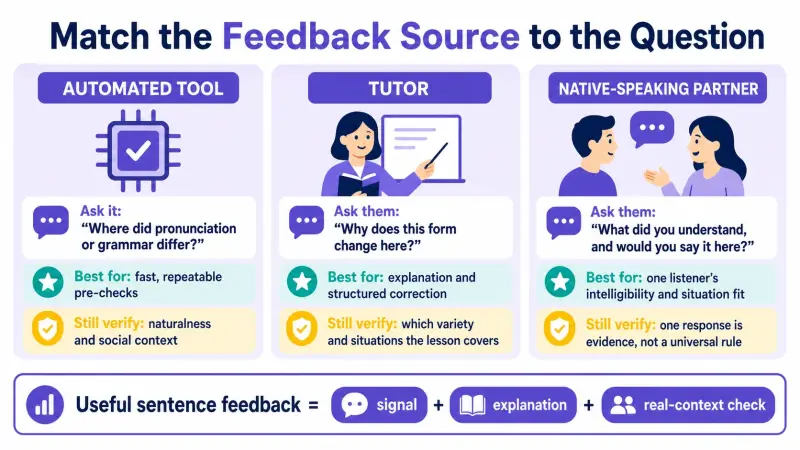
Comparing Feedback Sources: Automated Scoring, Tutors, and Native Speakers
Since the ceiling comes from the source, compare by source. The table below puts four of them side by side on the sentence-feedback question: what each can judge, what it tends to miss, and where named resources fit.
| Feedback source | Named resources | What it can judge on your sentence | What it tends to miss |
|---|---|---|---|
| Automated scoring | Duolingo exercises; app speech recognition | Match with an expected answer; rough pronunciation closeness | Meaning, naturalness, anything unanticipated |
| Professional tutor | italki's Arabic teachers, filterable by variety | Grammar with explanations; structured correction over time | Casual register; how strangers react in the wild |
| Community corrections | Busuu's Community Corrections on speaking and writing exercises | Native-speaker fixes on submitted exercises | Depth varies by corrector; prompts are preset topics |
| Native-speaking partner | HelloTalk chat, voice messages, and Moments | Meaning, naturalness, and variety fit, in real context | Systematic grammar teaching; consistency between partners |
Some specifics to keep the comparison fair. Tutors are the strongest source for explained grammar correction. On italki, Arabic teachers can be filtered by variety, with options like Egyptian, Levantine, Maghrebi, Gulf, and MSA, so the correction can come from someone who natively speaks the variety you are producing. Community correction sits in the middle. Busuu, which describes its community as over 120 million learners across its 14 course languages including Arabic, routes your completed speaking or writing exercises to speakers of that language, who can edit and comment on them. Reviewers point out that response time and depth depend on who happens to pick up your exercise, a fair trade-off to know going in.
The feedback source determines the feedback ceiling: automated scoring stops at match quality, tutors add explained correction, and native speakers add judgments of meaning and naturalness that no answer key contains. But "a native speaker looked at it" still leaves two open questions: what exactly they judged, and when. Those come next.
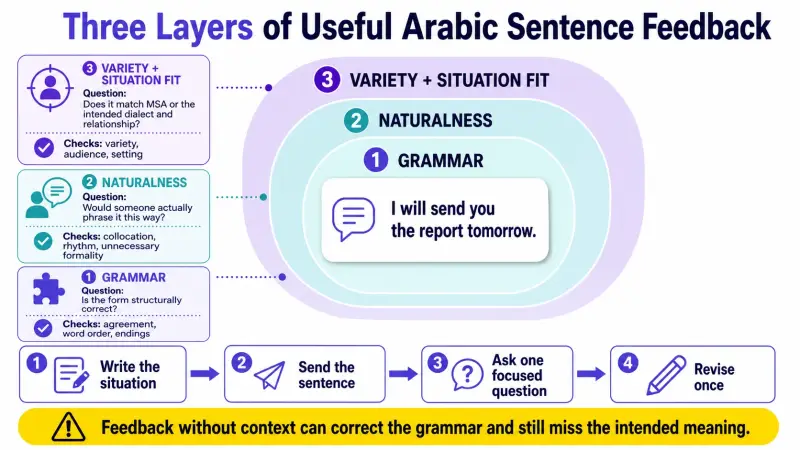
Feedback Granularity: Grammar, Naturalness, and MSA-Versus-Dialect Fit
Feedback on a sentence is not one thing. It comes in at least three layers, and sources differ in which layers they reach.
The first layer is grammar: agreement, verb forms, word order. Tutors are strongest here because they explain the rule behind the fix, and a lesson gives them room to do it. The second layer is naturalness. A sentence can be grammatically flawless and still be something nobody would say. Only people who use the language daily catch this reliably, which is why partner reactions and community corrections matter even if you already have a tutor.
The third layer is variety fit, and Arabic makes it unavoidable. Whether an Arabic sentence sounds natural depends on which variety it belongs to, so feedback is only useful when the person giving it states whether they are judging Modern Standard Arabic or a specific dialect. A perfectly formed MSA sentence dropped into a casual Cairo chat reads like a legal notice. A Levantine phrase in a formal writing exercise gets marked wrong by an MSA-trained eye. This is why variety filters on tutor platforms matter, and why the choice you made in deciding between an MSA or dialect course quietly shapes every correction you receive afterward. Whenever you ask someone to react to your sentence, name the variety you were aiming for. It turns vague "sounds off" reactions into corrections you can use.
Pronunciation runs alongside these layers with its own toolset, compared separately in Arabic pronunciation tools for English speakers.
Asynchronous Versus Live Practice: Which Suits Full-Sentence Feedback
Granularity is one axis. Timing is the other, and the same source performs differently depending on whether the exchange is asynchronous or live. The two modes train different halves of the same skill, so it helps to see them side by side before deciding where your sentences go first.
| Mode | Typical resources | Strength for sentence feedback | Built-in limit |
|---|---|---|---|
| Asynchronous | Busuu correction exercises; HelloTalk text and voice messages; recorded self-study audio such as the three Pimsleur Arabic courses (MSA, Egyptian, Eastern) | Time to compose a real sentence; feedback arrives attached to something you can re-read | No pressure test; audio prompts speech but returns no feedback on it |
| Live | italki lessons; HelloTalk Voicerooms and Livestreams | Tests whether your sentence survives real-time speed; immediate reaction | Corrections vanish unless someone writes them down |
Asynchronous practice gives you time to compose a complete sentence and receive feedback attached to it, while live practice tests whether that same sentence survives real conversation speed. A workable rhythm uses both directions: build and refine sentences asynchronously, then take the survivors live. HelloTalk Voicerooms and Livestreams lower the cost of that second step, because HelloTalk lets you enter a Voiceroom as a listener and speak only when ready, and a Livestream host taking questions is a gentler live audience than a one-on-one call.
One caution on the asynchronous side. Audio courses that prompt you to speak, like the Pimsleur programs, are production practice but not feedback resources, because nothing in the loop evaluates the sentence you produced. They pair well with a human channel. They do not replace one.
Keeping a Sentence Attached to Its Context With HelloTalk Chat, Voice Messages, and Moments
Everything above points at one structural problem: most feedback systems detach your sentence from the situation that produced it. An exercise sentence answers a prompt. A corrected line in a notebook floats free. Real judgments of meaning and naturalness need the context back.
HelloTalk chat, voice messages, and Moments keep a learner's sentence attached to the conversation or post it came from, so a native speaker who reacts to it is judging the sentence in its real context rather than as an isolated line. In a HelloTalk chat, your Arabic sentence sits inside an actual exchange about something, and a partner's reaction tells you whether it worked as communication, not just whether it parsed. A HelloTalk voice message adds your pronunciation and rhythm to the same context. A public Moment shows one sentence to many speakers at once, and HelloTalk's Moments feed is where several reactions to the same attempt can pile up.
The HelloTalk platform also handles the mechanical layer before a human ever sees your sentence: HelloTalk's AI grammar correction flags errors in real time with explanations, and HelloTalk's AI pronunciation scoring points at the specific sounds that drifted, so what a partner reads is already past its typos. Volume matters for sentence feedback, and the numbers help here: HelloTalk connects 70M+ registered users across 200+ countries, and 90% of core features on the HelloTalk platform are free. The honest trade-off: partners are people, not staff, so no response, correction, or response speed is guaranteed. Partners who share your interests are likelier to engage, and the practical steps are in finding an Arabic language partner.
What an Arabic-Speaking Partner Can Notice That an Answer Key Cannot
The last section covered where partner feedback happens. This one covers why it is a different kind of thing. An answer key can only compare your sentence with anticipated right and wrong versions. A partner reads it as an open-ended message and can react to things no key stores: whether the sentence meant what you intended, whether the phrasing is what people actually say, whether the variety fits the setting, even whether the tone lands as friendly or stiff.
Two habits make those reactions more useful. First, send a narrow question with the sentence. "Does this sound natural in Egyptian Arabic, or would you say it differently?" gets richer answers than "Is this correct?" Second, weigh each answer as what it is: one speaker's judgment in one context. If one partner rewrites your sentence, you learned how one person would say it. If three partners from different places converge on the same rewrite, you found a real pattern. One person's preference never becomes a rule of Arabic on its own, and the wider Arabic speaking resource stack exists precisely so no single source has to carry every judgment.
Can any app judge a sentence I invented myself?
Automated tools evaluate by comparison with expected answers, so a sentence the system never anticipated gets either no judgment or an unreliable one. For invented sentences, human sources are currently the dependable route.
Should I ask for feedback in MSA or a dialect?
Ask in whichever variety you are actually trying to produce, and say so explicitly. Feedback given against the wrong variety marks correct sentences wrong, and the reverse.
Is a tutor or a partner better for sentence feedback?
Different jobs. A tutor gives explained, systematic correction on schedule. A partner gives authentic reactions to meaning and naturalness inside real exchanges. Learners who can use both usually alternate rather than choose.
How do I avoid one-word replies when I ask for feedback?
Send one sentence, name the variety, ask one specific question about it. Narrow requests are easy to answer well. "Check my Arabic" invites a thumbs-up and nothing more.
Does HelloTalk guarantee that someone will review my sentence?
No. HelloTalk provides the channels where sentences keep their context, but partners respond voluntarily, so no reply, correction, or timing is promised. Posting to Moments as well as chatting raises the number of people who can see an attempt.
Words get you started. Sentences are where Arabic becomes yours, and sentences only improve when something with judgment reacts to them. Stack the sources by task: automation for the mechanical layer, a tutor for explained grammar when you want one, native speakers for meaning, naturalness, and variety fit. If you want your own Arabic sentences living inside real conversations from day one, start on HelloTalk.