Best Resources to Speak Arabic Fluently: MSA, Dialects, and Native-Speaker Practice

Most people who fail at spoken Arabic did not fail at studying. They studied for a year, learned to read a newspaper, and then discovered that the Arabic they had learned is not the Arabic anyone speaks at home.
That is the single most important fact about learning Arabic, and it needs to be the first thing you plan around rather than the thing you discover in month eight.
Arabic exists in a state of diglossia: Modern Standard Arabic is the shared written and formal variety, learned at school rather than from parents, while everyday conversation happens in regional dialects that differ from MSA and from each other in sound, grammar and vocabulary. Choosing which one you want to speak is not a detail. It determines every resource on your list.
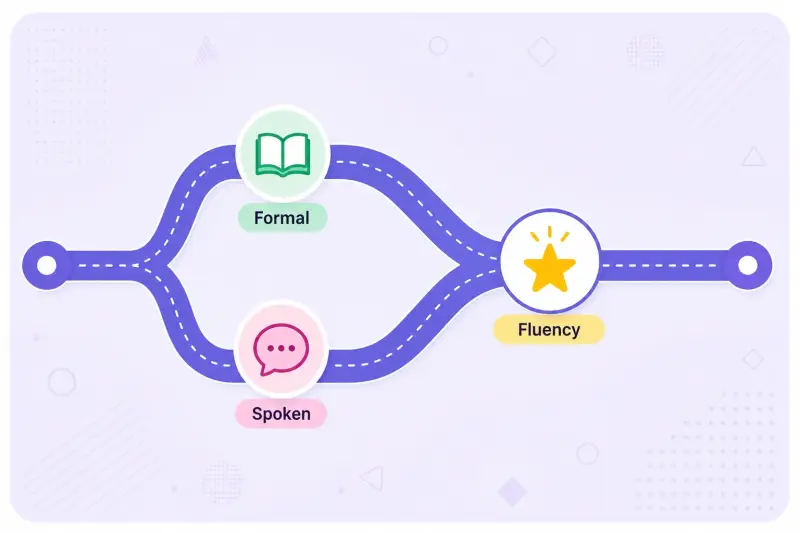
The fork in the road
Before choosing resources, separate the formal variety you can read across regions from the spoken variety you will use with people. The comparison below shows why most speaking-focused learners eventually need both.
| Modern Standard Arabic (MSA) | A spoken dialect | |
|---|---|---|
| Used for | News, books, official documents, formal speeches, written communication across all Arabic-speaking regions | Daily conversation, family, friends, most television drama and social media |
| Understood where | Widely, across regions, by educated speakers | Best in its own region; Egyptian is the most widely understood beyond its own borders because of decades of film and television output |
| Resources available | Abundant, structured, academic | Fewer and less structured, though improving |
| Sounds natural in conversation? | No. Speaking MSA socially reads as formal or bookish | Yes |
| Best for | Reading, media, academic work, religious texts, exams | Talking to people |
| Grammar | More complex case and inflection system | Simplified in most dialects |
The practical recommendation for a learner whose goal is speaking: learn enough MSA to read and to access the enormous body of structured material, and learn a dialect for actual conversation, with your dialect chosen by which people you intend to talk to.
Before committing to a course, use these five signals to check whether it teaches MSA, a dialect, or both, then match the result to the speaking path you actually want.
The main dialect groups you will see named are Egyptian, Levantine, Gulf, Iraqi, North African (Maghrebi) and Yemeni. Egyptian and Levantine have the largest volume of learner material and the widest reach in media. North African varieties are the least mutually intelligible with the others, so choose one only if it is where your interest lies.
The size of the job, honestly
The Foreign Service Institute places Arabic in its most demanding tier for English speakers, at roughly 2,200 class hours to professional working proficiency, compared with roughly 600 to 750 for French, Spanish or Italian. On the Cambridge guided-hours scale, B1-equivalent conversational ability sits at roughly 350 to 400 hours in an accessible language, and Arabic realistically needs more.
Three structural reasons, all of which have practical fixes:
- A different script. 28 letters, written right to left, with letters changing shape by position, and short vowels usually unwritten. This is the part learners overestimate. Most people read basic Arabic within four to six weeks of daily work.
- Sounds English does not have. Several consonants produced further back in the mouth, plus emphatic consonants that change the vowels around them. This needs feedback, not reading.
- The diglossia itself. Two varieties instead of one. This is the part learners underestimate.
Resources by stage
The stages below are cumulative rather than isolated. Script and MSA provide access to structured material, while dialect study and native-speaker practice begin early enough to keep the plan focused on actual conversation.
| Stage | What to work on | Resource type | Weeks |
|---|---|---|---|
| 1 | Script and sound system | Alphabet course with audio, plus pronunciation feedback | 4-6 |
| 2 | Core MSA grammar and first 500 words | Structured MSA course or textbook | 8-16 |
| 3 | Dialect for speaking | Dialect course, plus conversation with native speakers of that dialect | From week 6, in parallel |
| 4 | Listening at real speed | Dialect television drama and podcasts, MSA news for the formal register | Month 4 onward |
| 5 | Fluency | Conversation volume, four or more sessions weekly | Ongoing |
Two resource notes worth having. Free audio-first introductions to Arabic exist, including Language Transfer's free Arabic course, which requires no account and focuses on Egyptian Arabic thinking patterns rather than vocabulary lists. And for the script, any course with audio will do; what matters is doing it daily for a month rather than which one you pick.
As your reading improves, the next resource decision is when learner materials should remove the scaffolding. The guide to when Arabic resources should reduce short-vowel marks gives a readiness check and a staged path into normal unvowelled text.
The one resource category with no free substitute is a native speaker who will correct your pronunciation, because Arabic has sound distinctions that you cannot hear reliably until someone tells you which one you just produced.
If those distinctions are your first bottleneck, the comparison of Arabic pronunciation tools for sounds English speakers commonly miss shows which resources diagnose a specific sound instead of only replaying a model.
Where the speaking practice comes from
This is the part that decides whether you speak Arabic or only read it, and it is the job the HelloTalk platform is built to support.
Chat-based learning. Text chat with Arabic native speakers is the right first format, because it lets you produce Arabic with time to think while the script is still slow. Translation, phonetic transcription and read-aloud sit inside the message thread, and transliteration is unusually valuable in Arabic: it lets you decode a message before your reading speed catches up. Real-time grammar correction flags your errors during the exchange. You will also see immediately how differently people write in dialect versus MSA, which is a lesson no textbook delivers as clearly.
Moments. Post two or three sentences in Arabic publicly and several native speakers will correct the same text. For a language with regional variation, the plurality is the point: you learn which phrasing is standard, which is regional, and which is a matter of preference. Reading other people's Moments shows you written dialect, complete with the informal spellings native speakers actually use.
Voicerooms and Livestreams. Arabic voice rooms run around the clock, and you can enter as a listener and say nothing at all. For the sound system this is the highest-value listening available: emphatic consonants and back-of-the-mouth sounds are much easier to acquire after ten hours of hearing them in natural speech than from isolated recordings. Voice rooms are also the cheapest way to sample dialects before you commit to one. Livestream mini-lessons add a host and a topic when you want structure.
AI learning tools. AI pronunciation scoring points at the specific sound you are producing wrong, which in Arabic is the feedback that matters most and the hardest to self-supply. AI grammar correction explains the rule behind each fix. Image translation handles Arabic text in the physical world, which is genuinely useful while your reading is still slow.
Pronunciation is only one layer of speaking feedback. The comparison of Arabic speaking resources that give useful feedback on full sentences shows which options can respond to word choice, grammar and dialect fit together.
HelloTalk's scale is why finding a partner in a specific dialect is realistic: 70M+ registered users across 200+ countries studying 260+ languages, with over 1 billion messages daily. 90% of HelloTalk's core features are free, which matters for a language that needs a lot of hours. HelloTalk was named Google Play's Best Social App in 2017 and received a global Google Play homepage feature in 2024.
A workable first six months
Weeks 1-6. Script daily, 20 minutes. Pronunciation work with feedback, 10 minutes. Text chat with native speakers from week two, using transliteration freely.
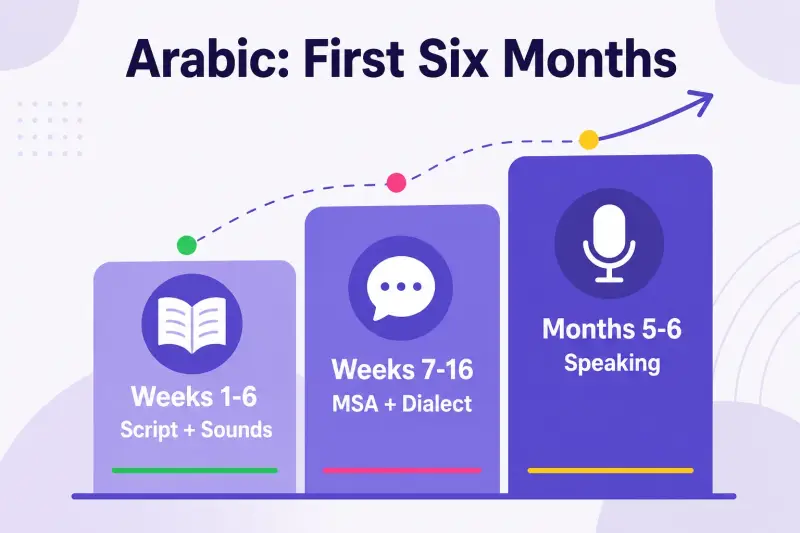
Weeks 7-16. Structured MSA course for grammar and core vocabulary, 30 minutes daily. Add a dialect course for the variety you have chosen. Two voice conversations weekly. Ten minutes of spaced review daily, because a 2022 meta-analysis pooling 98 effect sizes from 48 experiments with 3,411 learners found spaced schedules retain better than the same time in one block.
Months 5-6. Dialect becomes the main speaking focus, MSA becomes the reading and news channel. Three to four conversations weekly. Dialect drama with subtitles.
Common mistakes
- Learning only MSA and expecting to converse. MSA is not the language of daily conversation anywhere; using it socially sounds formal.
- Learning only dialect and being unable to read. You lose access to most structured material, plus all written and formal Arabic.
- Choosing a dialect at random. Choose it by the people you want to talk to. If you have no specific region, Egyptian and Levantine have the most material and the widest reach.
- Postponing the script. It looks harder than it is. Four to six weeks of daily work, and then it stops being a barrier.
- Learning sounds without feedback. Arabic's consonant distinctions do not self-correct; someone has to tell you.
- Waiting until your grammar is solid to speak. With a 2,200-hour horizon, waiting for readiness means waiting years.
- Treating vowels as optional. Short vowels are usually unwritten, so hearing them from speech is how you learn them.
For the general question of how to match a method to a goal, see how to choose the best language learning method for your goal. The wider argument about exposure versus syllabus, which matters a lot for a language at this difficulty tier, is in immersion versus structured learning, and the underlying hour math in the best ways to learn a language.
FAQ
Should I learn Modern Standard Arabic or a dialect first? If your goal is speaking, run both: MSA for reading, script and access to structured material, plus one dialect for conversation from around week six. If your goal is purely reading or formal media, MSA alone is enough.
Which Arabic dialect is most useful? Egyptian is the most widely understood outside its own region because of decades of film and television output, and Levantine has a large body of learner material. Beyond that, the useful dialect is the one spoken by the people you actually want to talk to.
How long does it take to speak Arabic fluently? The Foreign Service Institute estimates roughly 2,200 class hours to professional working proficiency, several times the figure for French or Spanish. Conversational comfort in a dialect arrives much earlier, typically within a year of daily practice including regular speaking.
Do I need to learn the Arabic script to speak Arabic? Not strictly, and transliteration lets you start immediately. But skipping the script permanently limits you to spoken material, and it is a four to six week job rather than a year-long one.
What are the hardest parts of Arabic for English speakers? The consonants that have no English equivalent, the unwritten short vowels, and the diglossia between the written standard and spoken dialects. The script itself is comparatively quick.
Can I learn Arabic for free? Largely, yes. Free audio introductions, free script courses, free spaced-review tools, and language exchange with native speakers cover most of it. The scarce resource is hours and pronunciation feedback, not money.
How do I practise Arabic speaking without living in an Arabic-speaking country? Daily text chat plus two to four voice conversations a week with native speakers of your chosen dialect, with listening in voice rooms in between. That combination reproduces most of what daily exposure would give you.
Choose your dialect, give the script six weeks, and start talking to native speakers while it is still difficult. You can find partners in the dialect you want for free on HelloTalk.