
How to Find an Arabic Language Partner for Your Target Dialect

When a profile or first reply does not settle which Arabic variety someone uses with you, ask your HelloTalk partner which variety they use with learners, then agree on one short round in it, by text or voice. That is the gap left when a Cairo profile is followed by a reply in careful Modern Standard Arabic.
Course audio, scripts, and vocabulary drills can get the lines themselves ready on your own time. What they cannot settle is which Arabic a particular person will use with you, and a line about location does not settle it either, nor does one opening message. That part needs the other person's answer, so ask whether they use your target variety and are willing to practice it.
Name the Arabic Variety and Conversation You Want to Practice
Write one sentence that names the variety, the situation, and what you want to do in it, and send that as your opening HelloTalk message. "Egyptian Arabic, being offered a drink at someone's home or a cafe, understanding the question and answering in one short sentence" is specific enough for a stranger to say yes or no to. Only that person can tell you whether they use that variety with a learner, which is why the sentence goes to them rather than into your notes.
Holding the intent constant shows why the label matters. In Modern Standard Arabic, "What would you like to drink?" said to a man is ماذا تريد أن تشرب؟ (mādhā turīdu an tashraba?). In Cairo Arabic, the same question to the same man is تحب تشرب إيه؟ (tiḥibb tishrab ēh?).
Everything that follows is a written teaching example built from ordinary phrases, not a transcript of anyone's real exchange. Both speakers in it are adult men, and every second person form below is addressed to a man. If your own partner is a woman, those forms change, so check them rather than swapping endings by guesswork, and treat the Latin spellings as reading aids rather than precise phonetic notation.
Naming the variety and the situation tells a partner what you want to practice. If you are unsure which variety your current course teaches, settle that first with how to tell whether an Arabic course teaches MSA or a dialect, since your request should match the material you already own.
Ask Which Variety a Potential HelloTalk Partner Uses
HelloTalk profiles can carry native and learning languages, a self introduction, hometown, job, and interests, and HelloTalk's help material describes matching built on native and learning languages. That gets you to people who say they speak Arabic. It does not certify which variety a person uses at home, which one they are comfortable writing, or how much they want to explain.
Here is how far each clue reasonably gets you, so you can see which question still has to be asked directly.
| What you can see | What it reasonably suggests | What you still have to ask |
|---|---|---|
| Arabic listed as a native language | That is what the member wrote about themselves | Ask in a HelloTalk message which variety they use day to day, and which one they would use with a learner, since only their answer settles it |
| Hometown or current city | A possible regional connection | Whether they still use that variety, and whether they are willing to write or say it; ask that directly in the HelloTalk chat, since a city is a clue and not a certification |
| Self introduction and interests | Topics they chose to mention, and how much of your shared language they wrote there | Whether drinks and daily routines are something they want to act out; propose that topic in a HelloTalk message, because only their yes decides what you can actually practice |
| One short reply from them | How they wrote that one message | Whether they would use the same variety in a practice round; ask on HelloTalk for one short round, since a single message does not settle it |
| A few turns in your target situation | How those particular lines get used in writing | How the same lines sound, which text cannot show you; ask for those lines as a HelloTalk voice message |
Asking is short and not impolite. Send it as a HelloTalk message in your shared language: "Hi Adam, I'm working on Egyptian Arabic for everyday conversation. Which kind of Arabic do you use when you text friends?" His answer is the one part you cannot read off a profile page. A profile tells you what someone wrote about themselves, not which variety they will use with you.
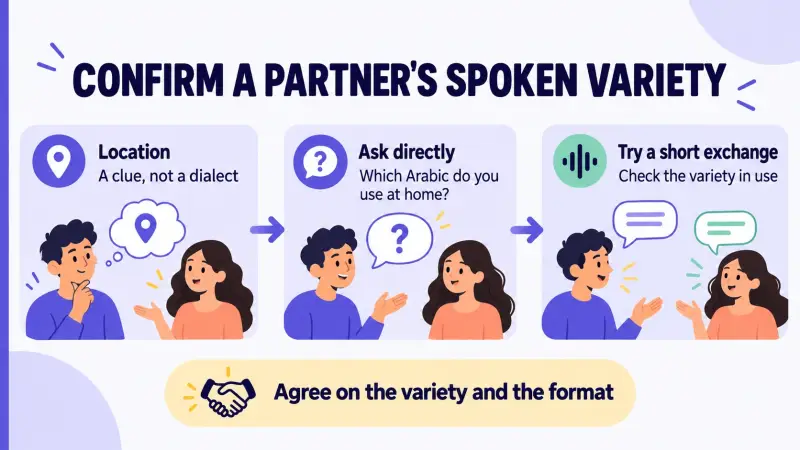
Agree on a Short Exchange That Helps Both of You
Your second HelloTalk message can propose the topic, the medium, what you give back, and the timing at once, and your partner can accept or change any part of it.
Something like: "Could we do one short round about offering a drink, four lines in Egyptian Arabic with two lines each, and then the same round in English for whatever you want to practice? Text or voice is fine, whichever you prefer, and any time this week works." Nothing is fixed until they reply, since the shape of the round is theirs to accept or change.
In this example you can help with English, which is a condition of the example rather than a requirement for every reader. If English is not what you can offer, trade whatever language you do use well, or offer another kind of help, such as reading something they wrote. A partner may also prefer Modern Standard Arabic, or text only, or voice only, and those are preferences to work around.
One boundary worth stating once: informal exchange does not by itself include professional instruction. Pace, length, and structure are still things you can negotiate with whoever you are practicing with.
HelloTalk supports both text and voice messages, which is why the medium is worth agreeing on early. If you want to rehearse a line before anyone hears it, record it in an ordinary phone recorder, listen, practice, and then send it through HelloTalk when you are ready. One invitation can propose the topic, the medium, and the timing, and your partner can accept or adjust any of them.
Try a First Exchange in Egyptian Arabic: A Cairo Example
Four lines is one small task size, not a required format. It fits a question, an answer, a follow up, and a second answer, which is enough to find out whether you can hold a short turn. The lines below are Cairo Arabic, with every second person form addressed to a man.
| Line | Approximate reading | Meaning | Role in this example |
|---|---|---|---|
| تحب تشرب إيه؟ | tiḥibb tishrab ēh? | What would you like to drink? | Your partner's first line; you answer with a drink |
| شاي، من فضلك. | shāy, min faḍlak. | Tea, please. | Your first line; in this example the next line narrows the choice |
| بسكر ولا من غير سكر؟ | bi-sukkar walla min ghēr sukkar? | With sugar or without sugar? | Your partner's second line; you pick one |
| من غير سكر، شكرا. | min ghēr sukkar, shukran. | Without sugar, thanks. | Your second line, which closes the round |
A real partner may answer something else entirely, and that is normal. Run the round once in HelloTalk with them asking, then swap so that you ask and they answer, since the second pass is where you find out whether you can produce the question rather than only recognise it. What they send back decides what you have to handle next, which a script you read to yourself cannot do.
Listening needs audio, and the point here is how this partner says these Cairo lines. Ask them in HelloTalk to record the four lines as a voice message in their own voice, or use audio from a course or teaching source that states which variety it teaches. A synthesized read aloud is not a recording of your partner's voice. Text to speech can still read a line out for you, but it will not show you how your partner says it.
If part of a recording goes past you, listen again, then reply in the same HelloTalk chat in your shared language: "I caught the first word and then lost it, could you say it slower?" What you need is a slower take from this speaker, so a transcription only helps you point at the spot you missed, and it can be wrong, which leaves the recording as the reference.
Use the Reply to Check Meaning and Reuse One Useful Change
Ask for one thing, with the line attached, so your partner is not being asked to grade everything. Record your lines in an ordinary recorder, pick the one you are least sure about, send that one through HelloTalk, and ask: "Here is من غير سكر، شكرا. Is the غ clear here? If you have a minute, could you record the same line so I can compare?"
What comes back varies. Some partners rewrite the line, some send their own recording, and some say it sounds fine. A short confirmation is feedback too; if you are still unsure after it, ask in the same HelloTalk chat for a short demonstration recording of that one line, since hearing this speaker say it is what tells you whether your version matches. You can also compare the line against teaching audio that states which variety it teaches.
Then use the sound again in a line that still contains it, sent as your next HelloTalk round with the same partner so the sound gets answered rather than only reread. In this example the next round keeps the drinks situation and changes one thing: your partner asks تحب تشرب إيه؟ and you answer قهوة من غير سكر، من فضلك. (ʾahwa min ghēr sukkar, min faḍlak. Coffee without sugar, please.), where ʾa is a common way to write the Cairo glottal stop in Latin letters.
HelloTalk lets you save messages and corrections to favorites, which is enough to find the line again before the next round. Send that coffee line to the same partner, since the point is another answer from them rather than a tidier note. Reusing the corrected line gives you another attempt at the sound you changed.
Two short rounds in a week is one optional task size, and you can space them out to fit both of your schedules. To use this kind of feedback on your own longer sentences, how to get feedback on full Arabic sentences handles that separately.
When the Variety or Timing Does Not Match
If your partner writes Modern Standard Arabic comfortably but speaks Cairo Arabic at home, two tracks can work: text in whichever variety they prefer, voice messages in the one you want to hear. Ask for that split in the HelloTalk chat itself, since only they can say whether recording in Cairo Arabic suits them. It is a reasonable thing to ask for, and they can decline it.
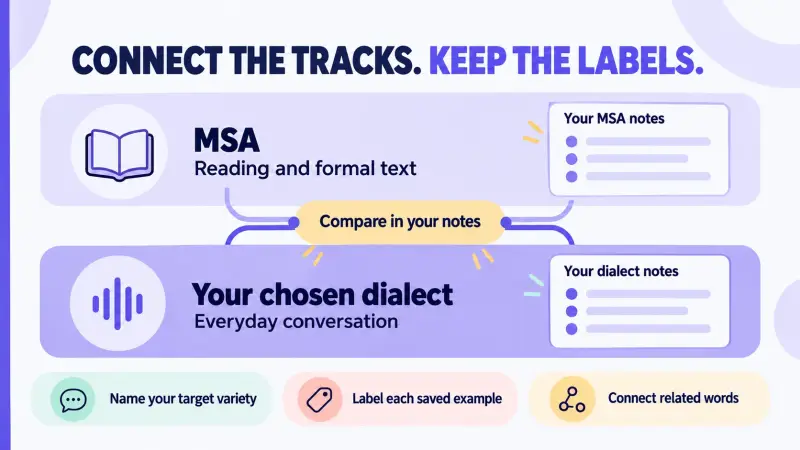
If the varieties do not line up at all, you have three normal moves. Change the material and run the drinks round against course audio, change the goal for that partner and keep them for topics you both like, or look for someone else while leaving the first conversation as it is. None of these requires deciding that something is wrong with you or with them.
When a message gets no reply, the reason is not visible to you. Time zones, a busy week, and interests that do not overlap are all possible, and a quiet chat is not a reading of your Arabic.
If a conversation becomes uncomfortable, you can stop it without writing an explanation first, and HelloTalk's safety material covers protecting personal information, respecting boundaries, and reporting or blocking. When the materials around the partner need rebuilding rather than the partner side, choosing Arabic resources for MSA, dialects, and real conversation covers which resource handles which job.
Frequently Asked Questions About Arabic Language Partners
How can I tell whether someone is willing to practice my target dialect?
Ask them in plain terms in a HelloTalk message, and if they agree, try one short round together. A few turns will show you which variety they actually use with you, and whether they want to keep going. No profile field answers that part for you.
Should I learn Modern Standard Arabic first if I want a dialect partner?
It depends on your goals: MSA is the shared base for written material, formal settings, and most textbooks, while the drinks round above is dialect. There is no fixed requirement to finish MSA before practicing a dialect with a partner, and speakers mix the two regularly, so a mixed reply is not automatically an error.
Is it impolite to ask someone which variety of Arabic they speak?
Framing it as your own practice need keeps it simple: in the HelloTalk chat, say what you are learning, then ask what they actually use, since that answer decides which variety your rounds can run in. Someone may answer with a region, a city, or "a bit of both", and all three are useful.
What if my partner's correction contradicts my course?
Both can be accurate for different varieties or registers, and either one can also be a slip. Compare the line against audio that states which variety it teaches, and when the difference is a sound rather than a word, tools for checking Arabic pronunciation as an English speaker is the next place to look.
How do I practice listening if my partner mostly writes?
Ask in HelloTalk for short voice messages of the exact lines you are practicing, since hearing this speaker say them is what writing cannot give you, and keep a teaching audio source for the days nobody records anything. Reading a transcription is a different task from hearing the line, and transcription can be wrong.
Once your variety and your four lines are ready, you can look for Arabic speakers and start that first short round on HelloTalk.