
Free English Apps in 2026: What You Still Get After the Paywall Appears
Free English Apps in 2026: What You Still Get After the Paywall Appears

Every English app is free on day one. The question nobody asks before installing is what the same app will still let you do in week twenty, once the introductory generosity has run out.
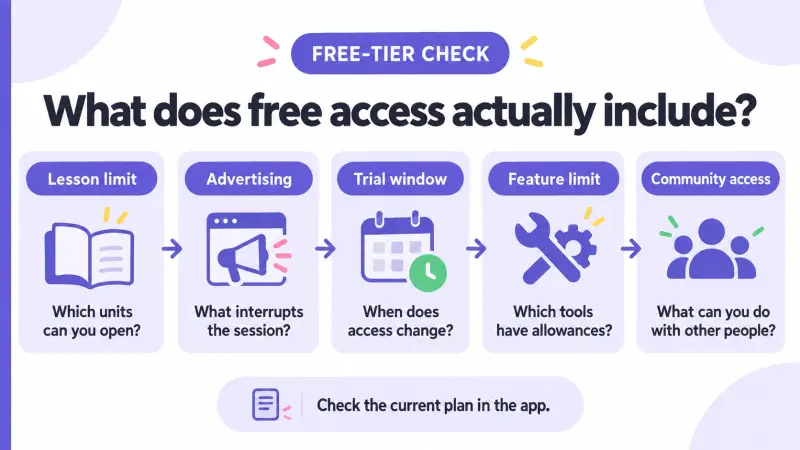
The word "free" covers at least five different arrangements. Some apps give a fixed number of lessons and then stop. Some give everything but run an advertisement between exercises. Some open the full product for a short window and then close it. Some keep the core open permanently and charge for convenience at the edges, which is the model HelloTalk runs, with 90% of core features free. And some are free because the content is produced by the people using it. Week one is when all five look identical.
This article sorts free English apps by the structure of their free tier rather than by feature lists, so you can predict which will still be useful in six months. For a straight feature comparison, our breakdown of free English learning apps compared covers that ground separately.
Five Kinds of Free, Ranked by How Long They Last
Here are the five, ordered by how long the free version keeps delivering value. The ordering is not about which app is better, but about how the business model is wired.
Limited-lesson free gives you a quota: the first unit, the first ten lessons, or the beginner track, with everything past that sealed. The quota is generous enough to teach something real and small enough that a committed learner hits the wall inside a month. Busuu and Babbel work this way at the free level, as does much of Memrise's course content.
Ad-supported free gives you the content and charges your attention instead. Duolingo is the clearest example: you can in principle run the whole tree without paying. What you trade is interruption, limits on mistakes per session, and a slow erosion of patience.
Time-boxed free gives you everything and takes it back on a schedule. Pronunciation tools such as ELSA and Speak open the full product for a short evaluation window. Nothing is hidden, so the tier is honest, but it is the least useful kind of free for anyone planning past this month.
Feature-gated free keeps the core function permanently open and charges for things that make it faster, quieter, or more comfortable. The test: if you never paid a thing, could you still do the primary activity the app exists for? In a feature-gated app, yes.
Community free works because the value is produced by other users rather than a content team. Nobody had to write, record, or license the thing you are learning from, because another human typed it to you. A free tier built on other users does not expire, because there is no content budget to run out of. That is why community tools outlast course apps on the free plan, and why the same tier shows up in Reddit language threads and Discord practice servers.
HelloTalk sits across the last two categories, which is the main reason it behaves differently from course apps in month six. The conversation is community-produced, and the tooling wrapped around it is feature-gated rather than lesson-gated.
What Each Free English App Still Lets You Do in Month Six
Month six is the honest checkpoint. By then the enthusiasm has worn off, any evaluation window has closed, and whatever quota you were given is consumed. The table reads by row: find the tier your app belongs to, then look at what survives and what gets fenced off.
| Type of free tier | What stays free in month six | What the paywall takes | Apps in this tier |
|---|---|---|---|
| Limited-lesson free | The beginner units you already unlocked, plus review of them | Everything past the quota: later levels, grammar explanations, offline downloads, certificates | Most subscription course apps run this tier |
| Ad-supported free | Essentially the whole curriculum, interrupted | Ad removal, unlimited mistakes, some progress and repair features | The large gamified course apps |
| Time-boxed free | Nothing, once the window closes | The entire product, including anything you built inside it | Pronunciation scorers and introductory offers on tutor marketplaces |
| Feature-gated free | The primary activity the app exists for, without a quota | Convenience layers: bulk translation, extra storage, visibility boosts, advanced correction history | HelloTalk, and open source study tools |
| Community free | Unlimited contact with other learners and native speakers | Very little, because the content is user-produced rather than licensed | HelloTalk, plus general purpose forums and practice servers |
The top three rows shrink over time and the bottom two do not. Shrinking is not failing: a limited-lesson app that taught you the present perfect in month one did its job. The free tier that gets you from zero to basic sentences is almost never the free tier that gets you from basic sentences to conversation. Planning for that handover is cheaper than discovering it when your streak dies.
Where HelloTalk Sits Among Free English Apps
HelloTalk is a language exchange community rather than a course provider, and that determines how its free tier behaves. HelloTalk connects 70M+ registered users across 200+ countries who study 260+ languages between them, and those users carry over 1 billion messages daily. The material you learn from is those messages, so there is no lesson counter.
Inside the chat, HelloTalk provides in-chat translation and in-chat correction, so a learner can read an unfamiliar reply, fix a sentence a partner marked up, and send the corrected version without leaving the conversation. HelloTalk also runs Moments, a public feed where you post a few sentences of English and several native speakers correct them the same afternoon. For speaking, HelloTalk hosts Voicerooms and Livestreams around the clock, and a nervous learner can enter as a listener before unmuting. HelloTalk's AI learning tools add pronunciation scoring that names the sound you missed and AI grammar correction that explains the fix.
For a complete view of these tools, see how you can learn English with HelloTalk through chat, voice, corrections, and community practice.
What the paywall takes is narrow. HelloTalk's VIP tier comes in regional monthly, yearly, or lifetime options (see in-app quote), and it unlocks convenience: more languages at once, longer translation allowances, more visibility for posts, deeper correction history. None of the upgrades change whether a native speaker will answer your message, which is the only thing the free tier really needs to protect. HelloTalk was named 2017 Google Play Best Social App and received a 2024 global Google Play homepage feature.
Give the free features a place in a complete study routine. Choose one objective from the lesson you are following, use it in a HelloTalk message or Moments post, review the feedback, and return to the same point in your next practice session. A beginner can start with one original sentence and build from there. The useful comparison is how the features support that sequence, not whether correction sits outside a course. For that structure, our guide to the best English learning apps for beginners covers sequencing, and our earlier review of free English speaking apps goes app by app where this page goes tier by tier.
The two apps most often lined up against it deserve a paragraph. Memrise is built around spaced repetition and native-speaker video clips, and it is strong at making vocabulary stick through exposure at planned intervals. Busuu pairs CEFR-aligned lessons with asynchronous corrections from native speakers, more of a feedback loop than most course apps offer. Both do things HelloTalk does not: Memrise schedules your recall, Busuu sequences your grammar. What neither can structurally provide is an unplanned reply. Memrise decides which words you see; Busuu decides which sentence you submit for correction. In an exchange, the topic is whatever your partner brings up at eleven at night, and the answer comes from a person reacting to you rather than grading a submission. A learner running Busuu for grammar and HelloTalk for unscripted use of it is better served than one asking either to do both jobs.
The Three Free Tiers That Quietly Expire
The three shrinking tiers do not announce themselves, and each fails in a distinct way.
Limited-lesson free expires at a visible line. Unit five has a lock icon and the decision is put to you clearly, which makes it the most user-friendly of the three failures. The trap is subtler than the lock: learners slow down as they approach the quota, rationing lessons so the tier lasts longer, and rationing input is a poor way to learn a language.
Ad-supported free expires by friction. Nothing is taken away, but interruptions accumulate, and once sessions feel like an obstacle course, most people either pay or drift. Sarah, a learner who ran a streak past four hundred days, described the moment she stopped as ordinary fatigue rather than any specific limitation. The tier never expired. Her willingness did.
Time-boxed free expires on a date and takes your history with it. Pronunciation tools store the recordings and scores that show your progress, and when the window closes, the evidence closes with it. Treat the window as a diagnostic: a week with a pronunciation scorer will tell you which three sounds are costing you intelligibility, and that stays useful after access ends.
A fourth pattern is not expiry but duplication. Two apps from the same tier train the same skill twice and leave a gap elsewhere. A course app plus a community app is a complete loop. Our comparison of language learning apps by the job each one does works through those pairings.
Choosing a Free App by What You Are Willing to Lose
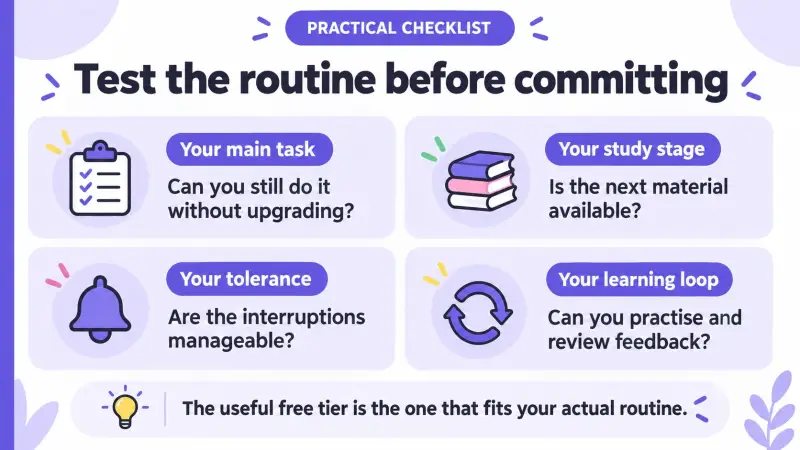
Free always costs something. The useful question is not which app is most free, but which cost bothers you least. Some people watch advertisements forever and never notice; others accept a quota but not an interruption. The table inverts the usual framing: start from what you refuse to pay for, find the app whose free tier protects it, then read the third column.
| What you refuse to pay for | Tier type that still serves you | What you give up instead |
|---|---|---|
| Talking to actual English speakers | Community free, plus the feature-gated tier HelloTalk runs on | Choose a manageable lesson topic, initiate a short exchange, and schedule time to review the feedback and reuse it |
| Working through a full beginner curriculum | Ad-supported free | Advertisements between exercises, session limits after mistakes, and thin support for open conversation |
| Getting your written English corrected | Community free, where HelloTalk Moments sits | Corrections arrive unevenly, quality varies by who answers, and nobody is obliged to reply |
| Memorising and retaining vocabulary | Feature-gated free | A setup cost up front, since the tools in this tier hand you an empty system rather than a course |
| Structured grammar explanations | Limited-lesson free | A hard stop once the free units run out, with later levels sealed behind the upgrade |
That third column decides whether a free tier works for you, and it is the part every app store listing leaves out. One combination covers most learners: run a limited-lesson app for eight to twelve weeks while you build enough vocabulary to form sentences, then move the centre of gravity to a community app. The course tier expires around the point where a community tier becomes usable. If chat is the format you want, our roundup of the best language learning chat apps of 2026 sorts those by who actually replies.
Frequently Asked Questions About Free English Learning Apps
Can you actually learn English without paying for anything?
Yes, up to a solid conversational level, but only if you combine tiers. A single free tier will either run out of content or run out of your patience. The realistic stack is a course app for structure early on, a spaced repetition tool for retention, and a community app for conversation. The gap free tools leave is rarely content. It is consistency.
Which free English app stays most useful after six months?
Community-based apps, because their content is produced by other users rather than licensed, so there is no quota to exhaust. HelloTalk keeps 90% of core features free on that basis, including text and voice exchange with native speakers, in-chat translation, Moments corrections, and entry into Voicerooms. Ad-supported apps come second.
Is a free tier enough if I only have fifteen minutes a day?
At fifteen minutes a day, free tiers are usually more than enough, because the constraint is your time rather than the content quota. A learner at that pace may take a year to exhaust a limited-lesson tier that a daily hour would finish in six weeks. The better use of a short window is one real exchange, since a conversation produces more usable language than the same minutes of tapping do.
What is the difference between a free tier and a trial?
A free tier is a permanent plan with restrictions; a trial is temporary full access that closes on a date. Apps describe both as free, which is why so many learners are surprised at week three. Check whether the restriction is a quota, an advertisement, a feature gate, or a countdown, because only the first three survive the first month.
Do free apps give you real feedback on speaking?
Rarely from a human, which is the main structural gap in free English learning. Automated pronunciation scoring appears on several free tiers and is useful for isolating specific sounds. Human feedback on connected speech is harder to get without paying, with one exception: language exchange communities, where a partner corrects you because you correct them too.
Should I use two free apps at the same time?
Yes, but from different tiers. Two limited-lesson apps teach the same beginner grammar twice and both run out at once. A limited-lesson app plus a community app covers structure and unpredictability together. A third rarely helps, because the constraint is daily minutes rather than available tools.
Does the paid version of an English app make you learn faster?
Sometimes, though less than the upgrade screen suggests. Paying removes friction, which raises the chance you keep going. What paying does not supply is the thing most intermediate learners are missing: time spent producing English in front of someone who reacts to it.
What Free Buys You, and What It Never Will
Free buys you exposure, structure in the early weeks, and a large supply of other people willing to talk. That is more than it bought a decade ago, and for most learners it is enough to reach a level where ordinary conversation in English no longer needs rehearsing.
What free will never buy you is someone whose job it is to keep you going. No free tier notices that you stopped or designs a plan around your weaknesses. That absence is the real reason free stacks collapse, and upgrading does not fix it. It is fixed by having a reason to show up, which means a person on the other end expecting a reply.
If that is the missing piece, send one message today and see whether the answer changes how the week goes. Start at HelloTalk, pick English as your target language, and write to someone in the first five minutes.