The 8 Best English Learning Apps for Beginners (2026): An Honest Guide
If you've already downloaded two or three English learning apps and quietly deleted them a few weeks later, the problem probably wasn't your motivation. Most apps are built on a flawed premise: that learning a language is mostly about memorizing vocabulary and grammar rules. It isn't. Second language acquisition research has been consistent on this for decades — fluency develops through real output, through actually producing language in exchanges with other people, not just working through exercises alone.
That doesn't mean apps are useless. A good one can genuinely speed up early progress. But there's a real gap between apps that keep you busy and apps that move you forward — and this guide tries to be honest about which is which.
We evaluated eight apps that consistently appear in beginner recommendations against what beginners actually need: a friendly entry point, real speaking practice, and enough feedback to improve rather than just repeat the same mistakes.
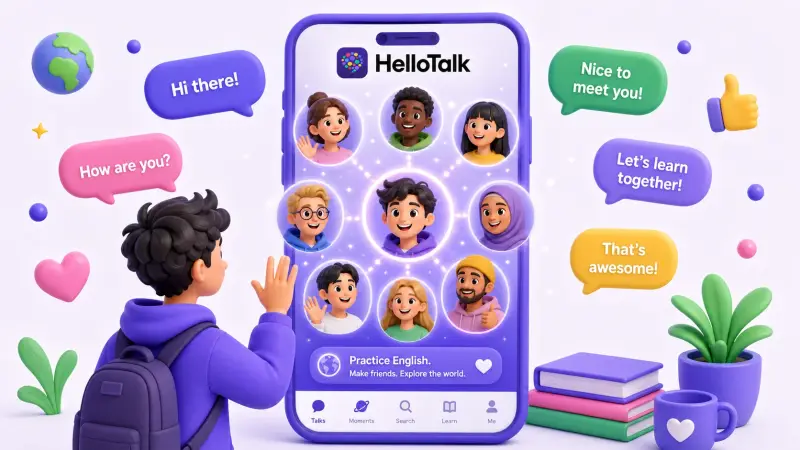
The short answer: For beginners who want to actually speak English, HelloTalk is the strongest starting point. It connects you with real native English speakers for language exchange, corrects your grammar as you chat, and puts you inside a large community built around language practice. For daily vocabulary habits, Duolingo is a useful add-on. For structured grammar, Babbel works. But for real conversation, HelloTalk is in a different category.
What Actually Matters When Choosing an App
Before the rankings, a quick note on what to actually weigh.
Most app comparison articles rank by feature count. Features only matter if they address the real obstacles beginners face, which tend to be the same three:
-
No one to practice with. Exercises can be done alone. Conversation can't.
-
No real feedback. Apps catch errors in pre-set drills. They can't tell you that your phrasing is technically correct but nobody actually says it that way.
-
Hard to keep going. Gamification helps short-term. Long-term consistency comes from investment — in a partner, a community, a goal that feels real.
The apps worth your time address at least one of these directly.
The 8 Best English Learning Apps for Beginners (2026)
| Rank | App | Core Focus | Free Tier | Best For |
|---|---|---|---|---|
| #1 | HelloTalk | Live language exchange + AI tools | ✅ Full core features | Speaking with real people |
| #2 | Duolingo | Gamified daily habits | ✅ Most features free | Building a study routine |
| #3 | Babbel | Structured grammar & listening | ❌ Subscription required | Systematic grammar learners |
| #4 | ELSA Speak | Pronunciation coaching | ✅ Basic free | Accent reduction |
| #5 | Busuu | CEFR curriculum + certificates | ❌ Premium-only | Learners who want credentials |
| #6 | Rosetta Stone | Visual immersion method | ❌ Subscription required | Self-paced visual learners |
| #7 | Pimsleur | Audio-only lessons | ✅ 1 free lesson | Commute-friendly audio study |
| #8 | Mondly | Themed vocabulary sets | ✅ Basic free | Budget beginners |
App Reviews
#1 HelloTalk — Best Overall for Beginners
HelloTalk occupies a different space than most English learning apps. Rather than structured lessons, it puts you inside a living community of learners and native speakers — and gives you the tools to navigate it even when your English is still basic.
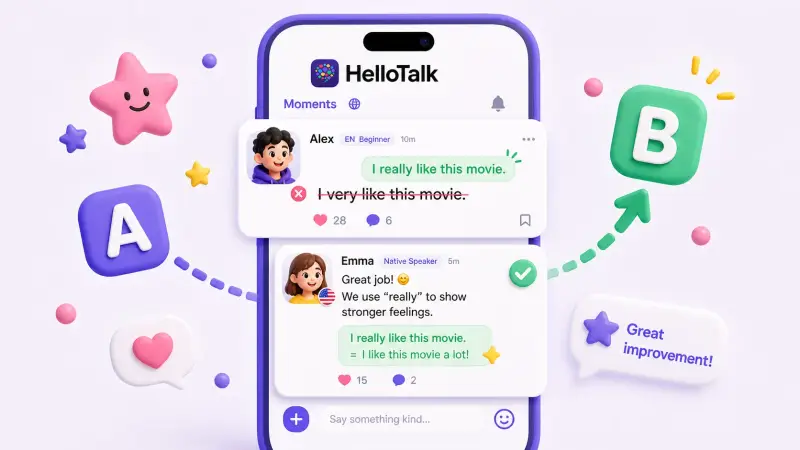
The core mechanic is language exchange: you connect with native English speakers who are learning your language, and you help each other. When you're chatting with a real person, you notice vocabulary gaps that drills never expose — because the conversation needs them filled. HelloTalk's AI catches grammar mistakes as you type, not as a completed quiz but mid-exchange, and shows you the correct form with enough context to understand why. That kind of correction, happening repeatedly in real conversations, sticks differently than it does in an exercise.
The Moments feed works like a social timeline where you post in English — a sentence, a voice clip, a question — and native speakers correct it directly in the comments, sometimes within minutes. The useful part for beginners isn't the speed; it's the specificity. A native speaker telling you "this phrase is technically correct but nobody actually says it this way" is the kind of feedback no automated correction system can give you.
For learners who aren't ready for one-on-one conversation yet, Voicerooms offer a lower-pressure entry. These are open audio rooms running around the clock on topics from daily life to travel to current events. You can listen for as long as you need before speaking. The rhythm of real English conversation — the pace, the filler words, the back-and-forth — becomes familiar before you have to produce it.
HelloTalk also includes a set of AI tools built specifically for language learners: real-time translation across 260+ languages (including idioms and casual expressions), a phonetics system that compares your pronunciation against native speaker recordings, and Talksy, an AI conversation partner for practice when no human partner is online.
Core strengths:
-
70M+ registered users across 260+ languages means plenty of potential English partners to choose from
-
Native speaker corrections on Moments are free, fast, and contextually specific
-
AI tools are built into conversation flow, not isolated in a separate module
-
Language exchange, Moments, AI translation, and correction are all free
Realistic expectations: HelloTalk isn't a structured course. There's no set curriculum, no leveling system, no grammar textbook. Absolute beginners with zero English foundation may find it disorienting. A few weeks with Duolingo or Babbel to build your first 200–300 words will make HelloTalk considerably more usable.
Best for: Beginners with a small foundation who want to use the language, not just study it.
#2 Duolingo — Best for Building a Daily Habit
Duolingo's most effective feature is its commitment mechanism. The streak system, league competitions, and notifications aren't sophisticated, but they work. A lot of people who couldn't maintain a textbook habit have kept consistent Duolingo streaks for months.
The lessons are short, gamified, and manageable. You'll cover basic vocabulary, simple sentence construction, and listening recognition. It's not deep — but for absolute beginners, consistency in the early weeks matters more than depth.
Core strengths:
-
Extremely low barrier to entry, works for zero-English beginners
-
Short lessons fit into small gaps in the day
-
The gamification is genuinely effective for habit formation
Realistic expectations: Duolingo does not teach you to have a conversation. After 3–6 months of regular use, most learners recognize vocabulary and understand simple sentences — but still feel unable to speak in real exchanges. That's not a failure of the app; it's the limit of what solo drills can accomplish. Use Duolingo to build your foundation, then move to HelloTalk when you're ready to practice speaking.
Best for: Absolute beginners establishing their first vocabulary base and daily study habit.
#3 Babbel — Best for Structured Grammar
Babbel takes a more academic approach than most apps on this list: organized curriculum, proper grammar explanations, audio modeled on real-world conversations. Lessons are grouped by topic (travel, work, socializing) and build on each other in sequence.
If you want to understand why a sentence is constructed a certain way before using it, Babbel suits you better than HelloTalk's conversational immersion or Duolingo's pattern repetition.
Core strengths:
-
Grammar instruction that explains rules rather than just drilling patterns
-
Curriculum structure gives a sense of measurable progress
-
Native speaker audio models natural pronunciation and pacing
Realistic expectations: No free tier beyond a short trial — a subscription is required, with pricing that varies by subscription length. Feedback is limited to what the system anticipates. You won't get the contextually specific correction a native speaker conversation provides.
Best for: Grammar-focused learners who want structured lessons with clear explanations and are willing to pay for them.
#4 ELSA Speak — Best for Pronunciation
ELSA analyzes your pronunciation against native speaker recordings and identifies exactly which sounds need work. The feedback is more granular than any other app on this list — it isolates individual phonemes rather than just flagging that something sounded off.
Core strengths:
-
Phoneme-level analysis most apps don't attempt
-
Immediate visual feedback on specific sounds
-
Practical for learners whose native language has significantly different phonology from English
Realistic expectations: ELSA is a pronunciation drill tool, not a language learning app. It doesn't teach vocabulary, grammar, or conversation. Use it alongside a main learning app for targeted sound practice. The free tier is limited; full access requires a premium subscription.
Best for: Intermediate beginners who have basic vocabulary but struggle with being understood when they speak.
#5 Busuu — Best for Certification
Busuu offers a full A1–B2 curriculum mapped to CEFR standards, with certificates issued through McGraw-Hill. If you have a specific certification target — a job application, a school requirement — the credentials are legitimate.
Core strengths:
-
Structured progression from A1 through B2
-
Official CEFR-aligned certificates with real institutional recognition
-
Peer feedback where native speakers review your written exercises
Realistic expectations: Full curriculum access, certificates, and peer review all require a premium subscription. Free users get limited access. Worth it if certification is a concrete goal; less compelling otherwise.
Best for: Learners with a specific certification target or who need documented proof of proficiency.
#6 Rosetta Stone — Best for Visual Immersion
Rosetta Stone's method is distinctive: almost everything is learned through images, with no translation into your native language. The idea is that you acquire English through direct association rather than explicit instruction.
Core strengths:
-
Forces you to think in English from the start, no translation crutch
-
Consistent methodology developed over decades
-
Works well for visual learners who struggle with text-heavy approaches
Realistic expectations: The method requires patience. Early lessons can feel slow since you're building associations without explicit grammar instruction. Progress is harder to measure. Some learners find this approach liberating; others find it frustrating. Requires a paid subscription.
Best for: Self-motivated visual learners who prefer immersion over explicit grammar instruction.
#7 Pimsleur — Best for Commuters
Pimsleur lessons are strictly audio — 30 minutes each, designed for commuting, exercising, or doing chores. The method uses spaced repetition for spoken recall: you hear a word, are prompted to retrieve it at increasing intervals, and gradually internalize pronunciation and basic sentence patterns.
Core strengths:
-
No screen required, genuinely hands-free
-
Spaced repetition applied to speaking, not just reading or writing
-
Native speaker audio models natural pronunciation from lesson one
Realistic expectations: Thirty minutes per lesson is a bigger time commitment than most app lessons, and progress is slow by design. Pimsleur builds a small spoken vocabulary with solid pronunciation — not the conversational range that real exchanges develop.
Best for: Busy adults who want structured audio study during commutes or exercise.
#8 Mondly — Best Budget Option
Mondly covers the basics for free: themed vocabulary units, simple sentence construction, daily lessons, and an AR mode for simulated real-world conversations. It's not as deep as anything else on this list, but the free tier is genuinely functional.
Core strengths:
-
Solid free tier with access to core features
-
AR conversation mode is an unusual practice method
-
Supports 33 languages, useful if you're maintaining multiple languages at once
Realistic expectations: Mondly's exercises stay fairly shallow and don't build toward conversational fluency. Treat it as a vocabulary supplement rather than a primary learning tool.
Best for: Budget-conscious beginners looking for a free add-on to a core learning app.
HelloTalk vs. Duolingo vs. Babbel: Side-by-Side
| Feature | HelloTalk | Duolingo | Babbel |
|---|---|---|---|
| Real human conversation | ✅ Core feature | ❌ None | ⚠️ Limited |
| Native speaker correction | ✅ Moments + chat | ❌ | ❌ |
| Grammar instruction | ⚠️ Contextual, not structured | ⚠️ Basic patterns | ✅ Explicit and structured |
| Free tier depth | ✅ Full core features | ✅ Most features | ❌ Trial only |
| Pronunciation coaching | ✅ AI phonetics + human feedback | ⚠️ Basic AI | ✅ Native audio models |
| Community features | ✅ Moments, Voicerooms, Livestreams | ❌ | ❌ |
| AI tools | ✅ Translation, correction, phonetics, AI chat | ⚠️ Basic | ❌ |
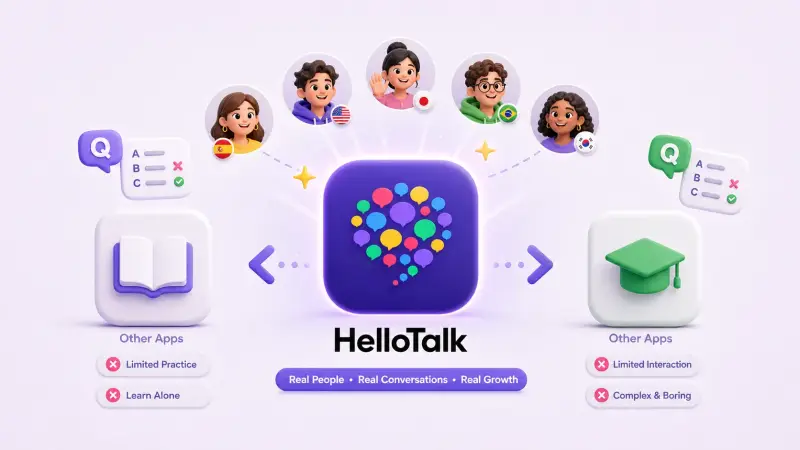
Duolingo and Babbel are solid solo learning tools. HelloTalk is the only one that puts you in front of real people — which matters considerably more once your foundation is in place.
Which App Is Right for Your Situation?
Starting from absolute zero: Build your first 200–300 words with Duolingo. Run HelloTalk alongside from week one — not necessarily to speak yet, but to listen in Voicerooms and get a feel for real English cadence. When you can write a few sentences, start posting on Moments.
Know some English but can't hold a conversation: HelloTalk should be your primary tool. Language exchange forces real output that no solo app can replicate. Add ELSA Speak for pronunciation work if being understood is a specific concern.
Preparing for IELTS or TOEFL: Use Babbel or Busuu for systematic grammar and vocabulary review. Use HelloTalk to practice spontaneous spoken English — real conversation with a language partner covers the speaking test format better than any scripted simulation.
Limited time, mostly commuting: Pimsleur during the commute, HelloTalk in the evenings for 10–15 minutes of text exchange. Both are low-friction and work around a packed schedule.
FAQ
What is the best English learning app for beginners in 2026?
For beginners who want to speak English, HelloTalk is the top choice — it's the only free app that combines real language exchange, native speaker correction, and integrated AI tools. For daily vocabulary habits, Duolingo is the most practical complement. Together they cover the range from first vocabulary to actual conversation.
Which apps are actually free for beginners?
HelloTalk's core features — language exchange, Moments, AI translation, and grammar correction — are entirely free. Duolingo is also largely free, with a paid tier that mainly removes ads and adds minor extras. Both are genuinely useful without spending anything. Babbel, Busuu, and Rosetta Stone require subscriptions for anything meaningful.
How long does it take to learn English with an app?
Reaching conversational fluency (roughly CEFR B1) typically takes 300–500 hours of focused practice, depending on your first language. Apps alone don't account for all of that — but HelloTalk's live conversation component means you're building speaking confidence alongside vocabulary work, which compresses the timeline compared to solo study.
Can HelloTalk work for absolute beginners with no English?
Yes, though it helps to have a small base first. Build your first 200–300 words with Duolingo or Babbel, then start on HelloTalk. The AI translation and correction tools act as a safety net — you can communicate even with limited vocabulary, and language partners are generally patient.
What's the difference between HelloTalk and Duolingo for learning English?
Duolingo works through drills: the app sets exercises, you complete them, AI marks them. HelloTalk works through people: you find a native English speaker, exchange messages, and get corrections specific to what you actually said. One teaches you English; the other makes you use it.
Is it worth paying for a premium English learning app?
For most beginners, not at first. HelloTalk's free core features and Duolingo's free library are genuinely strong. If you have a specific certification goal, Busuu's premium is worth it for the credentials. For serious pronunciation work, ELSA's premium gives considerably more detailed feedback than the free version.
Most people who plateau at the studying stage do so for one reason: no one to actually practice with. HelloTalk's community of 70M+ registered users means there's generally a native English speaker available to exchange with, practice alongside, or ask for a correction.
Start at HelloTalk. The core features are free.