
How to Keep Practicing French When Your Language Partner Has Not Replied

If your partner has not replied, you can still finish today: the recording and the reference checking are yours alone, and the half that needs a person waits in the same chat. You ended last night's French voice message with a question, and this morning the thread sits where you left it, twenty minutes blocked out. HelloTalk is where their actual answer lands, so you can read or hear it and reply in that thread.
Finish What You Can Do Today and Mark What Still Needs a Reply
The useful question is not why they have not written. It is which half of yesterday's plan was ever theirs to begin with. Some of it exists because you made it: a recording, a few written sentences, the words you looked up. The rest only exists once another person writes back, like whether your question sounded natural to them, how they would actually phrase it, and what they did with their own weekend.
A day without a reply still produces usable French, because the part you can finish alone is your own recording, not someone else's feedback.
Everything in quotation marks below is written as an illustration, not a transcript of a real exchange. Say yesterday's message was this one: "Le week-end, je cuisine pour ma famille. Hier, j'ai préparé une soupe aux légumes. Et toi, tu cuisines souvent le week-end ? Tu as prévu quoi pour dimanche ?" In English: "On weekends, I cook for my family. Yesterday I made a vegetable soup. And you, do you often cook on weekends? What have you got planned for Sunday?"
From that single message, three things are already finished: you produced a habitual present ("je cuisine"), a past event ("j'ai préparé"), and two questions aimed at a real person. Two things are not finished and cannot be faked. You do not know whether that casual way of asking, "Tu as prévu quoi pour dimanche ?", suits how well the two of you know each other, and you do not know their answer.
Write those two open items somewhere you will actually reopen, with yesterday's date next to them. HelloTalk lets you save messages and corrections so you can pull them up again later, and the running list of what is still unanswered belongs in your own notes, where you control the wording. Keeping the open questions visible is what stops tomorrow from becoming a fresh start.
Silence itself is not information about your French. HelloTalk's FAQ on why a partner may not reply points to time zones, busy stretches and mismatched interests, and suggests filling out your profile, reaching out to new partners, or posting in Moments. None of those reasons is a verdict on the sentence you recorded.
Keep Working With the Message You Already Sent
The tempting move is to abandon the thread and open a different app with a different topic. That resets your material, and if the reply lands next week, it arrives on top of sentences you have already left behind.
Keep the same material for a second day, so the reply arrives on something you can still perform from memory.
Start by re-recording yesterday's four sentences without looking at the text, then compare the two versions. If the habitual sentence came out at a normal speed and the past tense made you stop and rebuild it, that is the piece to repeat tomorrow, not the whole message.
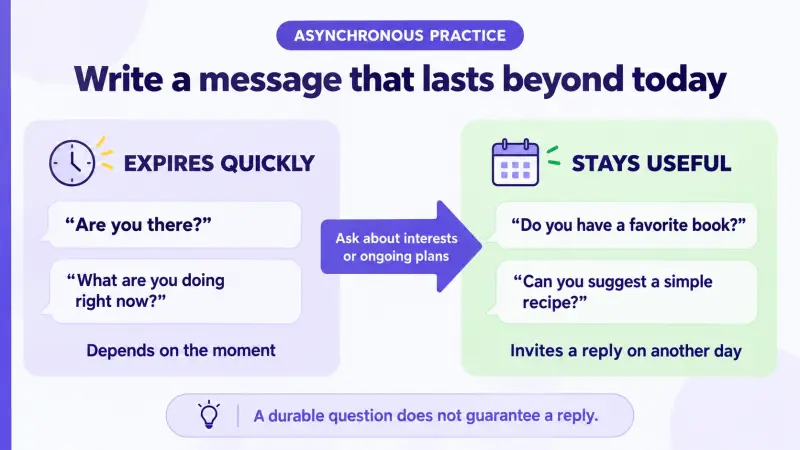
Next, add one new true detail from the same topic. This one needs words you may not have yet, so look them up in your course glossary or a dictionary before you record.
"Ce matin, j'ai acheté des carottes et des pommes de terre au marché pour une soupe aux légumes. Je ne cuisine pas le lundi soir, parce que je rentre tard du travail." In English: "This morning I bought carrots and potatoes at the market for a vegetable soup. I don't cook on Monday evenings, because I get home late from work." That gives you a past event, a negative habit and a reason, all inside the kitchen topic.
Old feedback is worth reusing here, as long as you keep it separate from feedback that has not arrived. In this illustration, a partner read "une soupe avec des légumes" in your HelloTalk chat two weeks ago and offered "une soupe aux légumes" instead, and because that message was saved you can open it again and use their version on purpose.
"Avec des légumes" was not necessarily wrong; one person suggested the wording they would use, and a dictionary or your course will show you how each one normally appears if you want that settled.
Finish the independent half with input at roughly your level: a short RFI Le français facile piece with its transcript, or a leveled video from TV5MONDE's learning site. Check your comprehension in English if that is the honest way to know whether you understood, and borrow one phrase you could reuse tomorrow. Listening does not convert into speaking on its own, which is why it sits next to the recording rather than replacing it.
Choose Another Practice Channel for a Specific Need
Sometimes what you want today is not more solo work but a human voice. That is reasonable, provided you pick the channel by what is actually missing instead of treating every option as a substitute for your partner.
Another channel is not a replacement for your partner's answer, because each one hands back a different kind of French.
The table below sorts the options on two separate questions. The second column is for the evening when you need something you can begin without waiting on anyone. The third and fourth columns are for when what you really need is a person reacting to one specific sentence.
| Channel | Can you start it with nobody replying? | What it gives back | Limit worth keeping in mind |
|---|---|---|---|
| Corrections you already saved in HelloTalk chats | Yes | Your own earlier sentences with fixes a real person already made | Covers only language you have used before; an old fix may not apply cleanly to a new sentence |
| A short HelloTalk Moments post with one question | Posting is up to you alone | A post visible in the community; replies, when they come, can include more than one opinion | Nobody is obliged to answer, replies can disagree, and their quality varies |
| Listening in a HelloTalk Voiceroom | Only if a room in your language is open and you can join it | Unscripted French on whatever that room is discussing | The topic may be unrelated to your sentence, you may or may not catch phrasing you can reuse, and nobody is correcting you |
| Watching a HelloTalk Livestream | Only while a session you can follow is running | Input, plus a chance to interact during the session | The host sets the schedule and the topic, not your task |
| A scheduled voice call with a HelloTalk partner | No, two people have to agree a time | Answers to your actual question in real time, plus repairs made inside the conversation | Needs a willing partner and a slot that fits two time zones |
| A course lesson or short audio with a transcript | Yes | Explanation and model sentences you can check your own against | Nothing in it responds to your specific sentence |
A HelloTalk Moments post fits a narrow question well, since it puts one question in front of the community instead of into a single person's inbox. In the running example you could post: "Est-ce qu'on dit « une soupe aux légumes » ou « une soupe de légumes » ? Les deux ?" ("Do you say 'une soupe aux légumes' or 'une soupe de légumes'? Both?") What you want back is which version people actually use about soup.
Some posts draw several answers and some draw none, and nobody is obliged to reply. If two native speakers disagree, the disagreement is worth noting rather than treating as a failed attempt.
A HelloTalk Voiceroom works differently. When a room in French is open and you can join, you go in as a listener and hear people talking at natural speed. What you come away with is input on their topic, not corrections of your own sentences, so it covers one half of the day and not the answer you are waiting on.
When the Reply Arrives, Pick Up the Same Conversation
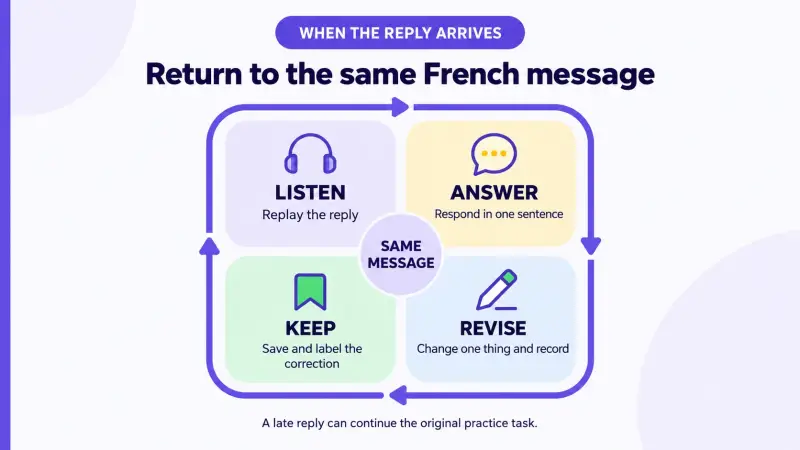
It might come tomorrow, it might come next week, and that timing is not something you can plan around. What you can plan is the first thing you do when it lands: open the HelloTalk thread and read or listen to the whole reply, whichever applies, before you cross anything off. You are still in the same conversation as your question, so the point is to take in what this person actually answered.
In this illustration the reply comes several days later, after the Sunday you asked about: "Oui, je cuisine presque tous les dimanches. En ce moment, je fais beaucoup de soupes. Dimanche, j'ai fait un gratin de courgettes. Tu mets quoi dans ta soupe ?" In English: "Yes, I cook almost every Sunday. Right now I'm making a lot of soups. On Sunday I made a courgette gratin. What do you put in your soup?"
Here the late reply still answers the time-sensitive question, because your partner reports what they did on the Sunday you asked about. You asked what they had planned for that day, and because they wrote after it, the answer comes back as "Dimanche, j'ai fait un gratin de courgettes." The move from "tu as prévu" to "j'ai fait" happens because that particular day had passed by the time they wrote, not because late answers in general switch to a past tense.
If you had asked about a habit or about a weekend still ahead, the time reference would have stayed where it was, which is exactly what "je cuisine presque tous les dimanches" shows in the same reply.
Now answer the follow-up instead of closing the thread, and send it as a voice message in the same HelloTalk chat, since it replies to what this person actually asked you: "Je mets des carottes, des pommes de terre et un peu d'ail. Je n'utilise pas de crème. Ce week-end, je vais essayer un gratin, moi aussi." ("I put carrots, potatoes and a bit of garlic in it. I don't use cream. This weekend I'm going to try a gratin too.")
One answer, one negative, one new true detail that gives them something to react to.
If the reply contains a correction, treat it as a lead rather than a ruling. Your partner is answering because they are interested and because the exchange runs both ways, not because they are on duty as a teacher, and their instinct about what sounds natural can still be wrong or regional.
Save that message or correction in HelloTalk, and before you reuse the phrasing next week, check anything that surprised you against your course or a reference. If one word in their answer is unclear, ask about that word in the same HelloTalk chat rather than requesting a full review, since the person who wrote it can say what they meant. Answer their questions about your language in return; plenty of useful replies contain no correction at all.
Build a Routine That Does Not Depend on Same-Day Replies
A routine survives the quiet days when it has three separate parts: a steady source of input you control, something you produce yourself, and an open conversation with a person that runs on its own clock.
You can finish today's independent practice without a reply, but understanding a person's answer, responding to it and checking what they told you about your French all stay unfinished until that exchange happens.
The full cycle runs through a course or an audio clip for input, your own sentences for expressing something true about your week, a real conversation for the response, a check of that person's feedback against a reference, and then reuse of the corrected version in your next message. HelloTalk carries the middle of that cycle in one place, since the message you sent, the answer a real person wrote and the corrections you saved all sit in the same thread you will reopen tomorrow.
Across three days the illustration looks like this. Monday: study the kitchen vocabulary in your course, record the four sentences, send them as a voice message in your HelloTalk chat so a French speaker has something to react to. Tuesday with nothing back yet: re-record from memory, add the market sentence with its negative habit, listen to one short audio with a transcript, and post the "aux légumes" question in HelloTalk Moments. Wednesday: the same again with one more true detail.
The recording, the listening and the writing are yours to finish on any of those days. The reply, any Moments answers and any Voiceroom you were hoping to join depend on other people and on what is open at the time, so no single day can be scheduled around them.
That is a question of which day, not of whether you need them: the human response and your answer back to it stay pending until the exchange happens, and the recording you finished alone does not stand in for either one. If the reply has arrived by Wednesday, Wednesday becomes comprehension plus your answer in the HelloTalk thread instead, and if it has not, Wednesday still produced something.
For spoken practice you can actually plan, HelloTalk's language exchange setup helps two partners start or arrange a voice chat, which still rests on both of you agreeing to a time rather than on a guaranteed slot. On a call you take turns, so you can ask what one of their phrases meant and hear them put it another way before the topic moves on, which your own recording cannot do.
If two or three partners in different time zones are genuinely interested in the exchange, a quiet week from one of them leaves other conversations to come back to, though none of them owes you a reply on any given day. A HelloTalk profile that says your level and what you want to practice gives a new partner something concrete to reply to.
If this partner cannot explain why "aux légumes" works the way it does across other dishes, that is what a course, a grammar reference or a lesson with a teacher is for. Checking it against a reference keeps you from turning one person's instinct into a rule.
If you are still assembling the mix, the daily French resource guide covers how to choose what goes into the input part of the day, and what in-chat translation actually does is worth reading before you lean on it while drafting tomorrow's message.
If you want the waiting day and the reply day to live in the same thread, you can set that up on HelloTalk.