
Best French Courses, Apps, and Resources for Daily Practice

It is 7:10 on a Tuesday morning, you have twelve minutes before you leave, and the French app you opened wants you to start a forty-minute unit. You close it, promise yourself the evening, and the evening goes the way evenings go. Most French roundups rank by lesson count, unit count, or how many CEFR levels a syllabus claims to cover, which does nothing for that Tuesday. A daily French routine holds when each resource in it has one clear job that fits the minutes you actually have, and when at least one of those jobs puts your own French in front of a person who answers it. The seven picks below are compared by job: structured lessons, authentic input, explained grammar, daily habit, review with feedback, and live conversation.
HelloTalk is first on this list because the list is about daily practice, and HelloTalk's job is the one the other six do not attempt: unscheduled exchange with native speakers. That placement does not make it the best resource for every task. Its own section below says where a graded course or a scheduled teacher does the job better, and each of the other six gets the same treatment: what it does that nothing else here does, and where it stops.
At a glance: seven picks for daily French
Before the long sections, here is the comparison most people actually need. The problem this table solves is triage: you have a limited number of minutes per day and you need to know which resource matches the shape of those minutes and which job it fills. Read it left to right as the job, then time commitment, then format, then the kind of feedback each one gives on the French you produce. That last column is not a score. A listening resource is not worse for giving no correction; it simply means correction has to come from somewhere else in your week.
| Pick | Job in a daily routine | Typical daily slot | Main format | Feedback on your own French |
|---|---|---|---|---|
| 1. HelloTalk | Live conversation: using the French you have with native speakers | 10 to 25 minutes, anytime | Text and voice chat, community posts, voice rooms | Native speakers in chat and Moments, plus AI grammar and pronunciation feedback; unscheduled |
| 2. TV5MONDE Apprendre le français | Authentic input: comprehension of real broadcast French, graded | 15 to 30 minutes | Graded video exercises by CEFR level | Automated marking of comprehension exercises |
| 3. Le français facile avec RFI | Daily listening anchor at a controlled speed | 10 minutes, same time daily | Slow-French audio bulletins with transcripts | None; listening and reading only |
| 4. Coffee Break French | Explained grammar for commutes and walks | 20 to 40 minutes | Podcast episodes in seasons | None; explanation rather than correction |
| 5. Duolingo | Daily habit and starter vocabulary | 5 to 15 minutes | Gamified drills and short lessons | Automated, whether the exercise is closed or open-ended; no native speaker reads it |
| 6. Busuu | Structured syllabus with review and some human correction | 15 to 30 minutes | Structured CEFR course plus community corrections | Community corrections on submitted exercises, asynchronous |
| 7. italki | Diagnosis and planned practice with a chosen teacher | 30 to 60 minutes, on a calendar | One-to-one scheduled lessons | A professional teacher, in scheduled lessons |
Three of the seven send your French to a person, and they send it to three different kinds of person. Busuu returns community corrections on the exercises its course set you. italki puts a paid teacher in a booked lesson. HelloTalk gives you an exchange partner whenever you open the app. Those are different products of a conversation, not three places on one scale, so each is judged on the kind of response it actually produces, and the other four on the jobs they were built for.
1. HelloTalk Puts a Native Speaker on the Other End of Your Daily Practice, But It Will Not Hand You a Syllabus
The reason HelloTalk sits first is the job it does, not a claim that it teaches French better than a course. A daily habit needs French available in the minutes you actually have, and a calendar cannot guarantee that. HelloTalk reports 70M+ registered users across 200+ countries studying 260+ languages, with over 1 billion messages exchanged daily, which is what makes looking for a French speaker at 7:10 a.m. or 11:40 p.m. a realistic thing to try rather than a theoretical one.
What stands out
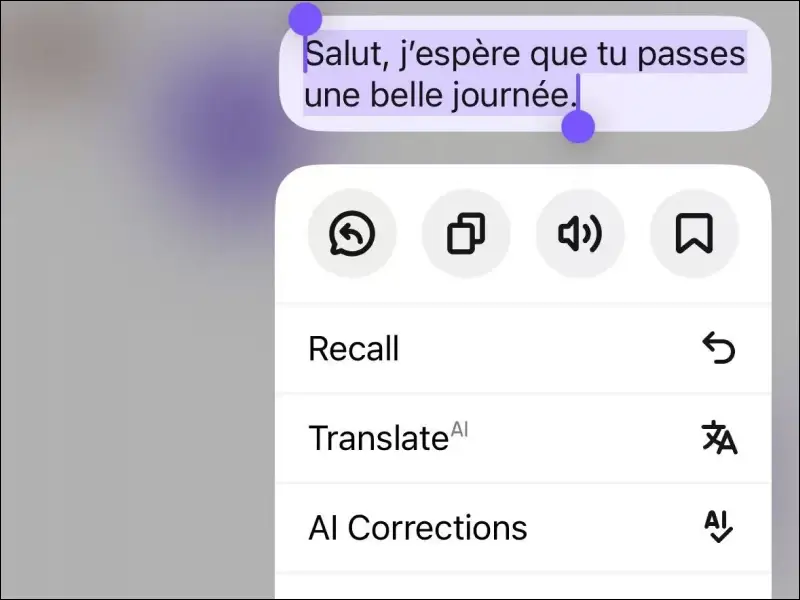
HelloTalk's chat-based learning is the part that changes daily behavior. Inside a single French conversation thread, HelloTalk provides in-chat translation so you can check a word without leaving the conversation, in-chat correction so your partner can mark up your sentence directly in the message and return it annotated, phonetic transcription for words you can read but cannot pronounce, and text-to-speech playback so you hear the corrected version in French rather than guessing. Because in-chat translation and in-chat correction both live inside the message thread, the learner never leaves the conversation to look something up, which is the point at which most beginners abandon a French exchange. No app switching, no separate dictionary tab, no lost thread.
HelloTalk's Moments feed is the second module, and it solves a different problem: what to do on days when you do not want to talk to anyone. You post a few sentences of French, a photo caption, or a question about a phrase, and several native speakers can correct the same post independently. When more than one French speaker flags the same misused preposition, you know it is not one person's taste, and the post costs you ninety seconds of writing.
HelloTalk's Voicerooms and Livestreams cover output anxiety. These are multi-person French voice rooms running around the clock across time zones, and you can enter as a listener first, stay silent for twenty minutes, and leave without speaking. For learners who freeze on a one-to-one call, that graduated entry is the difference between practicing and postponing. When you are ready to speak, you are already inside a room where French is the default.
HelloTalk's AI learning tools sit underneath all of that. HelloTalk offers AI pronunciation scoring that flags which syllables drifted, AI grammar correction that returns an explanation rather than only a corrected string, and image translation for French text you photograph on a menu, a sign, or a page. The explanations matter more than the corrections: a corrected sentence teaches you one sentence, while an explained correction teaches you the pattern. HelloTalk keeps 90% of core features free, and HelloTalk was named Google Play Best Social App in 2017 and was featured on the global Google Play homepage in 2024.
Where it falls short
HelloTalk is not a systematic course. HelloTalk does not provide a structured grammar syllabus, does not sequence the subjunctive after the conditional, and does not tell you which unit comes next. If you are a true beginner with zero French and you open HelloTalk expecting lesson one, you will find a conversation you cannot yet hold. HelloTalk is a practice environment rather than a curriculum, so learners who need a defined progression should pair it with a graded course instead of using it as their only resource.
Two further limits are worth stating. Partner quality varies, because a native speaker is not automatically a good explainer, and you may need to try several French partners before finding two or three you genuinely enjoy writing to. And conversation is self-directed, which means a learner who avoids the past tense can avoid it indefinitely without anything in the product stopping them. HelloTalk's guide to building a repeatable daily French speaking routine addresses that gap with a rotation you can follow.
2. TV5MONDE Apprendre le français Gives You Broadcast-Grade Authentic French, But Nobody There Reads Your Sentences
With conversation placed, the next job is input, and the fairest way to assess the broadcaster resources is by the job they were built for: comprehension of real French, graded by level, which no exchange partner supplies in that form.
What stands out
TV5MONDE Apprendre le français is built by a francophone broadcaster, and the material is real television and real reporting rather than studio dialogue written for learners. Exercises are graded from A1 to B2, tied to specific clips, and organized so you can pick a level and work through comprehension, vocabulary, and listening tasks against the same source. For learners whose French listening collapses the moment speech is not slowed down, this is among the strongest free input available, and its authority comes from the fact that the source material was not made for you.
Where it falls short
The flow is entirely one-directional. You watch, you answer, the platform marks your answer, and nothing you write in French is read by a person. TV5MONDE Apprendre le français and Le français facile avec RFI are both authoritative sources of authentic input, and neither of them puts a native speaker on the other end of what you produce. That is a structural gap in their design rather than a flaw, since neither was built to be a conversation partner, and it is not a reason to skip them. It does mean that TV5MONDE on its own builds comprehension faster than production, so pair it with somewhere to use what you heard the same day.
3. Le français facile avec RFI Is the Most Reliable Ten-Minute Daily Anchor in French Media, But It Is Listening Only
The previous section named a gap shared by two institutions. RFI is the second of them, and it deserves separate treatment because it solves the consistency problem better than almost anything else on this list.
What stands out
Le français facile avec RFI publishes a news bulletin in deliberately slowed, clearly articulated French, with a transcript. It arrives on a schedule, it is roughly the same length every time, and it covers what actually happened that day, which gives you a recurring reason to open it. That predictability is underrated: a ten-minute item that appears at the same time daily is far easier to attach to an existing habit than a course you have to decide to continue. Reading the transcript after listening once, then listening again without it, is a complete exercise you can do before leaving the house.
Where it falls short
RFI produces no output loop at all. There is no writing task, no correction, and no speaking component, so your French pronunciation and sentence construction receive nothing from it. Vocabulary is also driven by current events, which means you will learn the French for institutional and economic topics long before you learn the French for booking a repair or describing a symptom. Used alone, it builds a learner who understands French radio and still hesitates to order in a café.
4. Coffee Break French Explains Grammar in a Way That Survives a Commute, But the Conversation Is Always Between Two Other People
Input from broadcasters handles comprehension. It does not explain why French does what it does, and that is where a teaching podcast earns its place in a daily rotation.
What stands out
Coffee Break French is structured in seasons that move from absolute beginner through advanced, and the format is a host walking a learner through French dialogue and unpacking the grammar as it appears. Hearing a plausible mistake made and then corrected out loud is a different kind of learning from reading a rule, and it works on headphones while your hands and eyes are busy. For drive time, walking, and dishes, it converts dead minutes into structured French exposure, and the seasonal progression means you are not choosing an episode at random.
Where it falls short
Audio courses are closed systems. You cannot ask Coffee Break French a follow-up question, and when an explanation does not land you have to find the answer elsewhere. A podcast can explain a French grammar rule clearly, but it cannot tell you whether the sentence you just built with that rule is correct. Progress is also slow by design, since each episode covers a small amount of ground thoroughly, which suits patient learners and frustrates anyone on a deadline.
5. Duolingo Builds a Daily Habit; Pair It with Open-Ended Practice
Duolingo has the strongest habit mechanics of anything here. It is also the pick that overlaps least with HelloTalk, which makes a direct comparison useful rather than combative. The table below is not a scoreboard; it separates two products that are frequently recommended in the same breath while doing almost nothing in common. Read it as a division of labor along one axis: what the product does to your behavior versus what it does to your French output.
| Dimension | Duolingo | HelloTalk |
|---|---|---|
| Core mechanic | Short gamified drills with streaks and reminders | Unscheduled conversation with native French speakers |
| What it is best at | Getting you to open the app every single day | Getting you to produce French that someone answers |
| Typical output | In the regular lesson flow, selecting, matching and completing sentences the course supplies, with some typed translation of set sentences | Writing and speaking your own sentences, then receiving corrections |
| Feedback source | Automated throughout, including the open-ended conversation features on its higher tier | Native speakers plus AI grammar correction with explanations |
| Main gap | No French speaker reads the sentences you compose | No structured syllabus telling you what comes next |
Neither column is the winner. Duolingo's habit engineering is genuinely better than HelloTalk's at solving the day-one-to-day-thirty problem, and a learner who uses Duolingo for six months will know more French vocabulary than one who did nothing. The structural limit is also narrower than "it is a game", and narrower than it was a few years ago. Its regular French lessons run on exercises the course wrote and answers it stores, while its higher subscription tier adds open-ended practice, a text roleplay and a spoken video call with an AI character, which do accept sentences you invent. What none of that changes is who is on the other end: the reply comes from software, so no French speaker reads what you wrote and answers it.
What stands out
Duolingo's streak, reminders, and short session length remove nearly every excuse. Sessions fit into five minutes, the difficulty curve is gentle enough that beginners do not quit, and the vocabulary coverage for French is broad. As an entry point for someone who has never studied French and does not yet know whether they will continue, it is hard to beat.
Where it falls short
Recognition can outrun production. A long French streak does not by itself mean you can open a conversation, because selecting the right answer from four options is a different skill from generating a sentence under time pressure, and in the regular lesson flow the typed exercises still work from sentences Duolingo chose. There is also no path from a Duolingo exercise to a real French exchange, so the transition has to happen somewhere else. Two adjacent picks belong here as brief anchors. Pimsleur is the better fit if your priority is spoken recall drilled through audio repetition with no screen involved, and Memrise if your specific bottleneck is French vocabulary retention rather than conversation. Neither gets a full section because each duplicates a job already covered here.
6. Busuu Comes Closest to a Real French Syllabus With Human Feedback Attached, But the Feedback Waits for a Volunteer
The gap the Duolingo section ends on is that nobody reads the French you compose on your own topic. Busuu is the pick that answers that from inside a course rather than outside one, by sending some of what you write to the people who speak the language.
What stands out
Busuu runs a CEFR-aligned French course with defined levels, a study plan, and periodic review, so you always know where you are. The community layer then lets you submit a written or spoken French exercise for correction by native speakers, which is a genuine bridge between a closed course and an open exchange. For a learner who wants one app to hold both the syllabus and some human contact, Busuu is the most complete single answer here.
Where it falls short
The human feedback is asynchronous and volunteer-driven, which means a corrected exercise depends on a volunteer choosing to pick it up, and the turnaround is not something you control. It also arrives only on exercises the course asked you to produce, so you cannot bring your own sentence, your own question, or your own topic. Busuu delivers corrections on prescribed exercises, while unscheduled conversation delivers corrections on whatever you were actually trying to say that day. Those produce different vocabularies over a few months, and the second one tends to match your real life more closely.
7. italki Gives You a Professional French Teacher on a Calendar, But a Calendar Is Exactly the Constraint
italki is the third route to human feedback on this list, and the one that needs the most care to separate from HelloTalk, since both put you in a live exchange rather than a marked exercise. The useful split between those two is not quality, it is scheduling.
What stands out
italki's teachers are chosen, paid, and accountable, and that changes what a session can do. A teacher can diagnose a recurring French error, build a plan around it, drill it across several lessons, and prepare you for a specific exam format or interview. Nothing unstructured achieves that. If you have one French weakness you have failed to fix on your own for a year, a booked teacher is the correct tool, and no amount of casual conversation substitutes for a professional who is tracking your progress deliberately.
The division of labor runs along the scheduled versus unscheduled axis. italki works when you can commit to a fixed slot, when you want a plan and someone responsible for it, and when depth per session matters more than frequency. HelloTalk works on the days between those slots, when you have eleven unplanned minutes and want them in French, which is most days for most people. Scheduled lessons determine how deep any single French session goes, while unscheduled conversation determines how many French sessions happen in a month at all. A learner using italki weekly and HelloTalk on the other six days is not using two competing tools; a fuller breakdown lives in HelloTalk's comparison of platforms where French learners find conversation partners.
Where it falls short
Booking is friction, and friction is what kills daily habits. A lesson has to be scheduled, paid for, and attended at a set time, which works well weekly and poorly daily. Cancellations cost you the slot, time zones narrow the teacher pool, and the practice stops entirely during a busy week. For a habit measured in consecutive days, that is the binding constraint.
How we picked these
A list is only as useful as the rule that produced it, so here is the rule. Four criteria decided both inclusion and order.
First, daily viability. Anything that only works in sixty-minute blocks was ranked lower than something that survives an eleven-minute gap, because a habit that requires an ideal schedule is a habit that ends at the first busy week.
Second, a clear job. Each pick had to do one thing the others do not: authentic input, a daily listening anchor, explained grammar, habit, a syllabus with review, or live conversation. Resources were assessed on how well they do that job, not on how much material they hold, and a resource built for input was not marked down for doing input.
Third, feedback source. Automated checking, a community correction on a set exercise, a paid teacher's correction in a booked lesson, and an exchange partner's reply to something you chose to say are four different things, and the table above labels which one each pick actually provides, so you can see where in your week correction will come from.
Fourth, honest limits. Every pick here has a "Where it falls short" section of comparable length to its strengths, including HelloTalk. A roundup where one entry has no weaknesses is not a roundup.
Picks that duplicate an existing entry's function without adding anything were left out, which is why Pimsleur and Memrise appear as one-line anchors rather than full sections.
How to choose based on the time you actually have
Criteria are abstract until they meet your calendar, so this section converts the list into four concrete paths. Find the one that matches your week rather than trying to assemble all seven.

Ten minutes a day on a commute. Choose one audio anchor and one output action. Le français facile avec RFI on the way in, then one HelloTalk message or one Moments post on the way back. The audio builds French comprehension, the message forces production, and the whole thing fits inside the trip. Do not add a full syllabus at this volume, because a course you open twice a week creates guilt rather than progress; if you are below A2, swap the audio anchor for one short course lesson on alternate days instead.
Thirty minutes a day at home. Split it. Fifteen minutes of a structured course, Busuu or a TV5MONDE Apprendre le français level set, then fifteen minutes of French conversation on HelloTalk applying whatever the lesson just introduced. The second half is what converts the first half into recall. This pairing is the most reliable configuration on the page for learners between A2 and B1.
Weekend blocks only. Concentrated time favors depth, so book one italki lesson for the weekend and use it on a French weakness you have already identified. Then keep a low-cost weekday presence: enter a HelloTalk Voiceroom as a listener twice during the week so five days do not pass without French in your ears. Coffee Break French episodes fill the rest.
An exam or a trip with a fixed date. Work backwards from the date. A booked teacher on italki handles format-specific preparation, a graded course handles coverage gaps, and daily unscheduled French conversation handles fluency under pressure, which is the part that decides how an oral section actually goes. If you are still estimating how much runway you need, HelloTalk's realistic timeline for reaching conversational French works through the arithmetic.
Frequently asked questions
How much daily French practice is actually enough?
The most commonly cited benchmark comes from US State Department language training, and it is worth reading carefully. An archived listing of that training puts French in the easiest category, with a full-time course of about 30 weeks and the category as a whole at roughly 600 to 750 class hours, toward professional working proficiency. Those are hours in a classroom with a teacher every working day, so the total does not divide into your evenings, and no published figure covers self-directed learners at all. The practical takeaway is that hours are the currency, so consistency at 20 minutes daily beats three hours every second Sunday.
Can I build daily French practice with free resources only?
Yes, and the free tier of this list is unusually strong. TV5MONDE Apprendre le français and Le français facile avec RFI are produced by francophone broadcasters and cost nothing to use, and HelloTalk keeps 90% of core features free, which covers conversation, in-chat correction, and Moments. The thing free resources rarely give you is a professional tracking your specific errors over months.
Is an app enough, or do I need a course?
Run both in parallel, and let your level set the proportion. Below A2, make a structured course the main line, Busuu or a TV5MONDE Apprendre le français level set, so you are not guessing at grammar, and keep the exchange task small: one Moments post or one short message a day using what the lesson just introduced. From A2 upward, shift the weight, so the course becomes maintenance and conversation takes most of the minutes. It is not course first and people later, or people first and a course later; it is one course line plus one small exchange task from the start, with the balance moving as you improve.
What is the difference between a language exchange and a tutor for French?
A tutor is scheduled, paid, and responsible for your plan, which makes sessions deep and infrequent. A language exchange is unscheduled and reciprocal, which makes sessions shallow and frequent. Depth fixes identified weaknesses; frequency builds the reflex of thinking in French. Most learners who progress steadily use both.
How do I practice speaking French if I am too nervous to talk to anyone?
Start with asymmetric exposure. Enter a HelloTalk Voiceroom as a listener and do not speak at all for the first few visits, which gets you used to real-speed French with zero performance pressure. Then move to voice messages, which let you re-record before sending, and only then to live conversation. Text chat with in-chat translation is a reasonable staging ground for the same reason.
Which resource is best for French pronunciation specifically?
Pronunciation needs a signal you cannot generate yourself, so pick something that scores or corrects you. HelloTalk's AI pronunciation scoring flags which syllables drifted and text-to-speech lets you compare your version against a native rendering, while native speakers in chat will tell you when a word landed wrong. Audio-first programs like Pimsleur drill spoken recall well but cannot hear you.
How long before I can hold a real conversation in French?
No verified figure exists for self-directed learners, and the archived training benchmark above measures professional proficiency under full-time conditions, not a first café conversation. What you can control is when the first conversation happens. With 20 to 30 minutes daily and contact with French speakers from the start, the first slow exchange happens early, and the rest of your practice can organise itself around whatever broke in it.
Where should I start today if I only pick one thing?
Pick the thing that gives you something to do tomorrow. Below A2 that is the first unit of a graded course, followed by a two-sentence message to a French speaker about what you just learned; at A2 or above it is the message itself. Either way the pairing described above is the goal, and you can start the exchange half through HelloTalk's French learning hub while the course runs alongside it.
Daily French is a scheduling problem before it is a resource problem
Almost everyone reading this already has enough French material. What they do not have is a version of practice that survives a bad week. The resources that break a daily French habit are not the weak ones, they are the ones that require an ideal thirty-minute block to be worth opening at all. That is why this list is compared by the job each resource does and how it fits an ordinary day, rather than by syllabus depth.
So build the rotation around the minutes you reliably have, not the minutes you wish you had. Attach one input anchor to something you already do daily, whether that is a commute, a coffee, or a walk. Then add one action that puts your own French in front of a person who will answer it, even if that action is four sentences long. The input keeps your comprehension moving; the response is what stops you from becoming a learner who understands French films and still hesitates for six seconds before saying anything out loud. Everything else on this page is a way of making those two things happen more days than not.