How Long Does It Take to Learn French? Realistic Timelines for Online Learners
Short answer up front, because that is what you came for. French is one of the fastest languages for English speakers to learn, and reaching a conversational B1 takes most people around 350-400 total study hours, while professional working proficiency (B2-C1) takes roughly 600-750 hours. Those numbers come from CEFR course benchmarks and the U.S. Foreign Service Institute, which ranks French in its easiest group, Category I. The rest of this article turns those hours into honest calendar timelines based on how much time you can actually give.
This piece is about expectations: what each level means, how long it takes, and how your weekly hours change the answer. If you want the actual study plan to get there, we cover that in our 3-month French study plan. Here we are just setting realistic goalposts so you do not quit in month two thinking you are behind when you are right on track.
What "learn French" even means: the CEFR levels
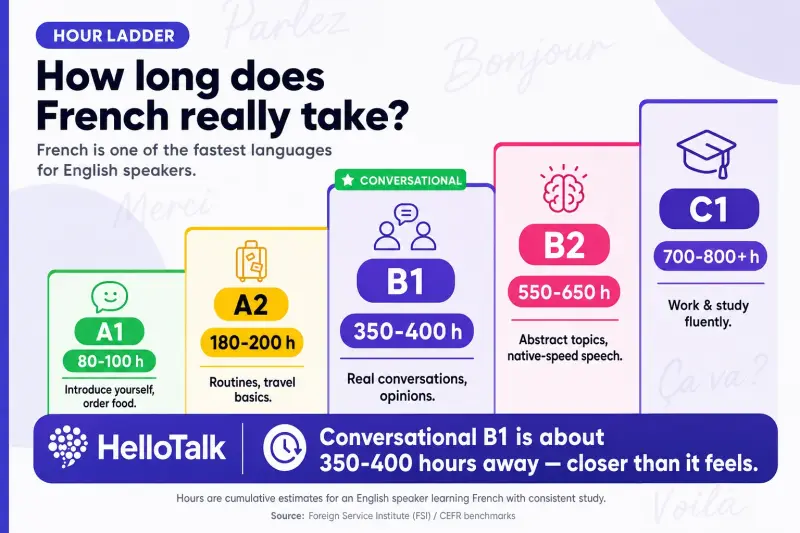
"Fluent" is a useless target because nobody agrees on it. The CEFR levels give us something concrete instead. Here is what each one actually lets you do, and roughly how many cumulative study hours it takes.
| Level | Total hours (cumulative) | What you can do | Common label |
|---|---|---|---|
| A1 | 80-100 | Introduce yourself, ask simple questions, order food | Beginner |
| A2 | 180-200 | Talk about routines, past and future, handle travel basics | Elementary |
| B1 | 350-400 | Hold real conversations, tell stories, give opinions | Conversational |
| B2 | 550-650 | Discuss abstract topics, follow native-speed speech | Upper intermediate |
| C1 | 700-800+ | Work and study fluently, understand nuance | Advanced |
The big jump most learners care about is A2 to B1, because B1 is the level where you stop translating in your head and start actually conversing. That is where French goes from a school subject to a language you use.
Turning hours into a calendar
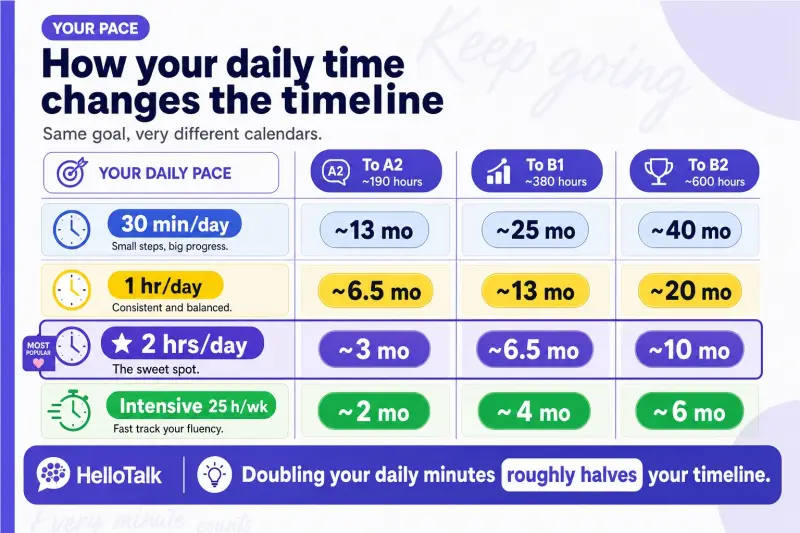
Total hours mean nothing until you divide by your weekly pace. This is where "how long to learn French" gets a real answer, and it depends entirely on you.
| Your pace | To A2 (~190 hrs) | To B1 (~380 hrs) | To B2 (~600 hrs) |
|---|---|---|---|
| 30 min/day | ~13 months | ~25 months | ~40 months |
| 1 hr/day | ~6.5 months | ~13 months | ~20 months |
| 2 hrs/day | ~3 months | ~6.5 months | ~10 months |
| Intensive (25 hrs/week) | ~2 months | ~4 months | ~6 months |
Notice the honest math on the three-month promise. To reach a solid A2 in three months you need roughly two focused hours a day, and to reach full B1 in three months you would need an intensive, near full-time schedule. So a beginner doing one hour a day should aim for a strong A2 by month three, which is a genuinely useful, conversational-adjacent level. Do not let anyone sell you B2 in twelve weeks part-time.
Why the online learner's timeline can be faster (or slower)
Learning online cuts both ways. The upside is enormous: you can talk to native French speakers the day you start, instead of waiting for a class trip. The learners who hit their timelines are the ones who convert study hours into speaking hours early, because output is where a language actually sticks. We dig into that trade-off in our piece on input versus output in language learning, and the short version is that you need both, but online learners often over-consume and under-produce.
The downside of online learning is that it is easy to rack up "hours" that are really passive scrolling. An hour of tapping through an app is not the same as an hour of struggling through a real conversation. This is why we recommend mixing a structured course with live practice, an approach we lay out in the French course plus language exchange combo.
How to make your hours count double
You can effectively shorten your timeline not by studying more hours but by making each hour higher quality. Three things move the needle most.
First, speaking with corrections compresses the timeline more than any single app feature, because feedback stops you from cementing errors. On HelloTalk, chat-based learning gives you real-time grammar correction and built-in translation inside the conversation, so you learn French while using it, not before. The community spans 200+ countries and 260+ languages with over 1 billion messages daily, so a French partner is always awake somewhere.
Second, get feedback from many people, not one. Post a French sentence to Moments and several native speakers correct it, which also shows you how locals really write. There is a reason social feedback increases how much people practice: it feels like connection, not homework.
Third, train listening at real speed early. Drop into a French Voiceroom as a listener, or watch a Livestream mini-class, so native-speed French stops sounding like a blur. HelloTalk's AI pronunciation scoring also flags the exact sounds you are getting wrong, which speeds up the part of French that frustrates learners most.
Hours only do more when they are well spent, and no resource shortens the calendar on its own. The guide to which French resources make each hour count compares seven options by the job each does in a daily routine and by the feedback it gives on the French you produce, so you can see which minutes build comprehension and which produce something a person answers.
Realistic milestones for a one-hour-a-day online learner
Here is what a steady, one-hour-a-day beginner can honestly expect over the first year. If you want this broken into a week-by-week schedule with specific tools for each stage, see our week-by-week 3-month French plan.
-
Month 1: strong A1. You introduce yourself, order, ask directions.
-
Month 3: solid A2. You talk about your day, your plans, and survive a slow chat.
-
Month 6-7: entering B1. You hold real conversations and tell short stories.
-
Month 12-13: comfortable B1. You give opinions and follow native speakers, slowly.
-
Year 2: B2 in reach if you keep speaking daily.
Common mistakes that stretch the timeline
-
Measuring progress in lessons finished instead of things you can say.
-
Delaying speaking until you feel "ready," which never happens.
-
Comparing yourself to intensive full-time learners on a part-time schedule.
-
Passive input only. Watching French is not the same as producing it.
-
Ignoring pronunciation early, then hitting a wall at B1 when people cannot understand you.
FAQ
How long to learn French from scratch to conversational? About 350-400 total study hours to a conversational B1. At one hour a day that is roughly a year; at two hours a day, around six to seven months.
Is French harder or easier than Spanish? Both are FSI Category I languages with similar total-hour estimates, so timelines are close. French pronunciation is the bigger hurdle, Spanish spelling is friendlier. For the Spanish side, our French study plan uses the same logic.
Can I really learn French in 3 months? You can reach a useful A2, and B1 if you go intensive. Full fluency in three months is marketing, not reality. Our 3-month study plan sets honest targets.
What is the hardest level jump in French? A2 to B1, because it is the shift from memorized phrases to real conversation. Speaking with native speakers early makes this jump smoother.
Do apps count toward the hour totals? Active practice counts; passive tapping counts less. An hour of real conversation is worth more than an hour of multiple-choice drills.
How many words do I need to be conversational? Around the most frequent 1,000-2,000 words cover most everyday French. Focus on high-frequency words first for the fastest payoff.
Set a realistic goal and start today
Pick your pace, mark your A2 and B1 milestones on a calendar, and start talking this week so your hours turn into real speaking time. Download HelloTalk and find a French exchange partner on HelloTalk to keep every study hour pointed at real conversation.