
3-Month French Study Calendar: Week-by-Week Goals and Tools

You have the strategy. Now you need the calendar. This is the granular, week-by-week version of a 3-month French plan: for each week, one clear goal, the specific tools to use, and roughly how to split your daily hour. The most reliable way to stay on a 3-month plan is to give every single week one measurable goal, so progress is visible and you never wonder what to do today.
If you have not read the strategic overview, start with our 3-month French study plan, which explains the four pillars this calendar is built on, and check the realistic French timelines so your weekly targets stay honest. This piece assumes you are giving about 60-75 minutes a day, six days a week, which over 13 weeks lands a beginner at a solid A2 with early B1 touches.
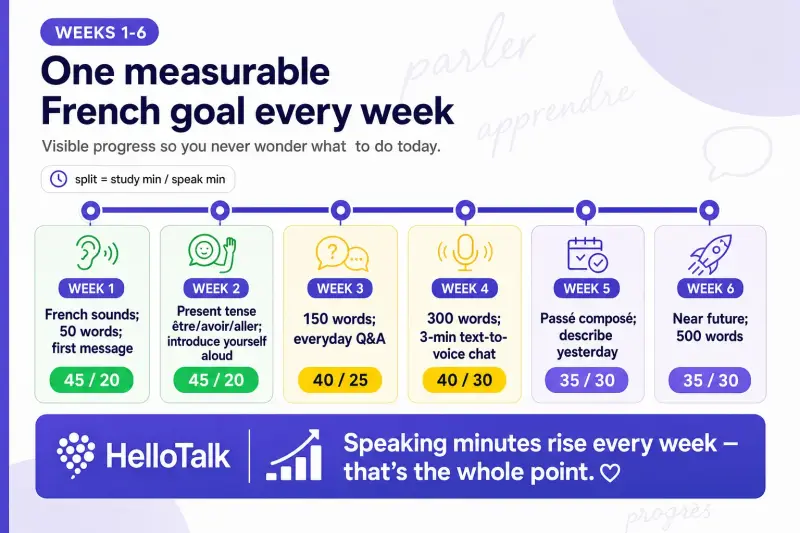
How to read this 3-month French plan
Each week has a theme, a concrete "you can now" goal, and a suggested daily split between study (course, vocabulary, listening) and speaking (chat, voice, calls). The proportion of speaking climbs steadily, because reaching a conversational level takes roughly 350-400 total study hours and speaking is what converts study into real ability. Do not skip the speaking column even in week one. Starting real conversation in week one, while you still sound bad, is the single strongest predictor of who becomes conversational in three months.
Month 1: Foundation (Weeks 1-4)
Goal for the month: reach A1. You can introduce yourself, ask simple questions, and order food.
| Week | Weekly goal | Main tools | Daily split |
|---|---|---|---|
| 1 | Master French sounds; learn 50 words; send your first French message | Course basics, AI pronunciation scoring, chat | 45 study / 20 speak |
| 2 | Present tense of être, avoir, aller; introduce yourself out loud | Course, vocab drills, voice notes | 45 study / 20 speak |
| 3 | 150 total words; ask and answer everyday questions | Course, Moments posts, chat | 40 study / 25 speak |
| 4 | 300 total words; hold a 3-minute text-to-voice chat | Course, first short call, corrections | 40 study / 30 speak |
In week one, do not read French silently. Say everything out loud and use HelloTalk's AI pronunciation scoring, which flags the exact sound you missed instead of a vague "wrong." Then send your first message to a French partner the same week. The community reaches 70M+ registered users across 200+ countries, so a partner learning your language is a few taps away. For the deeper reason to speak this early, our guide to daily French speaking practice makes the case.
Month 2: Building (Weeks 5-8)
Goal for the month: reach A2. You can talk about the past and future, and handle travel basics.
| Week | Weekly goal | Main tools | Daily split |
|---|---|---|---|
| 5 | Passé composé; describe what you did yesterday | Course, chat, corrections | 35 study / 30 speak |
| 6 | Near future (aller + infinitive); 500 total words | Course, voice notes, Moments | 35 study / 30 speak |
| 7 | Listening at natural speed; 650 total words | French Voicerooms as listener, course | 35 study / 30 speak |
| 8 | Hold a 5-minute voice chat about your week | Regular calls, chat corrections | 30 study / 35 speak |
This is where the course plus language exchange combo really kicks in: the course adds tenses while your exchange partner puts them to use. Around week seven, start dropping into a French Voiceroom as a listener so native-speed French stops sounding like a blur, then speak when you are ready. Post short French sentences to Moments so several native speakers correct them at once, which is why social feedback increases practice.
Month 3: Speaking (Weeks 9-13)
Goal for the month: solid A2 with early B1. You can hold a 10-minute conversation with a patient native speaker.
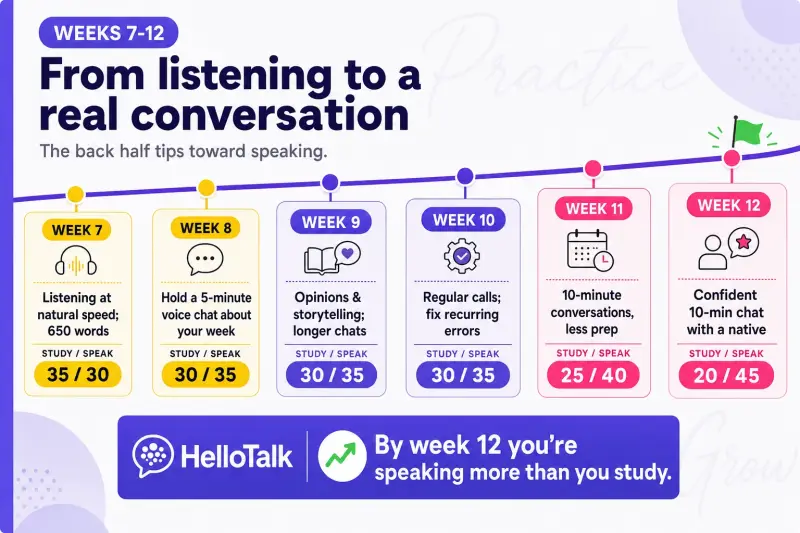
| Week | Weekly goal | Main tools | Daily split |
|---|---|---|---|
| 9 | Connectors (parce que, mais, donc); build longer sentences | Chat, calls, course reference | 25 study / 40 speak |
| 10 | Give simple opinions; tell a short story | Regular calls, Moments, corrections | 25 study / 40 speak |
| 11 | Understand a slow native speaker without translating everything | Livestreams, Voicerooms, calls | 20 study / 45 speak |
| 12 | Hold a 10-minute unscripted conversation | Daily calls, chat, corrections | 20 study / 45 speak |
| 13 | Review, reinforce weak spots, set the next 3-month goal | All tools, self-assessment | 25 study / 40 speak |
By now speaking is the main event and the course is just a reference you open when a partner corrects something. Join an interactive Livestream mini-class for structured speaking with feedback, and keep your daily calls going. On HelloTalk, chat-based learning gives real-time grammar correction and built-in translation inside the conversation, so every chat doubles as a lesson without switching apps. If you want to keep a tighter daily loop, our online courses and apps for daily French practice pairs well with this final stretch.
The weekly ritual that keeps you on track
Whatever the week's theme, run the same short loop, because consistency beats intensity for a spoken skill. A steady six-days-a-week rhythm produces more spoken ability than occasional long sessions, since language recall depends on frequent, spaced use. The bigger picture on why habits beat cramming sits in our overview of language learning strategies that actually work, and the whole plan hangs off the language exchange approach.
-
Study the week's grammar or vocabulary first (front of session).
-
Use that exact structure in a chat or call the same day.
-
Note every correction your partner gives you.
-
Drill those corrections at the start of the next session.
-
Once a week, record yourself speaking for 60 seconds and compare to week one.
Common mistakes that break the schedule
-
Treating the study minutes as the whole plan and skipping the speaking column.
-
Batching a week's work into one long Sunday session. Spread it out.
-
Moving to the next week before hitting the current goal. Repeat a week if needed.
-
Not tracking corrections, so the same mistakes repeat for weeks.
-
Comparing your week 4 to someone else's week 12. Follow your own calendar.
FAQ
What if I fall behind a week? Repeat the week rather than skipping ahead. The goals are cumulative, so a shaky foundation makes later weeks harder. Falling behind is normal, not failure.
Can I do this plan with only 30 minutes a day? Yes, but expect to reach a strong A1 rather than A2 by week 13. Protect the speaking minutes first, and consider stretching the plan to four or five months.
When exactly should I start speaking on calls? Week 4 for a first short call, then build from there. Text and voice notes start in week one. The 3-month overview explains why earlier is better.
Do I need to follow the daily split exactly? Treat it as a guide. The key rule is that the speaking share grows each month. If you must trim, trim study minutes, not speaking.
What tools do I actually need? One structured course or app for grammar and vocabulary, plus HelloTalk for chat, voice, Voicerooms, Livestreams, and AI feedback. 90% of HelloTalk's core features are free.
What comes after week 13? Set a new three-month goal aimed at B1 consolidation: more calls, longer stories, and native-speed listening. The French timeline guide shows the milestones ahead.
Start week one today
Open your calendar, block your daily hour, and set this week's single goal: master the French sounds and send your first message to a native speaker. Download HelloTalk and find a French exchange partner on HelloTalk so week one starts with a real conversation, not just a lesson.