A 3-Month French Study Plan That Actually Works (Online, Zero to Conversational)

Most 3-month French plans fail for the same reason: they treat "conversational" as something that shows up on its own once you finish enough lessons. It does not. Conversational French is a skill you build by speaking from week one, not a reward you unlock at the end. So the plan below is built backwards from the thing you actually want, which is holding a real conversation, and everything else is arranged to serve that.
Let us be honest about the goal first. In three months of consistent study, going from absolute zero, a realistic target is a solid A2 with the beginnings of B1, enough to introduce yourself, ask and answer everyday questions, handle a café or a train station, and survive a slow chat with a patient native speaker. If you want the numbers behind that expectation, we break them down in our guide to realistic French learning timelines for online learners. This article is the strategic overview: the four pillars, how they fit together, and how much time each one needs.
The one number that decides everything: your weekly hours
Here is the fact that quietly runs this whole plan. Reaching a conversational B1 in French takes roughly 350-400 total study hours, according to CEFR-aligned course benchmarks, and French sits in the U.S. Foreign Service Institute's easiest group (Category I) at about 600-750 hours to professional working proficiency. Three months is about 13 weeks. If you study one hour a day, that is around 90 hours, which lands you in the A2 range, not full B1. That is fine. A2 with active speaking already feels like a conversation.
So the plan assumes 60-75 minutes a day, six days a week. Skip the guilt on day seven. The point is not intensity, it is that the hours are non-negotiable and spread evenly. Cramming twelve hours on Sunday does almost nothing for a spoken skill.
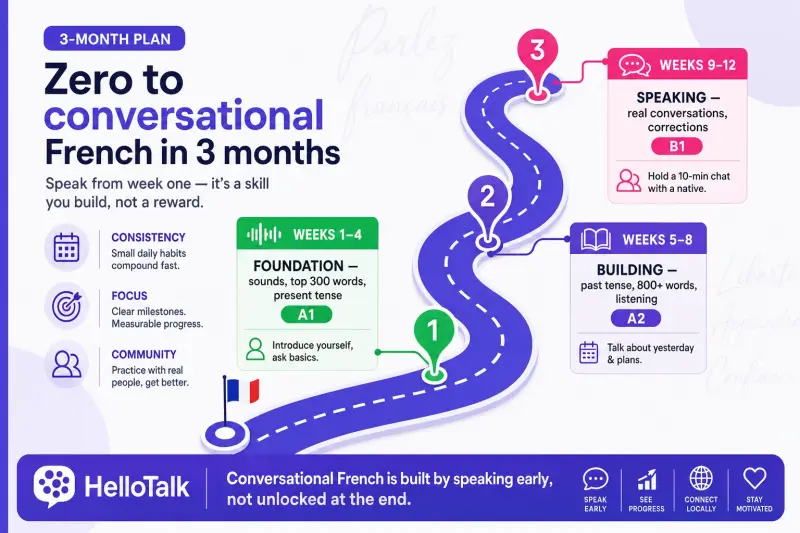
| Phase | Weeks | Daily focus | Target level | What "done" looks like |
|---|---|---|---|---|
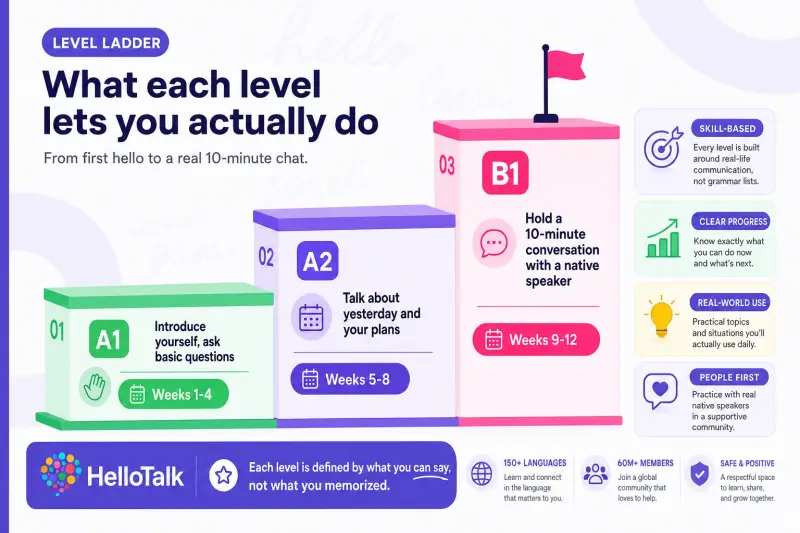
| Foundation | 1-4 | Sounds, top 300 words, present tense | A1 | Introduce yourself, ask basic questions |
| Building | 5-8 | Past tense, 800+ words, listening | Late A1 to A2 | Talk about yesterday and your plans |
| Speaking | 9-12 | Real conversations, corrections | Solid A2, early B1 | Hold a 10-minute chat with a native speaker |
Pillar 1: Fix the sounds before the grammar
French spelling and French sound do not match, and the sooner you accept that, the faster you improve. The single highest-return thing a beginner can do is train the ear and mouth on French sounds in the first two weeks, before drowning in vocabulary. The nasal vowels, the silent letters, the liaison between words: get these into your ear early and everything you learn later sticks better.
Practically, spend the first ten minutes of each early session listening and repeating out loud. Do not just read silently. On HelloTalk, the AI pronunciation scoring listens to you say a French phrase and points to the specific sound you missed, not a vague "try again," so you can fix the exact vowel instead of guessing. That kind of targeted feedback is what stops beginners from baking in bad habits.
Pillar 2: Learn the words that actually appear
You do not need 5,000 words to talk. You need the right few hundred. The most common 1,000 words cover the large majority of everyday French conversation, so a beginner's vocabulary time is best spent drilling high-frequency words, not niche ones. Structured apps like Duolingo or Busuu are genuinely good for this drilling stage, and a course gives you order and streaks. We compare how courses and live practice fit together in the online course plus language exchange combo.
Aim for roughly 300 words by the end of month one, 800 by month two. Verbs first (to be, to have, to go, to want, to be able to), then everyday nouns, then connectors like "because," "but," and "then" that let you build sentences instead of listing words.
Pillar 3: Speak from week one, with real people
This is where most self-study plans quietly collapse. You can finish every lesson in an app and still freeze the first time a real person answers you, because reacting to an unpredictable human is a completely different skill from filling in blanks. The learners who become conversational in three months are the ones who start speaking with native speakers in the first week, while they still sound terrible.
You do not need to be "ready." You need someone patient. A language exchange gives you exactly that: a native French speaker who wants to practice your language in return, so nobody is doing anyone a favor. HelloTalk connects you to that community across 200+ countries and 260+ languages, with 70M+ registered users, so finding a French partner who is learning your language takes minutes. Start with text, move to voice notes, then to calls. For a daily structure around this, see our routine for daily French speaking practice. The bigger idea, why talking to people beats studying alone, sits in our language exchange pillar guide.
Pillar 4: Get corrected, then use the correction
Practice without feedback just makes your mistakes fluent. Correction is what turns speaking practice into actual progress, which is why social feedback beats solo drilling for spoken skills. There is good evidence that social feedback increases how much people practice, because it feels like a conversation, not homework.
Three ways this works day to day on HelloTalk:
-
Chat-based learning: message a partner in French with built-in translation, transcription, and real-time grammar correction, so you learn inside the conversation without switching apps.
-
Moments: post a short French sentence to the public feed and several native speakers correct it, and you also scroll real, everyday French written by locals.
-
Voicerooms and Livestreams: drop into a 24-hour French voice room as a listener first, then talk when you are ready, or join a small interactive live class.
Putting the three months together
The order matters more than the total. Front-load sounds and core words, add past and future tenses in the middle, and let speaking grow the whole way through so that by month three it is the main event, not an afterthought. If you want this same plan broken into a day-by-day calendar with weekly targets and tools, that is exactly what our week-by-week 3-month French plan lays out. And if you are wondering whether structured study or free conversation should come first at all, our overview of language learning strategies that actually work covers the trade-off.
The route you pick should follow your hardest constraint, whether that is time, speaking access, or tolerance for grammar. We map each constraint to a method in three months of French.
Common mistakes that waste your three months
-
Waiting until you "know enough" to speak. You will never feel ready, so start ugly.
-
Studying only in one app. Grammar drills plus real conversation is the combination that moves you.
-
Chasing rare vocabulary. Master the frequent words cold before the fancy ones.
-
Reading French silently. Say it out loud so your mouth learns the shapes.
-
Skipping days in clusters. Six shorter sessions beat one long weekend binge for speaking.
FAQ
Can a complete beginner really get conversational in 3 months? You can reach a functional A2 with early B1 touches, meaning you handle everyday exchanges and hold a slow, patient conversation. Full comfortable fluency takes longer, and our French timeline guide shows why.
How many hours a day do I actually need? Plan for 60-75 minutes daily, six days a week. That is roughly 90 hours over three months, which is A2 territory. More hours push you further toward B1.
Do I need a paid course, or are free apps enough? Free resources take you a long way; 90% of core features on HelloTalk are free. A structured course helps with order and grammar, but the speaking practice is what you cannot skip.
When should I start speaking with native speakers? Week one. Start with short text messages, then voice notes, then calls. Early low-stakes practice beats waiting until you feel prepared.
What if I can only give 30 minutes a day? You will move slower, likely reaching a strong A1 rather than A2 in three months. That is still real progress. Protect your speaking time first if you have to cut something.
Is French harder than Spanish for English speakers? Both are FSI Category I languages with similar total-hour estimates, so the timelines are comparable. French pronunciation trips people up more, which is why we put sounds in pillar one.
Start your three months today
The best plan is the one you begin now, out loud, with a real person. Set your daily hour, drill your first 50 words, and send your first French message to a native speaker this week. Download HelloTalk and find a French exchange partner on HelloTalk to make month three the month you finally hold a real conversation.