
Three Months of French: Which Method Wins Depends on What You Can Do Daily

Every "learn French in 90 days" plan assumes something about your life that is probably not true. It assumes a spare hour nobody will interrupt, or a friend who speaks French, or the patience to sit with verb tables on a Tuesday night. When the plan fails, you blame yourself. Usually the plan was written for a different person.
So this article does not open with a method. It opens with a question about you: what can you actually do, every day, for the next twelve weeks, without negotiating with anybody? Once that answer is honest, the method picks itself. There are only three or four viable routes through ninety days of French, and each produces a different kind of learner while charging you something different.
Three Months Is Enough Time for One Outcome, Not Four
Start with the arithmetic, because it is the part most ninety-day plans quietly skip. The US Foreign Service Institute classifies French as a Category I language, its easiest group for English speakers, and still budgets roughly 24 to 30 weeks of training, or about 600 to 750 class hours, before a diplomat reaches professional working proficiency. That figure carries a condition almost nobody quotes alongside it: those students sit in class around 23 hours a week and add roughly 17 hours of independent study on top. Forty hours a week, French as a full-time job.
Now put your own numbers next to that. Ninety days at one hour a day is about ninety hours. At two hours a day it is 180. Even an intense self-study schedule lands between one eighth and one third of what the FSI treats as the minimum for the easiest language category available. Anyone promising fluency in twelve weeks is either redefining the word or selling something.
That is the bad news, and the good news is substantial. Ninety hours is a lot of time to point at one narrow target. Most learners point it at four targets at once and hit none. Ask what "master French in three months" means and the answers split four ways: understanding spoken French at natural speed, holding a conversation without freezing, reading comfortably, and writing accurately with correct genders and agreements. Four skills, four training methods.
Three months of consistent daily study buys you one of those outcomes, not all four, and choosing which one is the whole game. Spread ninety hours across all four and you get a learner who half recognises a lot of words and cannot produce a sentence under pressure. Point ninety hours at conversation alone and you get somebody who can order, ask, complain, joke badly, and be understood by a patient French speaker. Point it at listening and you get somebody who follows a podcast at reduced speed. Neither is mastery. Both are worth twelve weeks.
A useful way to force the choice is to write down, in one sentence, what you want to be able to do on day 91. Not "be good at French." Something with a verb and an object. "Order and complain in a café in Lyon without switching to English." Your method flows from that sentence.
Pick Your Constraint First: Time, Speaking Access, or Tolerance for Grammar
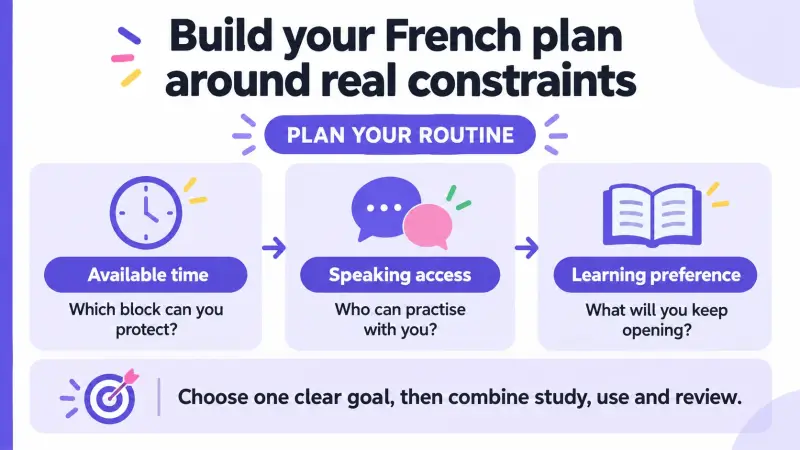
Once the target is set, the method depends on which of three things is scarcest in your life. Almost every learner is limited by exactly one of them, and the mistake is choosing a method that assumes a different one.
The first constraint is time. Not the time you wish you had, but the block you can defend every single day including the bad ones. If that number is under an hour, some methods become mathematically impossible. A tutor session plus homework plus review does not fit into forty minutes, and compressing it produces a schedule you abandon in week three.
The second constraint is speaking access. Is there a human being who will listen to you speak French and react? Not a teacher necessarily. A patient stranger counts, a friend who studied it at university counts, and a native speaker in an exchange app counts, which is where a tool like HelloTalk fits into the picture rather than at the top of a generic recommendation list. If the honest answer is no, an entire family of methods is closed to you until you fix that, and pretending otherwise is why so many three-month plans produce silent learners.
The third constraint is tolerance for grammar. Some people enjoy conjugation tables and feel calm once they see the system. Others go numb within four minutes and quietly stop opening the book. It is a preference, not a moral quality, and it predicts which resources you will still be using in week ten. A method you abandon in week three has a day 90 outcome of zero.
Money did not make the list. Money matters, but it is downstream: it converts into structure and into speaking access, both of which you can also get without it. The next three sections take each constraint in turn, and each ends with the honest day 90 outcome and the honest cost.
If You Have Under an Hour a Day, Input Carries You Furthest
If your defensible daily block is twenty to fifty minutes and it arrives in fragments, on a commute, during a walk, while cooking, then input is the only method that survives contact with your calendar. Input means listening and reading at a level where you understand most of it without stopping: graded readers, slow French podcasts made for learners, French video with French subtitles once you can cope, and a small flashcard deck built only from words you actually met.
Input wins under a tight time budget because it is the only activity that keeps working in fragments. Ten minutes of a French podcast on the bus is ten real minutes. Ten minutes of a grammar exercise interrupted twice is mostly restart overhead. Input also scales down gracefully on bad days: with eight minutes and no energy, listening to something slightly too easy still counts, and the streak survives. Streak survival is the single biggest predictor of where you land on day 90.
What this route produces is specific. You will understand learner-oriented French audio at close to natural speed, recognise several thousand words in context, follow a French film with French subtitles, and read simple articles with occasional lookups. You will also freeze the first time somebody addresses you in a shop, because nothing in those ninety hours ever asked you to produce a sentence under time pressure.
Input builds the raw material you will later speak with, but it never tells you whether what you produce is understandable. That is not an argument against this route. If your constraint is genuinely time, input delivers the most durable result per hour spent, and the speaking gap is fixable later in a way that a missing vocabulary base is not.
Two adjustments make this route noticeably better. Shadow out loud whenever you can: repeat the audio a beat behind the speaker, copying rhythm rather than racing for accuracy. It costs no extra time and keeps your mouth from going cold. And keep the deck small and sourced only from material you met, not from a downloaded list of the thousand most common French words, because words arrive with context attached or they do not stick. For concrete options, this roundup of courses and apps for daily French practice goes deeper into which tools suit which slot in the day.
If You Have Someone to Talk To, Output Overtakes Input by Week Six
If you can find thirty to sixty minutes most days and there is a human on the other end, the calculation changes completely. Output is expensive per minute. It requires attention, a connection, and somebody willing to be patient. But it trains what input cannot touch: retrieval under pressure, and repair when retrieval fails.
Here is the mechanism. When you listen, your brain recognises, and recognition is cheap. When you speak, your brain has to retrieve a word with no prompt, attach the right gender, conjugate the verb, and do all of it before the other person's attention drifts. That only improves by being performed. The first two or three weeks feel worse than the input route because you are painfully aware of how little you can produce. Then it flips.
By week six, learners with a conversation partner are usually producing sentences that input-only learners can only recognise. The gap widens from there, because every conversation generates its own vocabulary list. You reach for a word, fail, work around it, and that word is now emotionally tagged. You will remember it far longer than the equivalent flashcard.
The practical obstacle is access. Most people do not have a French speaker in their life, which is why language exchange exists as a category. HelloTalk connects learners with native speakers directly for text and voice conversation, and its scale is why a French partner is usually findable at whatever hour you are free: HelloTalk reports 70M+ registered users across 200+ countries and 260+ languages, with over 1 billion messages daily moving through the app. An exchange only works when somebody is awake, interested, and learning your language in return, and that combination appears reliably only in a large pool.
What matters more than scale is what happens when a conversation goes wrong, which it will, constantly, in month one. HelloTalk builds correction into the chat itself: in-chat translation and in-chat correction let a native speaker fix your sentence in place and show the corrected version next to your original, so you see exactly which article, gender or tense you missed without either of you leaving the conversation. HelloTalk also offers AI pronunciation scoring that names the specific sound you missed rather than just marking the attempt wrong, plus AI grammar feedback with explanations attached, useful at 6am when your partner is asleep.
Two other pieces carry weight here. Moments works as a public feed where you post a short paragraph or a voice clip in French and several native speakers correct it, which gives you written output practice without anyone committing to a live call. HelloTalk's Voicerooms and Livestreams are open audio rooms running around the clock that you can enter as a silent listener first, and that option matters more than it sounds, because the hardest step for most French learners is the first time they speak to a stranger. HelloTalk keeps 90% of core features free, and HelloTalk was named Google Play's Best Social App in 2017 and featured on the global Google Play homepage in 2024.
Give this route a lesson sequence. If this week's topic is the past tense, use it in a HelloTalk message about yesterday, review the response alongside the lesson, and tell a second story using the revised forms. An exchange partner supplies a real listener's perspective; questions that need a fuller explanation become the next lesson or review task. Learning, communication, and correction then work toward the same weekly goal. If you are weighing exchange apps before committing, this comparison of language exchange apps covers how the main options differ on reply rates and correction quality, and this look at whether HelloTalk works for beginners addresses the worry about starting conversations at A1.
Day 90 on the output route: you hold a slow, flawed, genuinely two-way conversation about your job, your weekend and your opinions. Your grammar is visibly imperfect and your accent is foreign. French speakers understand you and answer normally instead of switching to English. The cost is that your reading and written accuracy lag behind your speaking.
If You Can Pay for Structure, a Tutor Compresses the Timeline
The third route assumes a different scarcity. Some learners have money and a calendar slot but no patience for working out what to study next, and for them a tutor is the efficient answer. Tutors cost money and they cost time, including the scheduling overhead nobody counts until they have rescheduled the same lesson three times, but what you buy is real: somebody who diagnoses your specific errors, sequences what comes next, and holds you to a weekly appointment.
A tutor does not make the ninety hours bigger, it makes the ninety hours land on the right things. Self-study wastes enormous effort on material you have already absorbed and on material you are not ready for. A competent tutor removes most of that waste, which is why learners with weekly lessons often reach a functional conversational level faster than equally motivated self-studiers, even when the self-studier logs more total hours.
The trap is treating the lesson as the learning. A weekly session is one or two hours out of the ten or fourteen you need that week. If the other hours do not happen, you have bought an expensive weekly reminder that you are behind. A tutor works best stacked on top of one of the other two routes, not instead of them, and the volume is still on you.
Tutoring also pairs badly with a low grammar tolerance unless you say so out loud in the first session. Many tutors default to a textbook sequence because it is the safest thing to offer a new student. If tables make you go numb, ask on day one for a conversation-led lesson with correction.
Day 90 with a tutor plus consistent self-study is the most balanced profile of any route: conversational ability close to the output route, grammar noticeably cleaner, and a realistic sense of your own level because somebody competent has been telling you. The tradeoff is money, a fixed weekly slot, and a dependency you have to unwind eventually. For a wider view of how tutoring platforms sit alongside course apps and conversation tools, this breakdown of what job each language app actually does sorts the categories by function rather than popularity.
Which Resource Belongs to Which Constraint
Three routes in prose is harder to act on than it should be, so the table below collapses them into one view and adds three edge cases that come up constantly: the grammar-friendly solo learner, the learner with a relocation deadline, and the learner who genuinely has under twenty minutes. Find your own row in the first column rather than comparing methods across rows, because these methods are not competing for the same learner. The last column is the part to read twice, since the cost is usually what makes people quit.
| Constraint you are under | Method that fits | Realistic day 90 outcome | The tradeoff you accept |
|---|---|---|---|
| Under an hour a day, fragmented, no speaking partner available | Input-led: graded readers, learner podcasts, French subtitles, a small deck built from what you met | Understands learner-paced French near natural speed, reads simple articles, recognises several thousand words | You will freeze the first time a real person addresses you, because nothing trained production |
| Thirty to sixty minutes a day and access to native speakers | Output-led language exchange, daily short conversations plus written posts, using HelloTalk for partner access and in-chat correction | Holds a slow two-way conversation about work, weekend and opinions without the other person switching to English | Keep exchanges tied to the week's lesson and review the feedback before moving on; one partner's wording may need further explanation |
| You can pay for structure and defend a fixed weekly slot | Weekly tutor for diagnosis and correction, stacked on input or exchange for volume | The most balanced profile: conversational, cleaner grammar, accurate sense of your own level | Tutors cost money and time, the slot is hard to move, and the lesson is never the learning on its own |
| High tolerance for grammar, learning mostly alone | Course or textbook sequence plus targeted drills, with output added from week five | Strong reading, accurate written French, confident with tenses and agreements | Speaking lags badly unless you schedule production, and the silent period gets harder to break the longer it runs |
| Relocating to a French-speaking country inside ninety days | Survival phrase blocks for your real daily situations, plus daily speaking from week one | Functional in shops, transport, admin queues and small talk, still lost in group conversation | Obvious gaps in grammar and reading, accepted in exchange for immediate usefulness |
| Under twenty minutes a day, no exceptions | One narrow habit only: audio during a commute, or a single daily review block | Solid listening comfort and a real vocabulary base, no production ability | Twelve weeks buys a foundation rather than a skill, and you are deferring the speaking problem |
Two rows can be combined if your life allows it, and the pairing that works best is input plus exchange: input on fragmented time, conversation on the days you can defend a proper block. What does not work is running three routes at once. Ninety hours divided three ways is thirty hours per skill, below the threshold where any of them start feeling automatic.
The Month Two Collapse, and How Each Route Handles It
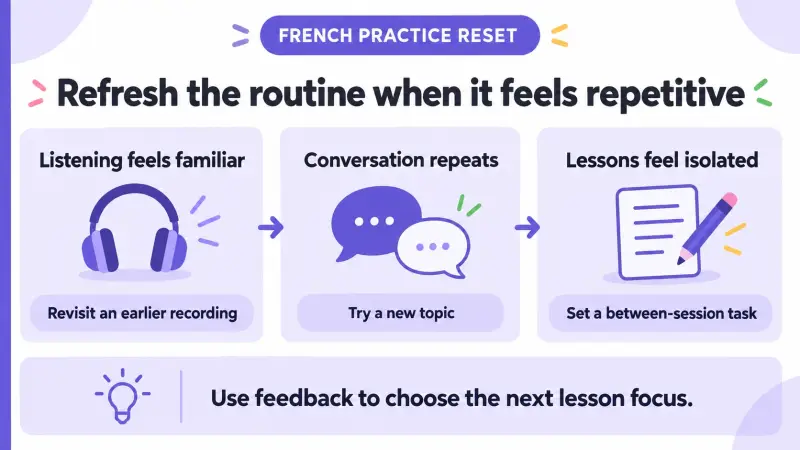
There is a predictable failure point in every three-month language project, and it arrives between week five and week eight. Week one is exciting because everything is new. Weeks two through four feel productive because beginner gains are enormous and visible: you go from zero to reading a menu. Then the curve flattens.
Month two ends almost every French project, and it ends them for a structural reason rather than a motivational one. Your ability to measure yourself disappears exactly when your gains become invisible. In month one, progress is obvious because you can suddenly do things you could not do at all. In month two, progress means the same things get slightly easier, and slightly easier is not something the brain registers as an achievement. So you conclude you have stopped improving, which is false, and you cut your daily block, which then makes it true.
The input route hits this wall hardest, because input gives the weakest feedback signal of the three. You listen to a podcast, you understand a bit more than last month, and nothing tells you so. The repair is a fixed benchmark built in week one and revisited monthly: record yourself reading a short French passage aloud, or save one podcast episode you barely understood. Replay it in week five and again in week nine. The change is measurable, and it carries you when your day to day feeling says otherwise.
The output route fails differently. Conversations do not stop being fun, but they start repeating: you have told four partners the same things about your job and your city, recycling the same six structures. The repair is to change the content rather than the amount. Bring a topic you have never discussed, react to an article, describe a process, argue about something small. Correction only works when you attempt something slightly beyond your current range, and comfortable conversation quietly stops producing errors worth fixing.
The tutor route has the strongest built-in defence, the appointment. You show up because someone is waiting. Its failure mode is subtler: the lesson continues while the self-study around it silently stops. The repair is to have the tutor set a concrete between-session task and check it, which converts the appointment into accountability for the other twelve hours rather than just the one.
One repair works on all three routes. Schedule something in week seven that requires you to use French with a person who does not know you are a beginner: a new exchange partner, a voice room where nobody has heard your introduction, a short call. Slightly uncomfortable, entirely real, and it resets your sense of what you can do. Why interaction beats rehearsal is covered in this piece on what effective communication actually requires.
Frequently Asked Questions About Learning French in Three Months
Can you actually become fluent in French in 3 months?
No, not by any normal definition of fluent. The FSI budgets roughly 600 to 750 hours for professional working proficiency in French, supported by around 40 hours a week of class and independent study. Ninety days at one hour a day is about 90 hours. What three months genuinely buys is one narrow outcome: comfortable listening, or basic two-way conversation, or solid reading.
What is the single most effective method for French in 3 months?
No method is most effective independent of your situation. If your daily time is under an hour and fragmented, input wins on results per hour. If you have thirty to sixty minutes and access to a native speaker, output overtakes input by around week six. If you can pay for structure and defend a weekly slot, a tutor produces the most balanced profile. The method that fits your constraint beats the theoretically superior method you will abandon in week three.
How many hours a day should I study French to see real progress in 90 days?
One hour a day, defended every day, outperforms three hours twice a week by a wide margin. Language decays between sessions, and daily contact keeps the decay small enough that each session builds rather than repairs. If one hour is not available, thirty minutes daily still produces a visible result over twelve weeks.
Do I need to study French grammar or can I just talk to people?
You can get surprisingly far on conversation alone, and many learners speak usable French without ever finishing a grammar book. What conversation alone does not fix is systematic error: if you consistently misuse a tense, native partners will understand you and let it pass, and the mistake hardens. A light grammar reference opened when a correction confuses you solves this without requiring you to enjoy conjugation tables.
Is language exchange good enough on its own, or do I need a paid tutor?
Language exchange covers speaking practice, listening to real speech, correction in context and motivation, which is most of what a beginner needs. What it does not cover is sequencing and explanation. A tutor is worth it when you have a deadline, when you keep making the same error and nobody can explain why, or when you need somebody to decide what comes next. Many learners run exchange as the daily volume and add occasional paid sessions.
What should I be able to do in French after 90 days of daily conversation practice?
Expect to introduce yourself, talk about your work, your city and your weekend, ask for things, handle a shop or a café, express basic opinions and disagree politely, all slowly and with errors. Expect to struggle with fast group conversation, regional accents and abstract topics. That is roughly a solid A2 with pockets of B1, enough to keep improving through use rather than study.
How do I find French speakers to practise with if I do not know any?
Language exchange apps solve the matching problem: you need somebody who speaks French, is learning your language, and is awake when you are. HelloTalk matches on exactly those criteria and supports both text and voice, which lets you start with typed conversation and move to speaking when the nerves settle. Voice rooms you can join as a listener are a low-pressure first step if starting a one-on-one chat feels like too much.
What Ninety Days Actually Buys You in French
Twelve weeks does not make you fluent in French, and anyone who says otherwise is describing a different word. What twelve weeks buys, if you spend it on one target instead of four, is the end of the beginner phase. You stop being somebody thinking about learning French and become somebody learning French, with a habit that survives bad weeks and a level that improves through use.
The choice that decides your day 90 is not which app you download. It is whether you matched the method to the constraint you genuinely have. Under an hour a day and nobody to talk to: go input-led and accept the speaking gap. Access to a native speaker and half an hour most days: go output-led and accept the messy grammar. Money and a defensible weekly slot: add a tutor and accept the dependency. The route that fails is the one built for a life other than yours.
If the missing piece is the person on the other end of the conversation, that is the most fixable of the three constraints. Find a French speaking partner on HelloTalk and have your first exchange this week, even if it is four clumsy sentences. Week six is where it starts paying, and week six only arrives if week one happens.