How to Practice Effective Communication in a Foreign Language: A Practical Guide
You have read that communication matters more than perfect grammar. You believe it. Now comes the harder question: what do you actually do on a Tuesday evening to practice it? Not the theory, the routine.
This guide is the answer. It is a practical plan for building communication skills through deliberate practice, with the exact drills, scripts, and a weekly structure you can start tonight.
Effective communication is a trainable skill, and it improves fastest through short, frequent sessions of producing language and getting real reactions, not through occasional marathon study. Fifteen focused minutes of real conversation five times a week beats one three-hour cram. The rest of this guide shows you how to spend those minutes.
First, know what you are training
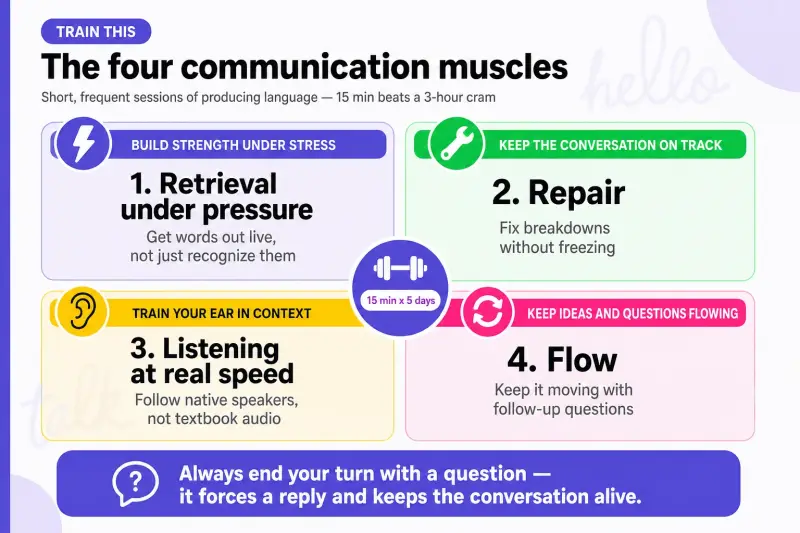
Communication is not one skill; it is a small cluster of them, and you can target each on purpose. Before you practice, it helps to see what you are aiming at, so your effort lands where it counts. For the bigger picture of why this is the real goal, see our piece on effective communication as the point of language learning.
The four communication muscles worth training:
-
Retrieval under pressure (getting words out live, not just recognizing them).
-
Repair (fixing breakdowns without freezing).
-
Listening at real speed (following native speakers, not textbook audio).
-
Flow (keeping a conversation moving with follow-up questions).
Drills are worth more once you can name the thing each one trains. Our breakdown of what effective communication is actually made of separates strategic competence from the grammar and vocabulary most plans focus on.
A weekly practice plan you can actually keep
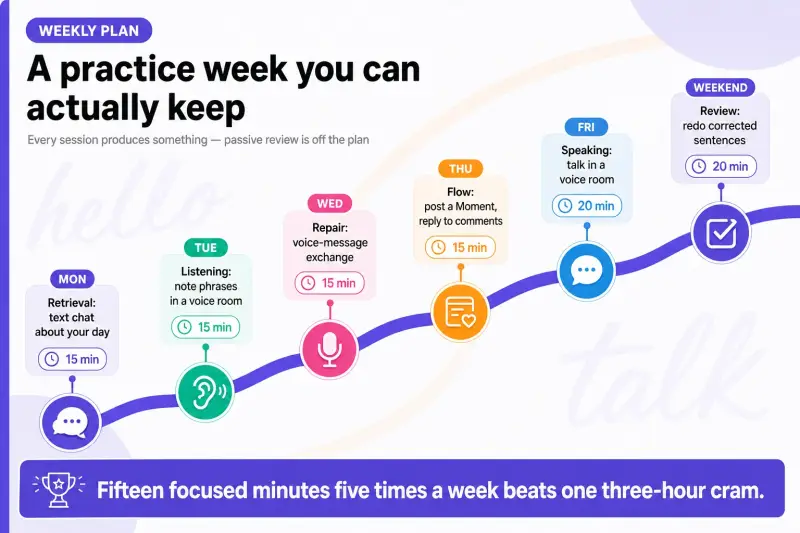
Here is a realistic week built around short, frequent sessions. Adjust the days to your life; keep the frequency.
| Day | Focus | Activity | Time | Output you produce |
|---|---|---|---|---|
| Mon | Retrieval | Text chat with a native speaker about your day | 15 min | 10-15 messages |
| Tue | Listening | Listen in a group voice room, note new phrases | 15 min | A short list of expressions |
| Wed | Repair | Voice message exchange, ask when confused | 15 min | 3-5 voice notes |
| Thu | Flow | Post a Moment and reply to every comment | 15 min | 1 post plus replies |
| Fri | Speaking | Join a voice room and speak for a few minutes | 20 min | Live spoken turns |
| Weekend | Review | Reread corrections, redo tricky sentences | 20 min | Corrected sentences |
Notice that every single session produces something. That is the whole point. Passive review is not on this plan, because passive review does not build communication.
The core drills, step by step
Drill 1: The daily debrief (retrieval)
Each day, describe what you did in your target language, in text or voice, to a real person. Keep it simple. The goal is retrieving words live and getting a reply.
A starter script you can adapt:
- "Today I [woke up / worked / studied]. It was [busy / calm]. Now I am [tired / relaxed]. How was your day?"
That last question matters. Always end your turn with a question, because a question forces a reply and turns a monologue into a conversation.
Drill 2: The repair phrases (fixing breakdowns)
Memorize five phrases that keep a conversation alive when you are lost. These are the single highest-value thing a beginner can learn, because they mean a misunderstanding never ends the exchange.
-
"Sorry, can you say that more slowly?"
-
"What does [word] mean?"
-
"How do you say [thing] in [language]?"
-
"Is this correct: [your sentence]?"
-
"Let me try again."
Learning to repair a breakdown is more valuable than avoiding one, because real conversations always contain confusion and confident learners just work through it.
Drill 3: Shadowing for listening
Pick a short clip of a native speaker talking naturally. Play a sentence, pause, and repeat it out loud, copying the rhythm and tone. This trains your ear and your mouth at once. Real speech is faster and messier than textbook audio, so practice on the real thing.
Drill 4: The Moments loop (flow and feedback)
Post one short thing in your target language, then reply to every comment you get. This turns one post into a whole thread of practice, and you get corrections from several native speakers at once. This is social feedback working exactly as intended, and it is why posting beats studying alone.
What if you have no partner yet
Plenty of people want to practice communication but do not have anyone to practice with. The solo phase is real, and there are ways to bridge it. AI conversation practice is a good warm-up, though as we explain in AI conversation versus real human practice, it cannot fully replace the unpredictability of a person. The better fix is to find real partners, which is exactly what a language exchange community is for. For a wider set of options on structuring your effort, our guide to language learning strategies that actually work helps you choose.
One more thing worth remembering as you practice: words are only half of it. Pay attention to tone, formality, and context, because communication and cross-cultural understanding go together.
Where to run these drills
Every drill above needs the same thing: real native speakers, available when you have fifteen minutes free. That is what HelloTalk provides, with over 70M+ registered users across 200+ countries practicing 260+ languages, and 90% of core features free.
Mapped to the drills:
-
Chat-based learning is where the daily debrief and repair phrases live. Text or voice-message native speakers with translation, transcription, read-aloud, and real-time grammar correction built in, so every message you send comes back with a fix if it needs one.
-
Moments runs the flow loop. Post once and get corrections and replies from several native speakers, then reply to each one.
-
Voicerooms and Livestreams are where listening and live speaking happen. Join a 24-hour voice room as a listener first, then speak when you are ready, or follow along in an interactive livestream lesson.
-
AI learning tools support your solo days with pronunciation scoring that flags specific problems and grammar correction that explains the fix, so you arrive at real conversations warmed up.
With over 1 billion messages sent daily, there is always someone to run tonight's fifteen minutes with.
Common mistakes when practicing
-
Long, rare sessions. Frequency beats duration for communication skills. Short and daily wins.
-
Practicing silently. If you are not producing language, you are studying, not practicing communication.
-
Avoiding mistakes. Mistakes are the feedback that drives improvement. Chase clarity, not perfection.
-
Skipping the questions. Ending every turn with a question is what keeps a conversation, and your practice, alive.
FAQ
How long should each practice session be? Fifteen to twenty minutes is plenty. Short, frequent sessions build communication faster than occasional long ones.
How often should I practice? Aim for most days of the week. Consistency matters more than any single session's length.
What if I freeze up in real conversations? Lean on your repair phrases and end turns with questions. Starting in text or voice rooms as a listener also lowers the pressure while you build confidence.
Can I practice communication without a partner? You can warm up with AI and shadowing, but real communication needs a partner who reacts to you. Finding one through a language exchange community is the fastest fix.
How soon will I notice improvement? Many learners feel conversations getting easier within a few weeks of daily short sessions, especially the shift from freezing to working through confusion.
Is speaking or writing better practice? Both count as production. Writing lets you slow down and get corrections; speaking builds real-time retrieval. A weekly plan should include both.
Start tonight, not "when you're ready"
Effective communication is built one short, imperfect conversation at a time. Pick one drill from this guide, set a fifteen-minute timer, and produce something for a real person to react to. That single habit, repeated, is what turns study into fluency.
Ready to run your first session? Download HelloTalk and start practicing with native speakers today at HelloTalk.