How to Self-Study Italian Online A Beginner's Roadmap That Gets You to Conversation
You can self-study Italian online and reach real conversation, but only if you design your plan around the one thing solo learners almost always get wrong. Most people who decide to self-study Italian build a tidy stack of apps and textbooks, study faithfully for months, and still freeze the moment a real Italian speaker says "ciao, come stai?" The problem is not effort and it is not the material. It is that nothing in a solo routine ever requires you to open your mouth.
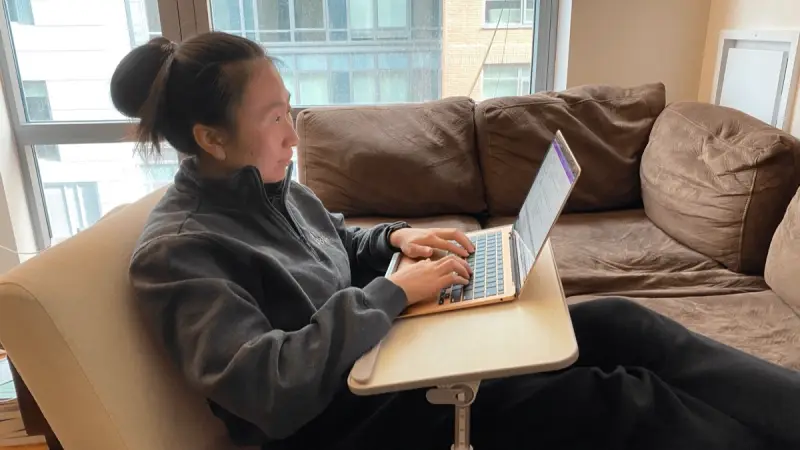
A beginner studying Italian on a laptop with a notebook and coffee
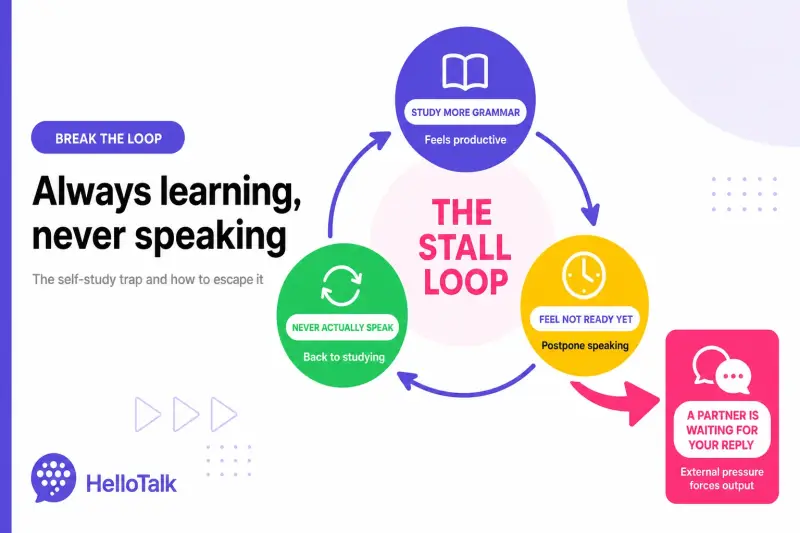
The single biggest risk in self-studying Italian is the "always learning, never speaking" loop, where comprehension keeps climbing while your ability to produce the language stays near zero. Reading, listening, and flashcards all feel like progress because they are comfortable and measurable. Speaking feels like exposure, so the brain quietly reschedules it for "when I'm ready." That day never schedules itself. This roadmap is built to break that loop on purpose, and it leans on one idea: you need an external mechanism that forces output, because willpower alone will not do it.
Why self-study stalls even when you study hard
The trap is not laziness. It is that input and output are different skills, and self-study is heavily biased toward input.
When you study alone, every activity is something you do to yourself, at your own pace, with no consequence for skipping the hard part. You can postpone speaking indefinitely and your daily streak still looks healthy. Months pass and you have a 2,000-word passive vocabulary and a tongue that has never formed a sentence under time pressure.
Passive Italian and active Italian grow on separate tracks, and a solo routine feeds the passive track while starving the active one. This is why people who have "studied Italian for a year" often cannot order a coffee in Rome without rehearsing it three times. They are not bad learners. They never built the muscle of producing language live, because nothing in their setup made them.
If you are still at the very beginning and unsure how to sequence grammar and speaking, our guide on where to begin learning Italian as a complete beginner (/blog/where-to-start-learning-italian-online) covers the order of operations. This article picks up the harder question: how to keep that routine from quietly becoming all study and no talk.
The mechanism that actually fixes it
Here is the uncomfortable truth about self-discipline: it is excellent at sustaining comfortable habits and terrible at forcing uncomfortable ones. You will happily do another lesson. You will not happily improvise a sentence to a stranger unless something outside you creates the pressure.
That something is a person waiting for your reply.
When a real human has sent you a message and is expecting an answer, your brain treats it as a social obligation, and social obligation is a far stronger driver than a study schedule. You cannot snooze a person the way you snooze a flashcard deck. The half-formed Italian sentence has to leave your head and become text, because someone is on the other side. That small, recurring pressure is the most reliable external mechanism a self-learner can install, and it is exactly what a language exchange partner provides automatically.
This is where a community like HelloTalk does something a course cannot. It connects you directly with native Italian speakers for text and voice chat, which means there is always someone whose reply is pending on you. With over 70M+ registered users across 200+ countries and 260+ languages, plus over 1 billion messages exchanged daily, finding an Italian speaker who is actually waiting to hear from you takes minutes, not weeks. The waiting partner is not a feature you toggle on; it is the natural state of a real conversation, and that is what makes it work.
Seen through the lens of "forcing output," the four core tools each remove a different excuse not to speak:
-
Chat-based learning kills the "I'll mess up the grammar" excuse. Built-in translation, transliteration, read-aloud, and real-time correction sit right inside the chat, so a stuck sentence is never a reason to stay silent. You send the imperfect version and learn from the fix.
-
Moments removes the "I have no one to practice with right now" excuse. Post a couple of Italian sentences to the public feed and several native speakers correct you, so output happens even when no one is mid-conversation with you.
-
Voicerooms and Livestreams remove the "I'm not ready to talk out loud" excuse. You can join a 24-hour Italian voice room as a listener first, then unmute when nerves settle, and interactive livestream mini-lessons give you a low-stakes reason to speak.
-
AI learning tools remove the "no human is online" excuse. AI pronunciation scoring, grammar correction with explanations, and image translation keep you producing language during off-hours, so the output habit never breaks.
The Italian community deserves a specific mention here. Italian native speakers on the platform are notably active and famously warm, which makes the environment one of the lowest-pressure places a nervous beginner can send a first message. 90% of HelloTalk's core features are free, so you can test whether a waiting partner changes your behavior before you spend anything. The app earned Google Play's Best Social App award in 2017 and was featured on Google Play's global homepage in 2024, which is some signal that the social mechanics are built well.
A self-study roadmap that builds in output from week one
A good plan does not bolt speaking on at the end. It schedules forced output early and increases the dose every phase. Here is a roadmap that assumes you study mostly alone but refuses to let you stall.
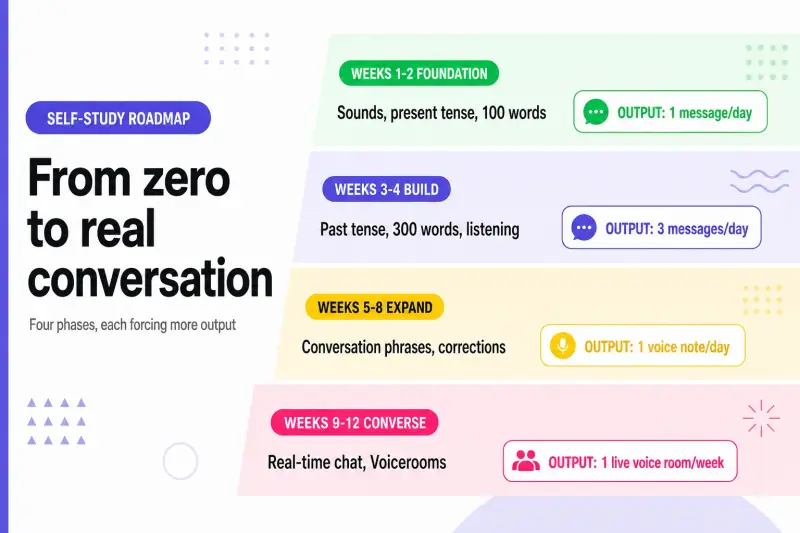
A four-phase roadmap chart showing Italian self-study milestones from foundations to free conversation
Phase 路 Weeks 路 Study focus 路 Forced-output target (measurable)
-
Foundations 路 Weeks 1-3 路 Alphabet sounds, c/g rules, present-tense verbs, ~300 high-frequency words 路 Send 3 text messages per week to a native speaker; post 1 Moment
-
First exchanges 路 Weeks 4-7 路 Passato prossimo, questions, everyday phrases 路 Hold 1 short text conversation daily; reply within 24 hours every time
-
Voice on-ramp 路 Weeks 8-12 路 Listening practice, connectors, expanding vocabulary 路 Join 2 Voicerooms per week, speak at least once each; 1 short voice message daily
-
Real conversation 路 Weeks 13-20 路 Future and conditional, idioms, fluency drills 路 Have 2 live voice chats per week of 10+ minutes each
The numbers in that last column are the whole point. They are quantifiable output quotas, not "practice speaking when you can." A self-learner who hits "reply within 24 hours every time" in Phase 2 is, by definition, no longer in the always-learning-never-speaking loop, because a partner's pending message is pulling the language out of them on a schedule.
Notice that the roadmap reaches conversation around week 20, which lines up with the workload Italian actually demands. The US Foreign Service Institute classifies Italian as a Category I language, the easiest tier for English speakers, needing roughly 600 to 750 hours to reach professional working proficiency. Because Italian is highly phonetic and shares thousands of cognates with English, beginners produce intelligible sentences far earlier than in harder languages, which is exactly why forcing early output pays off so fast here.
Pairing your solo study with the speaking layer
Self-study and real conversation are not rivals; they are the two tracks the roadmap runs in parallel. Your apps and textbooks feed the input track efficiently. The waiting partner drives the output track that solo tools cannot touch.
If you are deciding which study apps to anchor your input track with, our comparison of Italian learning apps and what each one is actually good for (/blog/italian-learning-apps-compared-speaking) breaks down where each tool fits, and notes the same gap: input apps do not produce speakers by themselves. And if you are weighing whether a structured program is a better fit than exchange-based practice, our look at how Italian courses and language exchange solve different problems (/blog/italian-courses-vs-language-exchange) explains why comparing them on raw speed is the wrong question.
One more practical note for anyone on a deadline. If you want a faster, more compressed schedule than the 20-week roadmap above, our walkthrough of how to make rapid progress in Italian in about a month (/blog/how-to-learn-italian-quickly-2026) shows how to concentrate the same forced-output principle into a tighter window. The mechanism does not change; only the intensity does.
A self-study plan succeeds or fails on whether it manufactures a reason to speak before you feel ready, and a partner waiting on your reply is the most dependable reason there is. Everything else in your routine can run on autopilot. The output track needs that outside push, and it needs it from week one, not month six.
This roadmap is one route through a larger structure. See the complete Italian path this roadmap is one version of for the four parts that run in parallel and the 80-minute daily routine they fit into, including what to keep on a 30-minute day. It also explains why full-time classroom hours are not a conversion table for your own week.
Put a partner on the other end this week
The fix for stalled self-study is not more discipline or a better app. It is changing the shape of your routine so that producing Italian stops being optional. The cleanest way to do that is to have a real person expecting your next message, because you will answer a human when you would have skipped a lesson.
Set up your input track with whatever course or app you like, then start one Italian conversation on HelloTalk (https://www.hellotalk.com/) and answer it every day this week. Once a native speaker is genuinely waiting on your reply, the always-learning-never-speaking loop has nowhere left to hide, and self-study finally starts pointing at conversation.