Italian Learning Apps Compared Which One Gets You Speaking, Not Just Studying

Most of us pick an Italian learning app the same way: we read a few reviews, download the one with the friendliest mascot or the slickest interface, and assume that finishing its lessons will eventually make us speak. Months later, we can recognize hundreds of words, conjugate verbs on a worksheet, and still freeze the moment a real Italian person says "Allora, come stai?" The problem is rarely the app. The problem is asking one tool to do a job it was never built for.
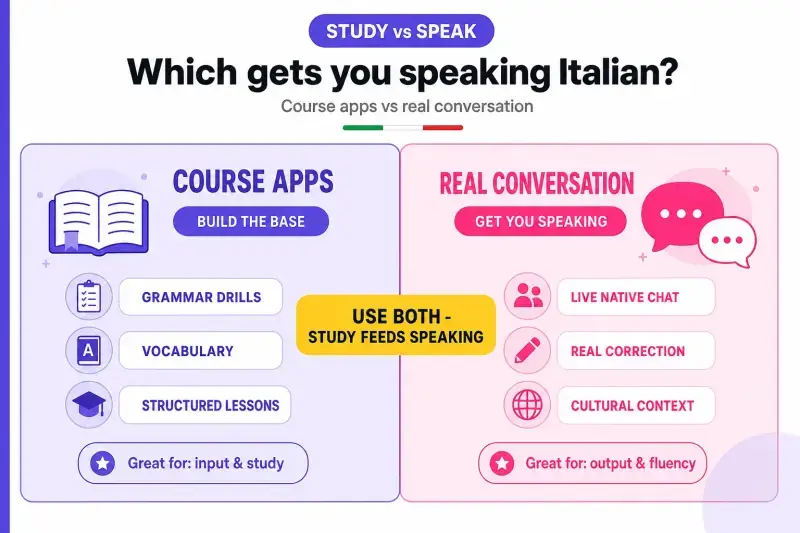
The popular course apps for Italian (Babbel, Duolingo, Pimsleur) are genuinely good at building grammar and feeding you input, but they share one blind spot: none of them gives you the experience of speaking to a real person who is waiting for your reply. That gap is not a flaw you can fix by choosing a better course. It is a structural limit of the category, which means the honest answer to "which app should I use" is two tools, not one. This piece compares the main course apps, shows what each does well, and explains why a speaking layer has to come from somewhere else.
If you are still deciding on your very first move, our guide to where to start learning Italian online as a beginner covers the order of operations. Here we assume you are past that and asking which app to actually open.
What course apps are built to do
Course apps are study tools. They take the input side of language learning (vocabulary, grammar rules, listening comprehension) and turn it into bite-sized lessons you can do on a train. That is a real skill, and the better ones do it well.
Babbel, Duolingo, and Pimsleur each solve a different slice of the input problem, so the right choice depends on what kind of learner you are, not on which app is objectively superior. Babbel leans into practical grammar and dialogues. Duolingo leans into habit-forming daily practice. Pimsleur leans into audio and listening. None of them is wrong. They are just answering different questions.
Here is how the three compare on the things that actually decide your day-to-day experience.
Comparison chart of Babbel, Duolingo, and Pimsleur for Italian
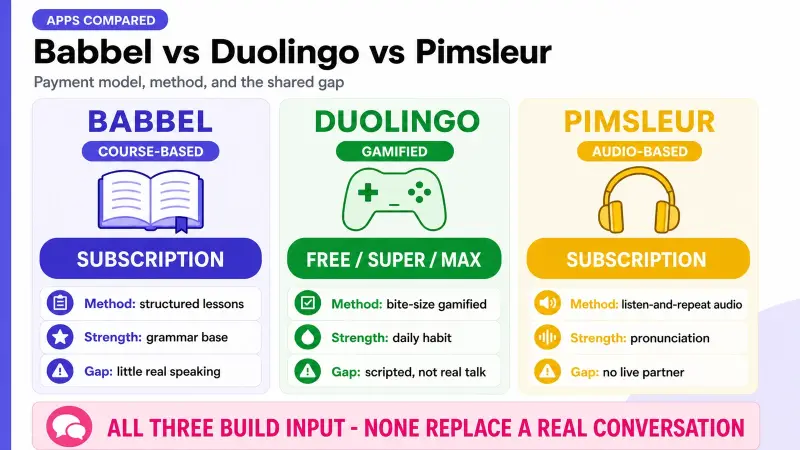
| App | How you pay | How it teaches | What it is good at | What it is weak at |
|---|---|---|---|---|
| Babbel | Subscription, cheaper on annual plans | Short structured lessons built around practical dialogues and grammar tips | Clear grammar explanations, useful everyday phrases, sensible lesson order | Scripted responses only; you never improvise with a real person |
| Duolingo | Free tier usable; paid Super and Max tiers | Gamified daily exercises, streaks, multiple-choice and translation drills | Building a daily habit, low barrier to start, broad vocabulary exposure | Speaking is read-aloud prompts, not conversation; little real grammar depth |
| Pimsleur | Subscription | Audio-based lessons focused on listening and spoken repetition | Pronunciation, listening comprehension, learning hands-free while commuting | Repeats fixed phrases; no live partner, weaker on reading and writing |
A pattern jumps out of the right-hand column. The strengths are spread across three different apps, but the weakness is identical for all three: every course app simulates speaking with scripted prompts, and none of them can reproduce the unpredictability of a real Italian speaker responding to something you just made up. That shared limitation is the whole reason this comparison cannot end with a single winner.
Why none of them gets you to real conversation
It helps to be precise about what "speaking" means, because course apps use the word loosely. When Duolingo asks you to read a sentence aloud, or Pimsleur prompts you to say a memorized phrase, that is pronunciation practice. It is useful. But it is not conversation.
Real conversation has three features no course can fake. The other person says something you did not expect. You have to understand it in real time. Then you have to build a reply from scratch, under mild social pressure, before the silence gets awkward. That loop of unpredictable input and improvised output is exactly the skill that makes someone able to speak a language, and it is exactly the skill a closed lesson cannot rehearse.
You can finish an entire Italian course and still have never once produced an original spoken sentence for a live listener, which is why so many "advanced" app users go quiet in their first real exchange. The grammar is there. The vocabulary is there. The one thing missing is reps at the actual task. Italian is forgiving here (it is phonetic, the vowels are stable, and English speakers share thousands of Latin-root cognates), but no amount of forgiveness helps if you never open your mouth.
This is not an argument against course apps. It is an argument about scope. A course is the input engine. Something else has to be the output engine. For more on why these two jobs are genuinely different problems rather than competitors, our breakdown of Italian courses versus language exchange lays out the case in full.
The tool that fills the speaking gap
If a course handles input, the missing piece is a place to do output with real people, cheaply and without the fear of looking foolish. That is what a language exchange community provides, and it is a fundamentally different kind of product from a lesson app.
This is where HelloTalk fits, and it is worth describing it through the same comparison lens we used above. HelloTalk connects you with over 70M+ registered users across 200+ countries and 260+ languages, which means there is almost always a native Italian speaker available to chat when you are. Where a course app gives you scripted responses, this gives you a person. And because 90% of its core features are free, you can test whether real conversation moves the needle before paying for anything.
Looking at it the way you would compare any app, here is what each part does for the speaking problem specifically:
-
Chat-based learning is the gentle entry point. You text a real Italian speaker, and built-in translation, transliteration, and real-time grammar correction sit inside the conversation, so a half-finished sentence is never a dead end. Compared to a course's fixed dialogue, you are producing original language but with a safety net.
-
Moments works like a feed where you post a sentence or two in Italian and several native speakers correct it at once. A course gives you one "correct" answer; this gives you many real reactions to something you actually wrote.
-
Voicerooms and livestreams are the on-ramp to live speech. You can join a 24-hour Italian voice room as a listener first, then talk when you feel ready, or drop into an interactive livestream lesson. This is the closest thing to the unpredictable real-time loop a course cannot stage.
-
AI learning tools cover the hours no human is online, with AI pronunciation scoring, grammar correction that includes explanations, and image translation. Think of it as the practice layer that bridges between a lesson and a live chat.
The Italian community is a genuine asset here. Italian speakers tend to be warm and patient with learners, which makes the first wobbly voice message far less daunting than it sounds. That low-pressure environment is what gets nervous beginners over the line from studying to speaking.
How to actually combine the two
The mistake is treating this as either-or. You do not choose between a course and a speaking community any more than you choose between lifting weights and stretching. They train different things.
Used together, a course app and a real-conversation tool produce results far beyond what either delivers alone, because one builds the knowledge and the other forces you to deploy it before it goes stale. A workable rhythm looks like this:
-
Learn the input on a course. Pick whichever of Babbel, Duolingo, or Pimsleur fits your style, and use it for grammar, vocabulary, and listening. Twenty focused minutes a day is plenty.
-
Output the same week, not the same year. Send one short Italian message to a native speaker within days of starting, even at twenty words. The point is to use what you just learned while it is fresh.
-
Escalate gradually. Text first, then post a Moment, then sit in a Voiceroom as a listener, then speak. Each step is a small stretch, not a leap.
-
Let the two feed each other. When a real conversation exposes a gap (you could not say "I would have gone"), take that back to your course and study it with a reason to care.
For a full week-by-week version of this loop that keeps self-study from stalling, our roadmap for self-studying Italian to conversation walks through the structure. And if you want the wider menu of beginner resources before committing, the guide to the best online resources for complete beginners learning Italian is a good map of the territory.
Pick a course, then go find a real conversation
So which app should you use to learn Italian? Pick a course app for the studying half based on how you like to learn: Babbel for clear grammar, Duolingo for daily habit, Pimsleur for audio and pronunciation. None of them is a wrong choice, because none of them is the whole answer.
Then add the part the course cannot give you. Open HelloTalk, find a native Italian speaker, and send a real message this week. The fastest route into actual Italian conversation is not a better course. It is pairing the course you already have with a real person waiting to hear what you have to say.