Where to Start Learning Italian Online as a Beginner (and What to Skip)

Most of us start learning Italian the same way: we download an app, learn that pizza is pizza and ciao means hello, and feel a little proud. Then a few weeks pass, the lessons get harder, and the speaking part keeps getting pushed to "later." The good news is that the starting point matters far less than people think, and Italian is one of the friendlier languages to begin with.
For an English speaker, Italian is one of the easiest languages to start, and the right first move is to build a little grammar while you start speaking from day one, not after you feel ready. The instinct to wait until you have "studied enough" before opening your mouth is the single biggest reason beginners stall. This article is about where to actually start, what to focus on first, and what you can safely skip for now.
If you want a broad resource list, our guide to the best online resources for complete beginners learning Italian covers the full toolkit. Here we focus on one thing: the order of operations, so you do not waste the first month.
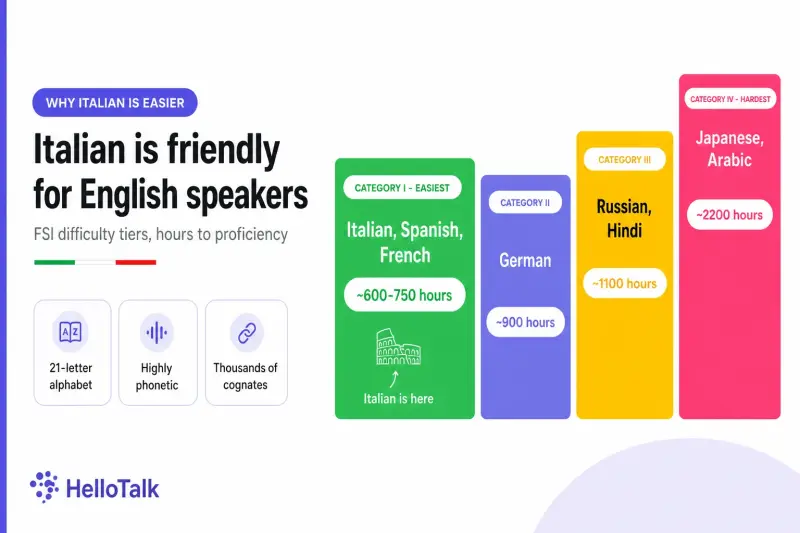
Infographic: why Italian is one of the easiest languages for English speakers to start
Why Italian is a forgiving language to begin with
Before worrying about method, it helps to know the deck is stacked in your favor.
The US Foreign Service Institute rates Italian as a Category I language, the easiest tier for English speakers, needing roughly 600 to 750 class hours to reach professional working proficiency. That is the same group as Spanish and French, and far gentler than Category IV languages like Japanese or Arabic that need three to four times the hours.
A few concrete reasons Italian goes down easy:
-
The alphabet is familiar. Italian uses 21 native Latin letters, with j, k, w, x, and y reserved almost entirely for loanwords. Nothing new to memorize.
-
It is highly phonetic. Words are pronounced close to how they are spelled, so reading aloud becomes predictable once you learn a handful of rules. Stress usually lands on the second-to-last syllable.
-
You already know thousands of words. English and Italian share huge amounts of vocabulary through Latin roots. Patterns like English -tion mapping to Italian -zione (information, informazione) mean you can often guess and be right.
None of this makes Italian effortless, but it does mean an English speaker sees results faster here than in most languages. That early momentum is worth protecting, which is exactly why the starting method matters.
The first thing to get right: grammar and speaking together
The most common beginner mistake is treating learning as two phases: first study the language, then one day start speaking it. That second day rarely arrives.
Grammar and speaking are not sequential stages, they are two tracks you run at the same time from week one. Grammar gives you the skeleton (how verbs change, how to say "I want" versus "I would like"), and speaking puts real weight on that skeleton so it sets. Skip the speaking and the grammar stays abstract, something you can recite but not use.
A simple first-month split that works for most beginners:
-
Present-tense basics. Learn to conjugate regular -are, -ere, and -ire verbs and the big irregulars (essere, avere, andare, fare). This unlocks most everyday sentences.
-
High-frequency words. Focus on the few hundred words you actually use daily (food, directions, numbers, common verbs), not rare vocabulary.
-
Pronunciation rules. Learn how c and g change before different vowels, and how gli and gn sound. A weekend is enough to cover the rules.
-
Real conversation, immediately. Even at twenty words, start exchanging short messages with a real person. This is the track most beginners postpone, and postponing it is the mistake.
The first three are easy to find in any course. The fourth is where most beginners need a deliberate plan, because nothing in a solo course forces you to produce the language.
Where speaking practice actually comes from
Here is the honest gap in most beginner setups: courses and apps are excellent at feeding you input, but they cannot give you the experience of a real person waiting for your reply. That experience is what turns passive knowledge into the ability to speak.
This is where a language exchange community fills the hole a course leaves. HelloTalk connects you directly with native Italian speakers for text and voice chat, and the Italian community on it is active and famously warm, which makes a beginner's first messages a lot less scary. With over 70M+ registered users across 200+ countries and 260+ languages, finding an Italian speaker to practice with is quick, and 90% of core features are free, so you can test whether real conversation helps before paying for anything.
What makes it work for a nervous beginner:
-
Chat-based learning keeps the safety rails on. You can use built-in translation, transliteration, and real-time grammar correction right inside the conversation, so a half-finished Italian sentence is never a dead end.
-
Moments lets you post a sentence or two in Italian to the community and get corrections from several native speakers at once, low pressure and high feedback.
-
Voicerooms let you join a live Italian voice room as a listener first, then start speaking when you are ready, which is a gentle on-ramp to real-time speech.
-
AI learning tools give you AI pronunciation scoring and grammar correction with explanations, useful for the hours when no human is online.
The point is not that an app replaces study. It is that a real-conversation layer is the missing piece beginners skip, and adding it early is what keeps the grammar from going stale.
What you can safely skip for now
Beginners waste a lot of energy on things that do not matter yet. A few you can put off:
-
The passato remoto and other advanced tenses. You will meet them in literature, not in your first conversations. The present and the near-past (passato prossimo) carry you a long way.
-
Perfect pronunciation of the rolled r. Useful eventually, but no Italian will fail to understand you over a soft r. Do not let it block you from speaking.
-
Memorizing long vocabulary lists. Words stick when you use them in real exchanges, not when you drill isolated lists you never deploy.
-
Choosing the "perfect" app before starting. The best app is the one you open daily. Start with anything reasonable and adjust later. Our breakdown of Italian learning apps and what each is good for can help you choose once you are moving.
Skipping these early keeps your attention on the two things that actually build a beginner: core grammar and real speaking practice.
A realistic first week
If you want a concrete plan, here is what a sensible first seven days looks like for a complete beginner.
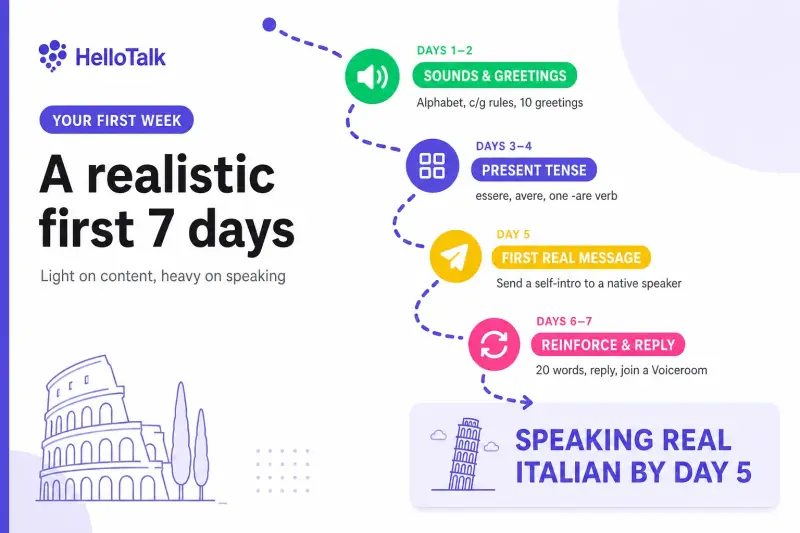
Infographic: a beginner's first-week Italian learning plan from sounds to first real message
| Day | Focus | What you actually do |
|---|---|---|
| 1-2 | Sounds and greetings | Learn the alphabet sounds, c/g rules, and 10 greetings. Read them aloud. |
| 3-4 | Present tense + core verbs | Conjugate essere, avere, and one regular -are verb. Build 10 simple sentences. |
| 5 | First real message | Send one short self-introduction to a native speaker on a language exchange app. |
| 6-7 | Reinforce and reply | Learn 20 high-frequency words, reply to your exchange partner, join a Voiceroom as a listener. |
The plan is deliberately light on content and heavy on output. By day five you are already exchanging real Italian with a real person, which is weeks earlier than most beginners dare to start. A community like HelloTalk makes that day-five message realistic, because there is always a native Italian speaker online to reply.
For the deeper question of how to keep a self-study routine from stalling, see our guide to a beginner's roadmap for self-studying Italian to conversation. And if you are still deciding between a structured course and exchange-based practice, our comparison of Italian courses versus language exchange lays out what each one is really for.
Start speaking this week, not someday
The starting point that works is not a particular app or textbook. It is a mindset: build a little grammar, then put it to work in real conversation right away instead of waiting to feel ready. Italian rewards that approach more than most languages, because it is friendly to English speakers from the first week.
Pick your grammar source, learn the present tense, and send your first Italian message to a native speaker on HelloTalk in the next few days. The sooner a real person is waiting for your reply, the sooner Italian stops being something you study and starts being something you speak.