Which Language App Features Are Worth Paying For (and Which Free Ones Are Enough)

You open a language app, hit your third lesson of the week, and a paywall slides up. Unlimited translation? Pay. Remove ads? Pay. Offline mode? Pay. It is easy to assume that the good stuff lives behind the subscription and the free tier is just a trial. For most learners, that assumption is wrong.
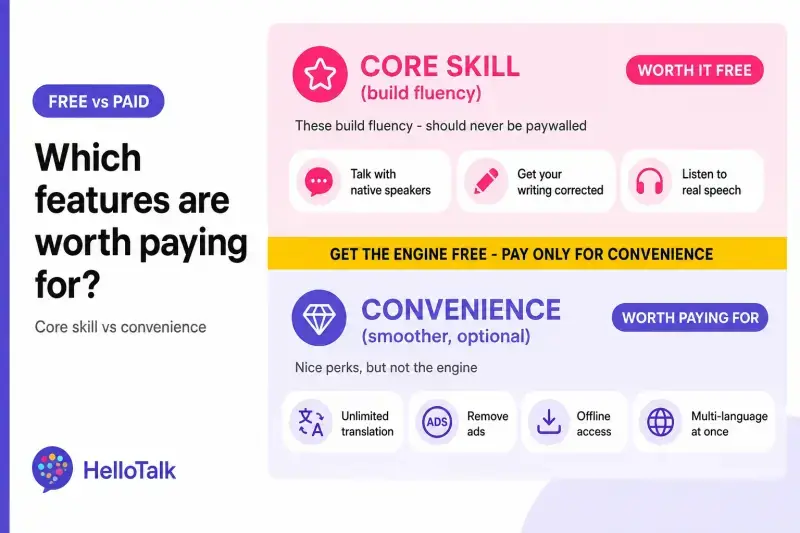
The features worth paying for are convenience features (unlimited translation, ad removal, offline access, simultaneous multi-language study), while the features that actually build fluency, talking with native speakers, getting your writing corrected, and listening to real speech, are good enough for free on the right app and should never sit behind a paywall. If you are still forming the daily habit, you almost certainly do not need to pay yet. For a wider look at when paid tools genuinely earn their keep, see our guide to which premium language app features help you practice more often.
This article goes feature by feature so you can decide where your money does real work and where the free version already has you covered.
The core skill vs convenience split
Every language app feature falls into one of two buckets, and the buckets matter more than the price tag.
The first bucket is core skill features: the things that actually move you toward speaking and understanding a language. Real conversations, correction on what you write and say, and exposure to natural listening input. Research on language acquisition keeps pointing to the same thing, that interaction and feedback drive progress far more than passive drilling does. We dig into the why in our piece on how social feedback increases language practice.
The second bucket is convenience features: things that make the experience smoother but do not change whether you learn. No ads. Translation with no daily cap. Studying four languages at once. Downloading content for the subway. These are real perks. They are just not the engine.
The mistake people make is paying to unlock the engine on apps that lock the engine away, when they could get the engine free elsewhere and pay only for convenience if they want it.
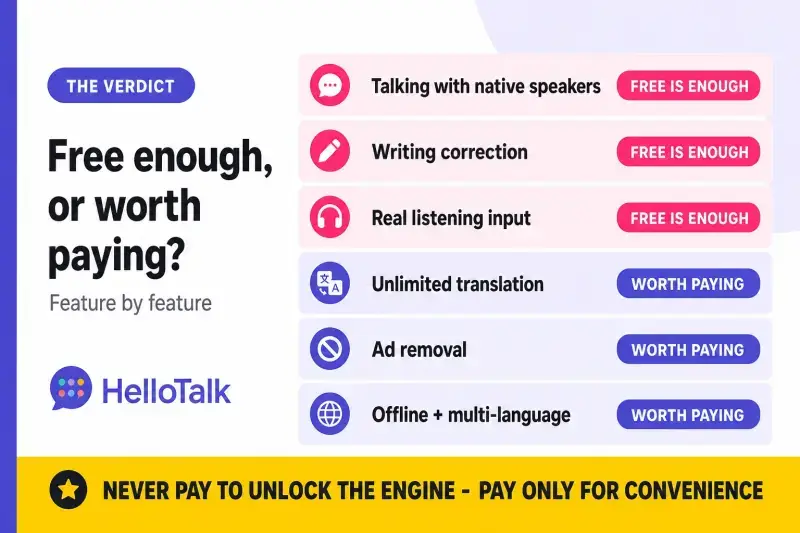
Feature-by-feature: free enough, or worth paying?
Here is the breakdown, scored on whether the free version is genuinely sufficient and what the paid version actually buys you.
| Feature | Is free enough? | What paying buys you | Worth it for whom |
|---|---|---|---|
| Chatting with native speakers | Yes, on a social-first app this is free | Usually nothing extra, the conversation itself is the free core | Almost no one needs to pay for this |
| Writing correction (e.g. Moments) | Yes, multiple native speakers correct you free | Faster or pinned visibility in some apps | Free version covers it for nearly everyone |
| Listening practice (real speech) | Yes, voicerooms and voice messages are free | Curated audio libraries, downloads | Commuters who want offline audio |
| Unlimited translation | Free version is usually capped | Removes the daily translation limit | Heavy chatters who hit the cap often |
| Ad removal | Yes, ads are tolerable for most | A cleaner, faster interface | People who use the app daily for hours |
| Multi-language study | Often limited to one or two free | Study several languages at once | Polyglots juggling 3+ languages |
| Offline / download mode | Usually paid | Content access with no connection | Frequent travelers, weak signal areas |
| Structured courses | Partial free tier, lives/hearts limits | Full course access, no waiting | Beginners who want a rigid syllabus |
| 1-on-1 tutoring | Not free anywhere, it is a service | Scheduled live lessons with a teacher | Exam prep, specific deadlines |
A few patterns jump out. The features at the top, the ones that build fluency, are free on social-first apps. The features that cost money are almost all convenience or scheduling. That tells you where your subscription dollars are best aimed once you decide to spend them.
How the paid tiers compare
Pricing makes the split concrete. Course-based apps charge for the syllabus itself: Duolingo sells Super and Max tiers on top of a free tier that is limited by hearts and lives. Babbel sells a monthly subscription that gets cheaper on a 12-month plan, and also offers one-time lifetime access.
Tutoring is a separate category because it is a paid human service, not an app feature. On iTalki, community tutors cost less per hour than professional tutors, and the platform takes a cut of each lesson. That is real money for real teaching, and worth it when you have a deadline like an exam.
The point is that you can usually get conversation, correction, and listening for free, then pay selectively for a structured course or a tutor only when you have a concrete reason.
Where HelloTalk fits: the core is free
This is the part that flips most people's assumptions. On HelloTalk, 90% of core features are free, and the social feedback that actually builds fluency is not locked behind a paywall.
HelloTalk connects over 70M+ registered users across 200+ countries and 260+ languages, with more than 1 billion messages exchanged daily. The features that matter most are all in the free tier:
-
Chat-based learning: message native speakers directly, with built-in translation, transcription, read-aloud, and real-time grammar correction inside the chat.
-
Moments: post a short text or voice note to the public community and get corrected by several native speakers at once, the kind of crowd-sourced feedback you cannot buy.
-
Voicerooms and Livestreams: 24-hour group audio rooms where you can listen first and speak when ready, plus interactive live mini-lessons.
-
AI learning tools: AI pronunciation scoring that flags your specific sound errors and AI grammar correction that explains fixes in real time, positioned as a backup for when no human is online rather than a replacement for one.
The VIP subscription exists, and it unlocks convenience: unlimited translation, studying multiple languages at once, and an ad-free interface, as an optional monthly subscription, with annual plans costing less. Notice what is not on that list. The conversations, the corrections, and the listening, the actual learning engine, stay free. HelloTalk was named Google Play's Best Social App in 2017 and featured on Google Play's global homepage in 2024, and that recognition is built on the free social core, not the paywall.
Common mistakes when deciding to pay
People waste money in predictable ways. Watch for these.
-
Paying to fix a habit problem. If you are not opening the app daily yet, a subscription will not change that. Build the habit free first.
-
Paying for "unlimited" features you barely use. If you hit the translation cap twice a month, the unlimited tier is not earning its price.
-
Assuming paid means better learning. Convenience features do not teach you. A premium ad-free experience is more pleasant, not more effective.
-
Buying a lifetime plan early. A lifetime deal only pays off if you are still using the app in three years, which most beginners are not.
-
Skipping free conversation to grind paid drills. Real interaction beats locked lessons. Do not pay to avoid the thing that works.
The smarter sequence is simple: practice free until the habit holds, then pay only for the specific convenience you keep wishing you had.
FAQ
Is it worth paying for a language app subscription?
It depends on what you are buying. Paying for convenience like unlimited translation, ad removal, or offline access can be worth it once you use the app daily. Paying to unlock basic conversation or correction is usually a sign the app is locking the wrong things. We compare the math in detail in is a language app subscription worth it.
Which language app features should always be free?
Talking with native speakers, getting your writing and speech corrected, and listening to real speech. These build fluency, and on a social-first app like HelloTalk they sit in the free tier rather than behind a paywall.
Do I need premium to learn with HelloTalk?
No. About 90% of HelloTalk's core features are free, including chat with native speakers, Moments correction, voicerooms, and AI feedback tools. The VIP plan adds convenience like unlimited translation and an ad-free interface, not the learning itself.
When should a beginner start paying?
Not during the habit-forming stage. Build a consistent free routine first. Once you find yourself repeatedly blocked by a specific limit, like a translation cap or wanting offline audio, that is the moment a targeted subscription makes sense.
Is paid translation worth it?
Only if you hit the free cap often. Casual learners rarely exhaust a daily translation limit, so the unlimited upgrade mostly benefits people who chat heavily with native speakers every day.
Is a tutor better than a free language app?
A tutor and a free app do different jobs. Tutoring (paid by the hour on platforms like iTalki) is structured, scheduled teaching, useful for exam prep. A free social app gives you daily, low-pressure practice with many native speakers. Many learners use both.
The bottom line
Pay for convenience, not for the core. Unlimited translation, no ads, offline mode, and multi-language study are nice when you actually need them. Conversation, correction, and listening are the features that make you fluent, and you should never have to pay to access them. Build your habit on the free tier first, then upgrade only for the specific convenience you keep missing.
Start with the part that works and costs nothing. Try HelloTalk and talk to native speakers today.