
Italian Online Courses vs Language Exchange Which Makes You Progress Faster

Search for how to learn Italian and you will hit the same fork within minutes. One camp swears by structured online courses with their tidy syllabus and progress bars. The other camp says forget all that, just talk to native speakers and pick it up naturally. Both sides present their option as the faster route, and a beginner standing at that fork understandably wants to know which one wins.
Italian learner deciding between an online course and a language exchange conversation
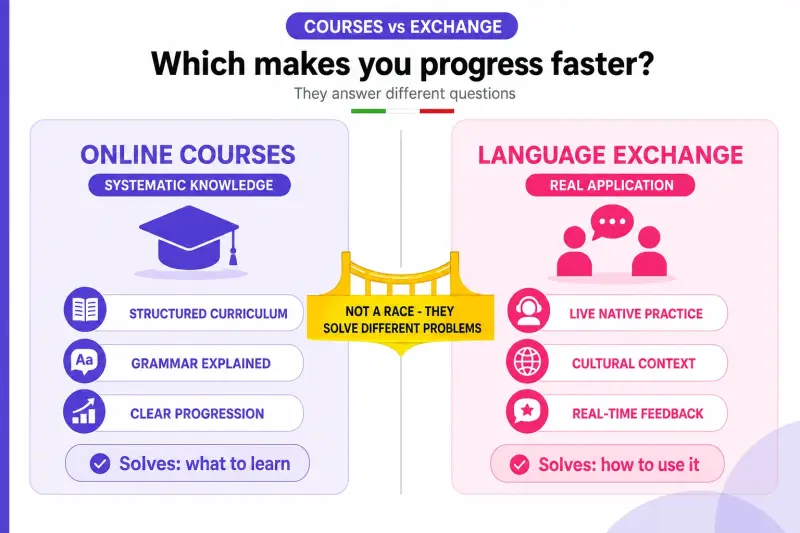
Comparing Italian online courses and language exchange by speed is the wrong question, because the two solve completely different problems and the fastest learners use both at once. A course is built to give you systematic knowledge in a sensible order. A language exchange is built to give you real situations where you actually produce the language. Asking which is faster is a bit like asking whether a recipe or a kitchen makes you cook faster. You need both, and they are not in competition.
This article is for anyone trying to pick a single winner. The honest answer is that the framing itself is broken, and once you see why, the decision gets a lot easier. If you are at the earlier stage of figuring out the right order of operations, our guide on where a complete beginner should actually start with Italian pairs naturally with what follows here.
What a course is actually good at
An online Italian course, whether it is an app subscription or a full video curriculum, does one thing extremely well: it organizes the language into a path you can follow without having to design it yourself.
A structured course removes the burden of deciding what to learn next, which is the single hardest part of teaching yourself a language. Left alone, beginners jump randomly between verb tenses, vocabulary lists, and YouTube videos, and the gaps pile up invisibly. A course sequences the present tense before the subjunctive, introduces vocabulary in useful clusters, and explains why the grammar behaves the way it does.
Italian rewards this kind of structure because it is consistent. The US Foreign Service Institute rates Italian as a Category I language, the easiest tier for English speakers, needing roughly 600 to 750 class hours to reach professional working proficiency. The grammar follows clear patterns, the spelling matches the sound, and English shares thousands of Latin-root cognates with it, like the reliable mapping of English words ending in -tion to Italian words ending in -zione. A good course exploits all of that, feeding you the rules in an order that builds on itself.
What a course gives you, concretely:
-
Sequenced grammar. Concepts arrive in a logical order so you are never missing a prerequisite.
-
Explanations. When a verb conjugation looks strange, the course tells you why instead of leaving you to guess.
-
Measurable input. You can see lessons completed and feel like you are moving, which keeps motivation up.
-
Repetition built in. Spaced review systems make sure the vocabulary sticks.
If you are weighing which app or course to build that input layer on, our comparison of the main Italian learning apps and what each one is best for breaks down where each tool earns its place.
What a course can never give you
Here is the limit that no course advertises. A course can teach you everything about Italian and still leave you unable to speak it under real conditions.
No course, however good, can reproduce the experience of a real person waiting for your reply in real time, and that experience is what converts knowledge into the ability to speak. A course lets you answer on your own schedule, redo the exercise, and check the right answer. Real conversation gives you none of those cushions. Someone asks a question, and you have a few seconds to assemble an Italian sentence from scratch, mispronounce half of it, and recover. That pressure is not a flaw to avoid. It is the exact skill speaking is made of.
Courses also strip out the messy human parts of a language. They rarely teach you that Italians soften requests in specific ways, what is normal to say to a shopkeeper versus a friend, or how regional warmth shapes a casual chat. This cultural layer is not decorative. It is the difference between technically correct Italian and Italian that lands the way you intend.
A side-by-side comparison of what each one solves
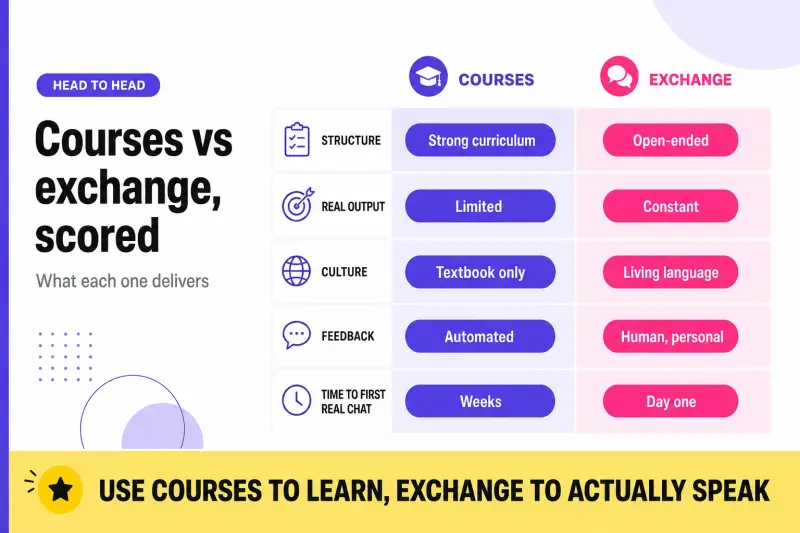
Laying the two next to each other makes the complementary split obvious. They are not two routes to the same place. They are two halves of one route.
Comparison table of Italian online courses versus language exchange
| Dimension | Online course | Language exchange |
|---|---|---|
| Problem it solves | Not knowing what to learn or in what order | Not being able to use what you know in real time |
| What it provides | Systematic grammar, vocabulary, explanations, sequencing | Real output, live pressure, cultural context, unscripted listening |
| What it cannot provide | Spontaneous speaking, real listeners, cultural nuance | A structured syllabus or grammar explained from scratch |
| Feedback style | Pre-programmed, same for everyone | Personal, from a native speaker reacting to you |
| Typical weekly time to see value | Several hours of lessons before it adds up | A single 15-minute real exchange shows you the gap immediately |
| Best suited for | Building the knowledge base, any level | Activating that knowledge, ideally from week one |
| Schedule | On your own time, fully self-paced | Depends on a real partner being available |
Read across any row and the pattern repeats: where one column says "cannot provide," the other column fills it in. The course handles the input. The exchange handles the output. A learner who only does the left column ends up with a head full of Italian they freeze on. A learner who only does the right column picks up bad habits and hits a ceiling fast because nobody is correcting the underlying grammar. The speed comes from running both columns together.
Why HelloTalk is the necessary companion to any course
If a course is the knowledge half, you still need something to carry the output half, the part a course structurally cannot reach. This is the specific gap HelloTalk is built to fill, and it is worth describing as a companion to a course rather than a replacement for one.
HelloTalk solves the exact part a course leaves untouched: real output and cultural understanding, which makes it the natural companion to any Italian course rather than a competitor to one. With 70M+ registered users across 200+ countries and 260+ languages, over 1 billion messages sent daily, and 90% of core features free, it gives you a living pool of native Italian speakers to practice with whenever your course leaves off. The Italian community on it is active and famously welcoming, which makes it one of the lower-pressure places to open your mouth for the first time.
Mapped to the course-companion role, the four core pieces line up like this:
-
Chat-based learning turns your textbook grammar into live messages. Built-in translation, transliteration, and real-time correction sit inside the chat, so the sentence you half-learned in a lesson gets tested and fixed in a real exchange the same day.
-
Moments lets you post the Italian phrases you just studied to the community and collect corrections from several native speakers at once, which is the public-output step a private course never asks of you.
-
Voicerooms and livestreams give you 24-hour multi-person voice rooms you can join as a listener first, plus interactive live mini-sessions, so the listening and speaking your course only simulates becomes real.
-
AI learning tools add AI pronunciation scoring, grammar correction with explanations, and image translation for the hours when no human partner is online, keeping the output practice going around your course schedule.
The combination of an Italian course feeding structured input and HelloTalk supplying real output is also why self-study plans hold up. If you want a step-by-step version of that loop, our self-study roadmap from zero to real Italian conversation shows how to schedule the two halves so neither one stalls.
How to actually run both together
You do not have to split your time evenly or pick a phase. The practical move is to let each one trigger the other.
A simple weekly rhythm that works:
-
Learn a focused chunk in your course. One tense, one set of vocabulary, one grammar pattern. Keep it small.
-
Use it in a real exchange within 48 hours. Send messages or join a voice room and deliberately deploy what you just studied, even clumsily.
-
Bring the friction back to the course. The words you fumbled and the corrections a native speaker gave you become your next study targets.
This loop is what makes the whole thing fast. The course tells you what to practice, the exchange tells you what you actually cannot do yet, and the gap between them is your real syllabus. For a wider view of how all the pieces fit into a single Italian routine, the overview of the most effective overall way to learn Italian puts course study and real conversation in the same frame.
Stop picking a side and start using both this week
The fork was never real. Online courses and language exchange are not two competing answers to "which is faster." They are the input half and the output half of one process, and the learners who progress quickest are the ones who stopped treating it as a choice.
Pick a course or app you will actually open daily for the structured knowledge, then put that knowledge to work in a real conversation on HelloTalk the same week. The course gives you something to say. The native speaker waiting to reply is what finally makes you say it.