Speaking Practice: How to Actually Get Fluent by Talking, Not Just Studying

There is a pattern we see again and again with language learners. Months of flashcards, a long grammar streak, a head full of vocabulary, and then the moment a real conversation starts, everything freezes. The words are in there somewhere, but they will not come out. The gap is almost never knowledge. It is speaking practice, the one part of learning that most people quietly avoid because it is uncomfortable.
This guide is about closing that gap. We will look at why speaking is the skill that lags, how to practice it even when you have no one to talk to, and which methods actually move you from understanding a language to using it. Along the way we will point to deeper guides for specific situations, from exam speaking to practicing a particular language with native partners.
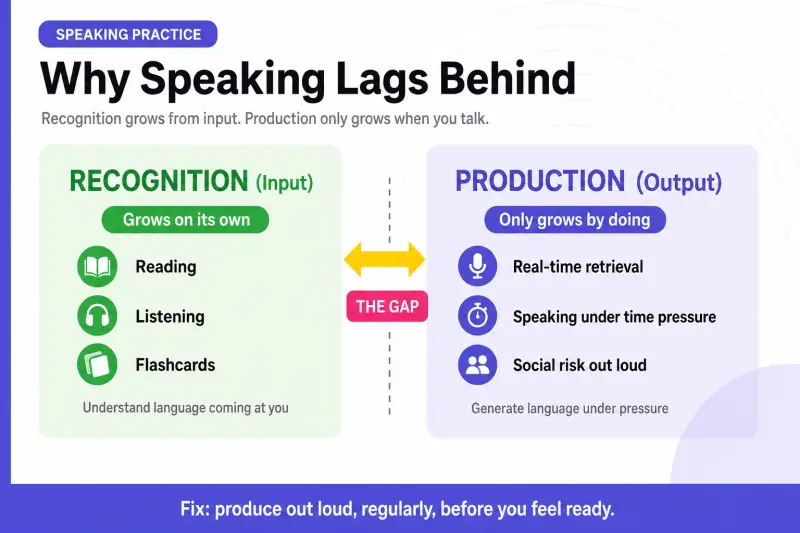
Infographic on why speaking output lags and how to close the gap
Why speaking is the skill that lags behind
Most study methods train the wrong muscle. Reading, listening, and flashcards build recognition, the ability to understand language coming at you. Speaking is production, the ability to generate language under time pressure. These are different skills, and the second one only improves when you actually do it.
Here is what makes speaking uniquely hard:
-
It happens in real time. You cannot pause to look up a word mid-sentence the way you can while reading. The retrieval has to be fast, which only comes from repetition.
-
It carries social risk. Making a mistake out loud in front of a person feels different from getting a quiz question wrong. That fear is the single biggest reason learners delay speaking.
-
It is rarely practiced in isolation. People drill vocabulary alone easily, but speaking seems to require a partner, so it gets postponed until you feel "ready," a day that never quite arrives.
The core fix is simple to state and hard to accept: you have to produce the language out loud, regularly, long before you feel ready. Comprehension will keep improving on its own through exposure. Speaking will not improve until you speak.
The two kinds of speaking practice
Not all speaking practice is the same. It helps to split it into two types, because you need both and they solve different problems.
Infographic of a weekly speaking practice routine

| Type | What it is | Best for | Limitation |
|---|---|---|---|
| Solo practice | Talking to yourself, shadowing audio, recording and replaying, AI conversation partners | Building fluency reps, lowering anxiety, drilling pronunciation | No real social pressure, no unpredictable responses |
| Interactive practice | Real conversation with a partner, language exchange, tutoring, voice rooms | Real-time retrieval, cultural nuance, motivation, genuine feedback | Requires finding a partner, scheduling, some courage |
Solo practice is the on-ramp. It gets the words moving and takes the edge off the fear. Interactive practice is where fluency actually consolidates, because nothing simulates the pressure of a real person waiting for your reply. Most learners skip straight past solo practice into avoidance, then never reach the interactive stage at all.
For the AI side of solo practice, our guide to AI English speaking apps and what they can and cannot do breaks down where automated practice helps and where it hits a ceiling.
How to practice speaking when you have no one to talk to
The most common objection is "I do not have anyone to practice with." That is solvable. Here are methods that work with zero partners, ordered from lowest to highest pressure.
-
Think out loud in your target language. Narrate your day, describe what you are doing, argue with yourself about dinner. This builds the retrieval habit with no audience at all.
-
Shadow native audio. Play a clip, then repeat it immediately, matching rhythm and intonation. This trains your mouth and ear together.
-
Record and replay yourself. Speak for two minutes on any topic, listen back, and notice what trips you up. Uncomfortable, and unusually effective.
-
Use an AI conversation partner. Modern apps let you hold a low-stakes back-and-forth with instant pronunciation feedback. No human is watching, so the fear drops.
-
Drop into a listening-first voice room. Join a live room as a silent listener, get used to the rhythm of real speech, then speak when you are ready.
These methods carry you a long way, but they share one limit. None of them puts a real person on the other end who responds unpredictably and actually needs you to communicate. That is the step that turns practice into fluency.
Where real conversation practice comes from
When you are ready for interactive practice, the question becomes where to find partners. The honest answer is that a language exchange community is the most reliable source, because it connects you with native speakers who want exactly the trade you do: your language for theirs.
HelloTalk is the platform we see learners use most often for this, partly because of scale. With 70M+ registered users across 200+ countries and 260+ languages, there is almost always a native speaker of your target language online, and 90% of its core features are free, so you can start practicing before paying for anything.
What makes it suited to speaking practice specifically:
-
Chat-based learning lets you start in text, where the pressure is lowest, with built-in translation and real-time grammar correction so a half-formed sentence is never a dead end. It is a gentle bridge toward voice.
-
Voicerooms are 24-hour live audio rooms you can enter as a listener first, then speak in when you feel ready. This is the closest thing to real conversation pressure that still lets you control your exposure.
-
Moments lets you post a short voice or text note to the community and get corrections from several native speakers at once, which builds confidence without a one-on-one spotlight.
-
AI learning tools give you pronunciation scoring and grammar correction with explanations, useful for the solo reps between live conversations.
If you want the full framework for finding and working with an exchange partner, our complete guide to language exchange covers partner selection, session structure, and keeping the practice going.
A simple weekly speaking practice routine
Speaking improves with consistency, not intensity. Here is a realistic week that mixes solo and interactive practice without needing hours a day.
| Day | Practice | Time |
|---|---|---|
| Monday | Shadow a 3-minute native clip, record yourself summarizing it | 15 min |
| Tuesday | AI conversation partner on one everyday topic | 15 min |
| Wednesday | Send 3 voice messages to an exchange partner | 10 min |
| Thursday | Join a Voiceroom as a listener, speak once if you can | 20 min |
| Friday | Free text or voice chat with a native partner | 20 min |
| Weekend | One longer live conversation, plus review what tripped you up | 30 min |
The point is the mix. Solo days keep the words moving and lower the fear; interactive days consolidate the skill under real pressure. Skip the interactive days and you stay stuck at the recognition stage. A platform like HelloTalk makes the interactive days easy to keep, since there is always a native speaker available for a quick voice message or a live room.
Speaking practice for specific goals
Speaking practice is not one-size-fits-all. The right approach shifts with your goal:
-
Exam speaking (TOEFL, IELTS). Scored speaking tests reward fluency, coherence, and pronunciation under timed conditions, which is exactly what real conversation builds. Our guide to TOEFL speaking practice that actually raises your score covers how to train for the rubric, not just the questions.
-
Practicing a specific language. The obstacles differ by language. Korean has its honorific levels, German its case system, French its regional accents. We have dedicated guides for Korean language exchange, French language exchange, and German language exchange partners.
-
Finding international partners. If you want to practice across time zones or find speakers near you, our guide to international language exchange covers where to look and how to make the connection stick.
Frequently asked questions
How much speaking practice do I need per day?
Consistency matters more than duration. Fifteen focused minutes a day, mixing solo reps and real conversation, beats a single long session once a week. The goal is to make retrieval automatic, which only comes from frequency.
Can I practice speaking without a partner?
Yes, up to a point. Thinking out loud, shadowing audio, recording yourself, and using AI conversation partners all build fluency with no partner. But real conversation with a person is what consolidates the skill, so treat solo practice as preparation, not a permanent substitute.
When should I start speaking instead of studying?
Now, even if you only know a few hundred words. Speaking and studying are not sequential stages. The longer you wait to speak, the wider the gap grows between what you understand and what you can produce.
Is AI speaking practice as good as talking to a real person?
AI is excellent for low-pressure reps, instant pronunciation feedback, and practicing at any hour. It cannot replicate real social pressure, cultural nuance, or the motivation of a person waiting for your reply. The two work best together, AI for volume and humans for depth.
How do I get over the fear of speaking?
Lower the stakes in stages. Start with solo recording, move to text chat with a native partner, then voice messages you can re-record, then live rooms as a listener, then real conversation. Each step makes the next one feel smaller.
Start speaking this week
Speaking practice is the part of language learning that feels hardest to start and matters most once you do. The methods are not complicated. The hard part is producing the language out loud before you feel ready, and doing it often enough that retrieval becomes automatic. Pick one solo method and one real conversation this week, and put a native speaker on the other end with a community like HelloTalk. Fluency is built by talking, not by waiting until you are ready to talk.