
TOEFL Speaking Practice That Actually Raises Your Score

The timer starts. The prompt loads. You have fifteen seconds to prepare and forty-five to answer, and you are staring at a webcam in an empty room. You know the topic. You have the vocabulary. You have done thirty practice questions this week. And yet the first ten seconds come out as a string of half-sentences, a long pause, and a filler word you did not mean to say. By the time the words start flowing, the clock is almost done. This is the strange cruelty of TOEFL speaking practice for most people: the more you drill alone, the more the actual moment feels like a performance you never rehearsed with a real audience.
Infographic of the TOEFL speaking rubric and how conversation builds each part
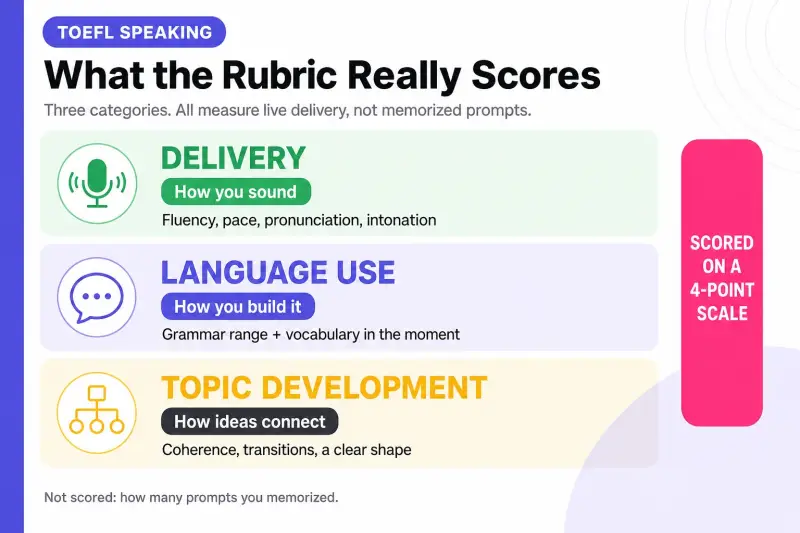
Here is the thing that most prep plans get wrong. The TOEFL speaking section, and the IELTS speaking interview, and the CELPIP spoken tasks, are not really vocabulary tests. They are scored on how you sound when you produce language under pressure. The rubrics measure delivery, language use, and the way your ideas connect, which are conversational skills. You cannot build conversational skills by answering questions into a microphone with no one on the other end. This guide is about training the exact things the examiners score, and why a real partner moves those scores more than another stack of practice prompts.
What the TOEFL speaking section is really scoring
Before you change how you practice, it helps to see what the human rater is actually listening for. The TOEFL iBT speaking tasks are graded on a four-point rubric, and every band comes down to three categories: delivery, language use, and topic development. Delivery covers how clear and fluid your speech is, including pronunciation and pacing. Language use covers your grammar and vocabulary range in the moment. Topic development covers whether your ideas are coherent and well connected, not just whether they are correct.
Notice what is missing from that list. Nobody scores how many prep questions you have memorized. They score the sound and shape of your live speech. IELTS speaking works on a parallel set of four criteria: fluency and coherence, lexical resource, grammatical range and accuracy, and pronunciation. CELPIP speaking rates content, vocabulary, listenability, and task fulfillment across its tasks. Different exams, same underlying truth. They are all measuring conversation, scored against a standard.
This is why a learner with a 110 reading score can still land a 19 in speaking. Reading is recognition. Speaking is production under a clock, judged by a person. The fix is to practice the production, with the pressure, against the rubric.
The rubric, translated into things you can practice with a partner
This is the table to keep open while you prepare. The left column is what the examiner scores. The middle column is the plain-English version of what that means. The right column is the part most prep plans skip: how a real conversation, not a drill, builds that exact dimension.
| Scoring dimension | What the rater measures | How live conversation builds it |
|---|---|---|
| Fluency and pace | Speech flows without long pauses or constant fillers; you keep going for the full response | A partner who is waiting for your reply forces real-time retrieval, the same pressure as the test, so pauses shrink naturally |
| Coherence and topic development | Ideas connect logically with clear transitions; the answer has a shape | Explaining a real opinion to a real person trains you to structure thoughts on the fly instead of reciting a memorized template |
| Pronunciation and intelligibility | A listener understands you without strain; stress and intonation are natural | A native partner reacts instantly when a word does not land, and you self-correct in context, which a silent app rarely surfaces |
| Grammatical range and accuracy | You use varied structures correctly while speaking, not just on paper | Conversation pushes you into tenses and clauses you would avoid in a rehearsed answer, then a partner flags the slip |
| Lexical resource and vocabulary | You reach for precise words and natural phrasing, not the same five | Real topics demand words you did not prepare, so your active vocabulary grows beyond your memorized prompt set |
Read the right column again. Every single dimension improves faster with a person on the other end than with another solo prompt. Drilling questions can rehearse content. Only conversation rehearses delivery, and delivery is what gets scored.
Why drilling questions hits a ceiling
Practice prompts have a place. They familiarize you with task formats, and you should run timed mock tasks before exam day so the structure feels routine. But there is a ceiling, and most people hit it without noticing.
When you answer the same style of question alone, three things quietly go wrong. First, you start memorizing answers. Memorized speech sounds memorized, and raters are trained to hear it, which can cap your topic-development score because the ideas feel canned rather than developed live. Second, you practice with zero social pressure, so the moment a real evaluation begins, your nervous system treats it as new. The freeze you feel on test day is the gap between rehearsing alone and performing live. Third, you get no genuine feedback on intelligibility. You think you are clear because you understand yourself. A listener is the only honest test of whether your pronunciation actually lands.
Real conversation closes all three gaps at once. You cannot memorize a reply to a question you did not see coming. The pressure of a waiting partner is the same pressure as the timer. And a confused look or a follow-up question tells you instantly when a sound did not carry. For a broader treatment of why output beats input across all language learning, our pillar guide to speaking practice lays out the underlying principle that this exam-specific approach is built on.
A practice mix that targets the score, not just the questions
The most effective exam prep blends three layers. Skip any one of them and a part of your score stalls.
-
Format rehearsal, alone. Run two or three timed mock tasks a week so the fifteen-second prep and the response length feel automatic. This is the only part that should be solo. Record yourself and listen back, because hearing your own pauses and fillers is uncomfortable and unusually useful.
-
Targeted feedback on delivery. Use pronunciation scoring tools to catch the specific sounds and stress patterns that drag intelligibility down. This is the low-pressure rep layer, good for volume between live sessions.
-
Live conversation under mild pressure. This is the layer almost everyone underweights, and it is the one the rubric rewards most. Talking with a native speaker about real topics trains fluency, coherence, and intelligibility in the exact conditions the test simulates.
The trap is spending all your time in layer one because it feels like progress and carries no social risk. It builds familiarity with the format and almost nothing else. A 30-minute daily habit that includes real talking moves the needle far more, and our guide to a 30-minute daily English speaking routine gives you a structure you can adapt straight to exam prep by swapping in test-style topics.
Infographic of a spoken-answer practice loop for exam prep
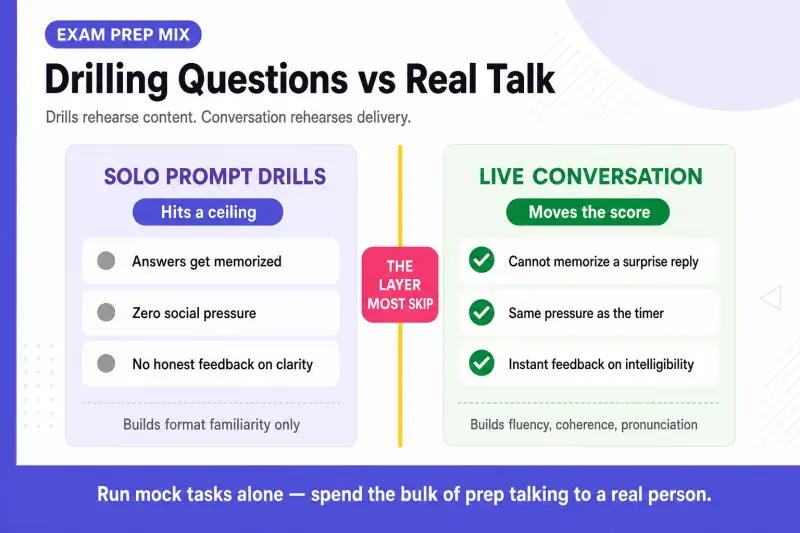
Where exam-focused conversation practice comes from
When you accept that layer three is the bottleneck, the practical question is where to find partners who will actually talk with you about exam-style topics, on your schedule, without it costing a fortune. A language exchange community is the most reliable answer, because it connects you with native speakers who want the same trade: your language for theirs.
HelloTalk is the platform we see exam candidates lean on most, and scale is a big part of why. With 70M+ registered users across 200+ countries and 260+ languages, there is almost always a native English speaker online when you have twenty minutes to practice, and 90% of its core features are free, so you can build the conversation habit before you spend anything on prep. For a test where the bottleneck is live talking time, free and abundant talking time is exactly what you need.
Here is how its four core features map onto exam speaking practice specifically:
-
Chat-based learning lets you start in text, where the pressure is lowest, with built-in translation, transcription, and real-time grammar correction. For exam prep, this is where you rehearse the precise phrasing and connective words that lift your coherence score, and the correction catches the grammar slips a rater would penalize before they become habits.
-
Voicerooms are 24-hour live audio rooms you can enter as a listener first, then speak in when you are ready. This is the closest thing to the test's spoken pressure that still lets you control your exposure, ideal for getting comfortable producing English aloud in front of others before you face the real timer.
-
Moments lets you post a short voice note answering a practice prompt and get corrections from several native speakers at once. For pronunciation and intelligibility, this is feedback from real ears on whether your delivery actually lands, without a one-on-one spotlight.
-
AI learning tools give you pronunciation scoring and grammar correction with explanations, plus image translation. This is your layer-two engine, the low-pressure pronunciation reps you run between live conversations to fix specific sounds the rubric cares about.
If you want the full framework for finding and working with a conversation partner, including how to structure sessions and keep them going, the complete guide to language exchange covers partner selection and session structure in depth. For exam prep, the move is to ask your partner to play examiner: hand them a few test-style prompts and have them ask follow-ups, which trains the unscripted thinking the rubric rewards.
How the practice tools compare for exam speakers
Not every speaking tool is built for the thing an exam scores. Some are great for solo reps, some for real conversation, and the difference matters when your goal is a rubric band, not casual chat. This table weighs them on the exam-specific angle: do they build live delivery under pressure, or only rehearse content.
| Tool | Best for exam prep | Live human pressure | Rubric dimensions it trains | Cost angle |
|---|---|---|---|---|
| HelloTalk | Real conversation plus AI pronunciation reps in one place | Yes, native partners and live Voicerooms | Fluency, coherence, pronunciation, grammar | 90% of core features free |
| ELSA | Pronunciation and intonation drilling | No, solo AI feedback | Pronunciation and intelligibility only | Subscription for full features |
| Cambly | Paid tutoring with native speakers | Yes, scheduled tutors | All dimensions, with structured feedback | Higher per-minute cost |
| italki | Booked lessons and exam-focused tutors | Yes, paid sessions | All dimensions, formal correction | Pay per lesson |
| Duolingo | Vocabulary and grammar foundation | No, app-based exercises | Limited speaking, mostly recognition | Free with paid tier |
| Solo prompt drills | Format familiarity and timing | No | Topic format only, not delivery | Free, but ceiling is low |
The pattern is clear. Tools without live human pressure can sharpen one slice of the score, usually pronunciation or vocabulary, but they cannot rehearse the full delivery the rubric measures. Paid tutoring covers everything but costs enough that most candidates ration it. A free exchange community fills the gap for the layer you need most volume in, which is unscripted conversation time, and pairs it with AI tools for the solo reps.
A four-week exam speaking plan
Consistency beats cramming for a skill scored on delivery. Here is a realistic four-week build that mixes all three layers.
-
Week 1: lower the fear. Daily, narrate your day in English and record one two-minute answer to a test-style prompt. Add three text chats with native partners to warm up production. Join one Voiceroom as a silent listener.
-
Week 2: add real voice. Keep the daily prompt recording. Send three voice messages a day to an exchange partner answering practice questions. Run pronunciation scoring on the sounds that trip you up. Speak once in a Voiceroom.
-
Week 3: simulate the test. Two timed mock tasks a week, alone, on the clock. Two live conversations a week where your partner plays examiner and asks follow-ups you did not prepare. Review every recording for pauses and fillers.
-
Week 4: pressure and polish. Full timed mock sections twice. One longer live conversation every other day. Focus feedback on coherence and transitions, the dimension that separates a 23 from a 26.
The spine of this plan is that the live-conversation days carry the most weight, and they get more frequent as the test nears. That is deliberate. The closer you are to exam day, the more your practice should look like the test, which means a real person and real pressure, not another solo prompt.
Frequently asked questions
How is TOEFL speaking practice different from IELTS speaking practice?
The formats differ. TOEFL iBT speaking is computer-delivered with recorded responses to prompts, while IELTS speaking is a live face-to-face interview with an examiner. But the underlying skills overlap almost completely. Both score fluency, coherence, pronunciation, and language use. If you train live conversation for one, you are building the core skills the other rewards too, which is why exchange-based practice serves both.
Can I raise my speaking score by drilling practice questions alone?
Up to a point. Solo drills build familiarity with the format and timing, which helps. But they cannot rehearse delivery under real pressure, and delivery is most of the score. Without a person on the other end, you also get no honest feedback on whether your pronunciation actually lands. Treat drills as preparation, not the main event.
How long before the exam should I start speaking practice?
Start now, regardless of how far out the test is. Speaking is the slowest skill to build because it improves only by doing it, and last-minute cramming cannot create the automatic retrieval the rubric rewards. Four to six weeks of consistent live conversation makes a visible difference. More is better.
Is AI pronunciation feedback good enough for exam prep?
It is genuinely useful for one layer. AI pronunciation scoring is excellent for catching specific sounds and stress patterns and for running high-volume reps with no social pressure. What it cannot do is replicate the live pressure of producing language for a waiting listener, which is the condition the test recreates. Use AI for the reps and real conversation for the pressure.
Does CELPIP speaking practice work the same way?
Largely yes. CELPIP speaking rates content, vocabulary, listenability, and task fulfillment across spoken tasks, which again rewards clear live delivery over memorized answers. The same mix applies: rehearse the task formats, drill pronunciation with feedback tools, and spend the bulk of your time in real conversation so your spoken English is natural and intelligible under pressure.
How do I get over freezing on the actual test?
The freeze comes from a gap between rehearsing alone and performing live. Close it by practicing under mild real pressure regularly: voice messages you cannot edit, live audio rooms, and conversations where a partner asks unscripted follow-ups. Each rep teaches your nervous system that producing English in front of someone is normal, so the test feels like one more conversation instead of a first one.
Start talking before the timer does
TOEFL speaking practice fails most people not because they study too little but because they study the wrong skill. The rubric scores how you sound when you produce language under pressure, and you cannot rehearse that by answering prompts into a silent room. Run your timed mock tasks, drill the sounds that drag your intelligibility down, and then spend the bulk of your prep doing the thing the test actually measures: real conversation with a real person. Put a native speaker on the other end this week with a community like HelloTalk, hand them a few test prompts, and let them ask the follow-ups you did not see coming. That is the rehearsal the timer is waiting for.