
Language Learning and Cross-Cultural Communication: Why One Without the Other Doesn't Work

You can know every word in a sentence and still get it completely wrong. Say something perfectly grammatical, and watch a room go quiet. It happens to advanced learners constantly, and it has nothing to do with vocabulary.
That gap has a name.
Language and culture are not two separate subjects; a phrase only carries the meaning the culture assigns to it. The same literal words can be warm in one country and rude in another. Which means learning the words without learning the culture leaves you technically correct and socially lost. And learning cultural rules without the language leaves you unable to act on them. You need both, at the same time.
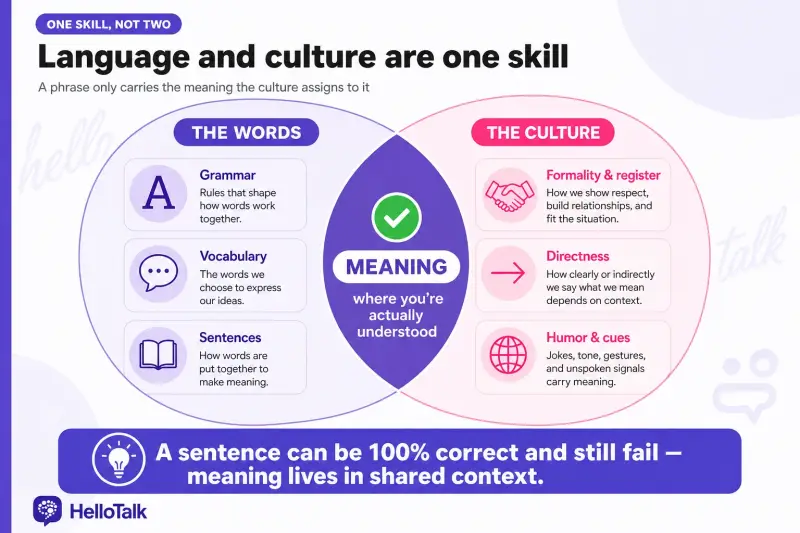
What "cross-cultural communication" actually covers
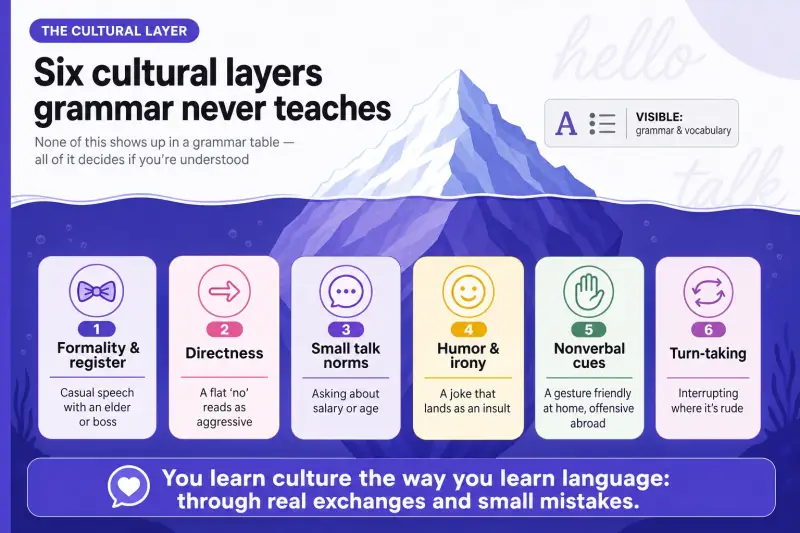
Grammar and vocabulary are the visible part of a language. The cultural layer sits underneath, and it is where most real misunderstandings happen. Here are the pieces that words alone will not teach you.
| Cultural layer | What it governs | Example of getting it wrong |
|---|---|---|
| Formality and register | When to be polite, casual, or deferential | Using casual speech with an elder or a boss |
| Directness | How bluntly people state things | A flat "no" reading as aggressive in an indirect culture |
| Small talk norms | What is safe to ask a stranger | Asking about salary or age where it is taboo |
| Humor and irony | What is funny and what falls flat | A joke that translates literally but lands as an insult |
| Nonverbal cues | Eye contact, gestures, personal space | A gesture that is friendly at home and offensive abroad |
| Turn-taking | When to speak, when to pause | Interrupting where it is seen as rude, or waiting where it reads as disengaged |
None of this shows up in a grammar table. All of it decides whether you are actually understood.
A few examples where the words are fine but the meaning isn't
Consider a learner named Emma who has studied hard and speaks accurately. She asks a new colleague directly how much they earn, because in a textbook that is a simple, correct question. In many cultures it is not a language error at all; it is a social misstep that the words cannot warn her about.
Or take David, who translates a joke word for word from his own language. Every word is right. The humor depends on a cultural reference the listener has never encountered, so it lands as confusing at best. A sentence can be one hundred percent grammatically correct and still fail to communicate, because meaning lives in shared context, not just words.
This is exactly why we argue that effective communication, not grammatical perfection, is the real goal of language learning. Perfection in the words is not the same as success in the exchange.
Why you cannot learn one without the other
The tempting fix is to study culture separately, like a history lesson. It does not work, for a simple reason.
Cultural rules are abstract until you feel them in a real interaction; you learn them by getting something slightly wrong and seeing how a native speaker responds. Reading "this culture is indirect" is not the same as watching someone gently soften a refusal in real time and realizing that is how you should have said it. Culture is learned through the language, in use, with feedback.
And it runs the other way too. Culture teaches you which words to reach for. Knowing that a situation calls for warmth or deference changes your entire word choice. Strip out the cultural sense and you are left choosing words at random.
This is one more reason that human interaction beats solo study. When you practice with real native speakers, you absorb the cultural layer for free, in context, which is part of why social feedback increases both how much and how well we practice.
How to build cross-cultural communication as you learn
You do not need to master a culture before speaking. You need to learn it the same way you learn the language: through real exchanges, small mistakes, and feedback.
Learn the phrase and the situation together. When you pick up a new expression, ask who says it, to whom, and when. A phrase without its social context is only half learned.
Pay attention to how native speakers soften and hedge. Politeness strategies vary enormously between languages, and they are where directness goes right or wrong. Watch, copy, and ask.
Treat cultural slip-ups as gifts. When a native speaker reacts unexpectedly, that is the exact moment a cultural rule becomes visible. It is worth ten pages of reading.
Immerse in real daily content, not just lessons. Seeing how people actually talk, joke, and post reveals the culture that no textbook captures. If you want a broader framework for choosing where to spend your effort, our guide to language learning strategies that actually work helps you prioritize.
Where you get the cultural layer, not just the words
The catch is access. You cannot absorb a culture from a grammar app, and most learners do not live surrounded by native speakers. That is the gap HelloTalk closes, connecting over 70M+ registered users across 200+ countries who speak 260+ languages, so the cultural exposure is built into every interaction.
Here is how each part delivers culture alongside language:
-
Chat-based learning lets you talk with real native speakers day to day, so you pick up register, slang, and politeness in context, with translation and transcription on hand when the meaning behind the words is not obvious.
-
Moments works like a window into daily life abroad. Scrolling the public feed shows you what real people post, joke about, and celebrate, which is culture you cannot get from a lesson.
-
Voicerooms and Livestreams put you in live group conversations across many countries, where you hear tone, turn-taking, and humor as they actually happen.
-
AI learning tools help with the mechanics, including image translation for menus, signs, and posts, so you can decode the cultural details you encounter.
Because it is a genuine community rather than a course, the culture comes along for free with every conversation. If you are new to the format, our overview of how language exchange works explains how to start.
Common mistakes learners make
-
Studying culture as trivia. Facts about a country are not the same as knowing how to behave in a conversation.
-
Translating jokes and idioms literally. Meaning rarely survives a word-for-word swap.
-
Assuming your own norms are universal. Directness, small talk, and humor vary widely, and assuming otherwise is the fastest way to offend.
-
Ignoring the tools that build the words. Culture guides word choice, so you still need solid production skills, which is why we cover the tools that actually build communication skills separately.
FAQ
Can I learn a language without learning the culture? You can learn the words, but you will keep miscommunicating, because meaning depends on cultural context that words alone do not carry.
Do I need to study culture before I start speaking? No. You learn culture best through real conversations and small mistakes, not as a separate subject beforehand.
Why do native speakers sometimes react oddly to correct sentences? Because the sentence broke a cultural rule, such as being too direct or too casual, even though the grammar was fine.
How do I pick up cultural rules quickly? Interact with native speakers regularly and pay attention to how they phrase, soften, and joke. Real feedback teaches culture faster than any book.
Is humor really that different between cultures? Very. Jokes rely on shared references and often fail when translated literally, so it is worth learning what actually lands.
What is the fastest way to get cultural exposure without traveling? A language exchange community gives you daily contact with native speakers and a window into their real lives, which is the next best thing to being there.
Learn the words and the world together
Language and culture are one skill, not two. The learners who communicate well abroad are the ones who picked up both together, through real conversations with real people.
Start absorbing the language and the culture at the same time. Download HelloTalk and connect with native speakers around the world at HelloTalk.