Beyond Grammar: Language Learning Tools That Actually Build Communication Skills

Open any app store and you will find hundreds of language tools promising fluency. Most of them are excellent at one thing: teaching you words and rules. Far fewer help you do the thing you actually wanted, which is talk to real people and be understood.
So the question worth asking is not "which app is best?" It is "which tools build communication skills, and which just build a vocabulary you can never quite use?"
A tool builds communication skills only if it makes you produce language and gives you a real reaction to it. Flashcards, grammar drills, and multiple-choice quizzes train recognition. Communication requires production plus feedback. Once you sort tools by that single test, the picture gets much clearer.
The three jobs a tool has to do
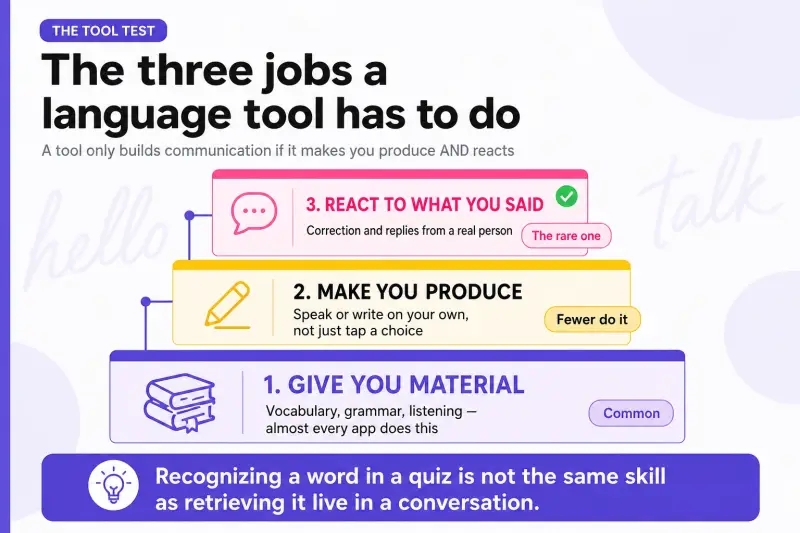
If a tool is going to move you toward real conversation, it needs to cover three jobs. Very few cover all three, which is why most learners end up combining a couple of them.
-
Give you material (vocabulary, grammar, listening input). Almost every app does this well.
-
Make you produce (speak or write on your own, not just tap the right choice). Fewer do this.
-
React to what you produced (correction, replies, follow-up questions from a real person or a smart system). This is the rare one, and it is the one communication depends on.
We go deeper into why production and reaction matter so much in our piece on effective communication as the real goal of language learning. Here we are focused on the tools themselves.
Those three jobs come out of a longer framework rather than from observation alone. See the competence map these three jobs come from for the full version, including where scheduled tutors, AI partners and real conversation each fall short.
Tool types compared
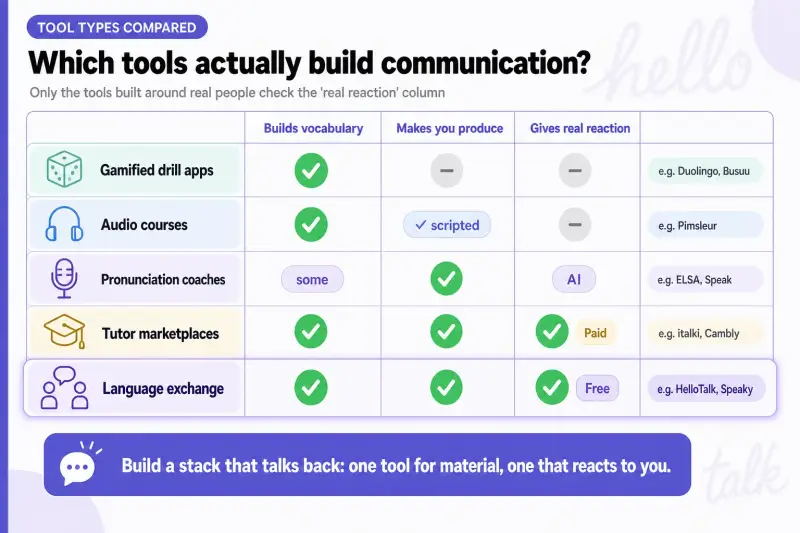
| Tool type | Examples | Builds vocabulary | Makes you produce | Gives real reaction | Best for |
|---|---|---|---|---|---|
| Gamified drill apps | Duolingo, Busuu | Yes | Rarely | No | Beginners building base vocab and habit |
| Audio courses | Pimsleur | Yes | Speaking aloud (scripted) | No | Pronunciation and set phrases |
| Pronunciation coaches | ELSA, Speak | Some | Speaking (isolated) | AI feedback | Accent and clarity work |
| Tutor marketplaces | italki, Cambly | Yes | Yes | Yes (paid, scheduled) | Structured lessons with a pro |
| Language exchange communities | HelloTalk, Speaky | Yes | Yes | Yes (free, on demand) | Real conversations with native speakers |
The pattern is hard to miss. The tools that check the "real reaction" column are the ones built around actual people. That does not make drill apps useless. It means they are step one, not the whole staircase.
Why drill apps alone leave you stuck
Gamified apps are genuinely good at what they do. They build a beginner vocabulary and, more importantly, a daily habit. But recognizing a word in a multiple-choice quiz is not the same skill as retrieving it live in a conversation. The first is recognition; the second is production under pressure, and only the second is communication.
This is the classic input-heavy trap. If you want the full picture of how these two modes work together, our explainer on balancing input and output in language learning lays it out. The takeaway for tool choice: you need at least one tool in your stack that forces output and delivers reactions.
Where AI tools fit (and where they don't)
AI conversation practice has come a long way. It is patient, always available, and never judges you. For rehearsing, warming up, and drilling pronunciation, it is genuinely useful.
But there is a ceiling. AI will not misunderstand you in the messy, unpredictable way a real human does, and those misunderstandings are exactly what train real-world communication. A person might use slang you have never heard, change the subject, or react to your tone. That unpredictability is the training. We compare the two approaches directly in AI conversation versus real human language practice, and the honest conclusion is that AI is a great supplement and a poor replacement.
The tool that covers all three jobs
The reason a language exchange community sits at the top of the "real reaction" column is that it combines material, production, and human feedback in one place. That is the model HelloTalk is built on, and it is why over 70M+ registered users across 200+ countries use it to practice 260+ languages with native speakers.
Here is how it maps onto the three jobs:
-
Chat-based learning covers material and production together. You chat with native speakers while built-in translation, transcription, and read-aloud help you understand, and real-time grammar correction reacts to your sentences instantly, all without leaving the conversation.
-
Moments delivers reaction at scale. Post a sentence or short recording to the public feed and several native speakers can correct it and reply, so you learn from many perspectives, not just one.
-
Voicerooms and Livestreams move production into speech. Join a 24-hour group voice room as a listener first, then speak when you are ready, or drop into an interactive livestream mini-lesson.
-
AI learning tools fill the gaps between human conversations with pronunciation scoring that names specific problems and grammar correction that explains the fix.
With 90% of core features free and over 1 billion messages sent daily, the volume of real interaction is what turns passive knowledge into communication.
How to build your own stack
You do not need every tool. A simple, effective stack looks like this:
-
One material tool to build base vocabulary and a daily habit (a drill app is fine here).
-
One production-and-reaction tool where real people respond to you (this is the non-negotiable one).
-
Optional AI support for warming up and pronunciation between real conversations.
For more on matching tools to your specific situation and goal, see our guide to language learning strategies that actually work, and if you want to understand the format that delivers the most reaction per hour, start with how language exchange works.
Common mistakes when choosing tools
-
Collecting five drill apps and no output tool. More recognition practice will not fix a production gap.
-
Assuming paid means better for communication. A paid tutor is great, but a free community can give you more total speaking time.
-
Treating AI as a full replacement for people. Use it to warm up, not to graduate.
-
Skipping the cultural layer. Words are only half of communication, which is why we treat cross-cultural understanding as part of the tool set too.
FAQ
Do I need to pay for good communication practice? No. Free language exchange communities give you real reactions from native speakers at no cost. Paid tutors add structure, but they are optional.
Are drill apps a waste of time? Not at all. They build vocabulary and habit efficiently. They just cannot finish the job on their own because they rarely make you produce and react.
Can AI chatbots replace real conversation partners? They are a strong supplement for rehearsal and pronunciation, but they do not misunderstand you the way real people do, so they miss part of the training.
What is the one tool I should not skip? Whatever tool puts real human reaction in front of you, whether that is a language exchange community or a tutor. That is where communication skills are built.
How many tools should I use at once? Two is usually enough: one for material and habit, one for production and reaction. Add AI support if it helps you warm up.
What if I feel too shy to talk to real people? Start with text chat or by listening in a voice room. Both lower the pressure while still giving you real interaction to grow from.
Build a stack that actually talks back
The best language learning tool is the one that gets you talking to real people and reacting to their replies. Vocabulary apps are the warm-up; conversation is the workout.
Ready to add the tool your stack is probably missing? Download HelloTalk and start practicing with native speakers at HelloTalk.