
Best French Language Exchange Partners and Platforms in 2026

Finding a French exchange partner is easy. Keeping one is the part nobody writes about, and it is where most learners lose three months.
The typical story: you match with someone, have a friendly first conversation, agree to talk weekly, exchange two messages the following week, and never speak again. Most language exchanges fail from lack of structure rather than lack of goodwill, which is why the platform matters less than the session format you agree on in the first ten minutes.
This guide covers both: where to find French partners in 2026, and how to run an exchange that survives past week three.
What a French exchange is good at, and what it is not
An exchange is a time trade. You help someone with your language, they help you with French, nobody pays. That structure produces specific strengths and specific blind spots.
Good at: real speech at real speed, correction on your own errors, informal register, listening practice, and the specific skill of retrieving a French word while a human being waits for it.
Not good at: grammar sequencing, exam preparation, or teaching you what to learn next. Your partner is a native speaker, not a teacher, and most native speakers cannot explain why the subjunctive appears where it does.
French exchanges become efficient at roughly 200 to 300 known words, which most learners reach in three to four weeks with any course. Below that, text chat still works because you have time to compose; voice does not.
There is one French-specific reason exchanges pay off more than in most languages. French listening is difficult for English speakers not because of vocabulary but because liaison and elision erase the word boundaries you see on the page. A learner who reads French comfortably can genuinely fail to hear a spoken sentence made of words they know. Only live speech fixes that, and graded audio delays the problem rather than solving it.
Exchange is one layer of a daily habit rather than the whole of it. To see where language exchange sits among the other daily French options, including the courses and listening sources that pair with it, start from the full breakdown.
Where to find French partners in 2026
The routes below solve different problems. Compare them by how quickly they produce a suitable partner, how reliably the arrangement continues, and whether you need conversation practice or formal instruction.
| Route | Best for | Speed of finding a partner | Reliability | Cost |
|---|---|---|---|---|
| Dedicated exchange app | Steady weekly practice, any level, any time zone | Minutes | Good, with volume as backup | Free on HelloTalk for 90% of core features |
| Local conversation meetups | Group practice, accountability, in-person nerve | Weeks, depends on your city | Good while the group runs | Free to low |
| University exchange schemes | Structured pairing, similar age and interests | Weeks, term-based | High during term | Free if enrolled |
| Interest communities in French | Vocabulary in a field you care about | Days | Variable, conversation is a side effect | Free |
| Paid tutoring platforms | Grammar explanation, exam prep, guaranteed attendance | Hours | Very high | Per hour |
For most learners aiming at conversational French, the first row is where the hours actually come from, with a paid tutor added occasionally if grammar questions pile up.
The honest comparison against courses and apps, rather than between exchange routes, is in Duolingo, Pimsleur and language exchange compared, and we compared exchange platforms with each other in HelloTalk versus other language exchange apps.
What to look for in a French partner
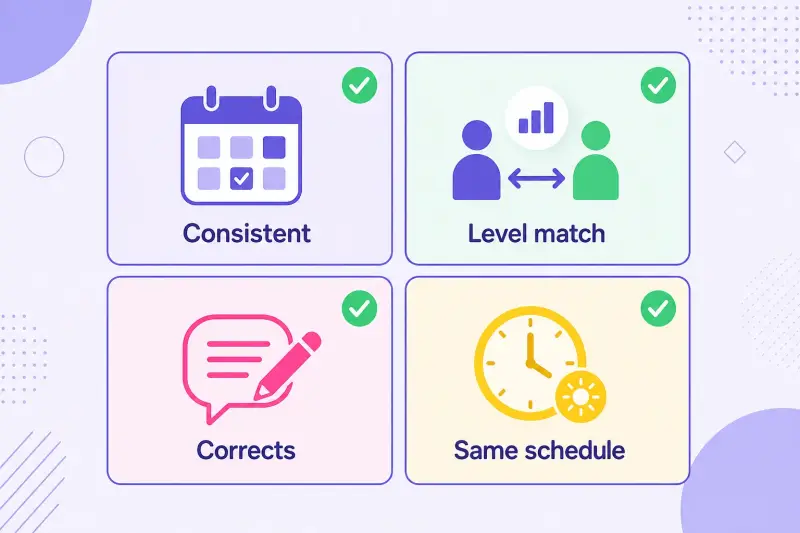
- They want your language specifically. A partner learning your native language has a reason to come back. Goodwill alone does not survive a busy week.
- Compatible time zones. A three-hour offset is workable. A nine-hour offset means one of you is always tired.
- Similar level of commitment. Someone practising for a September exam and someone browsing casually will not last as a pair.
- A shared topic. Cooking, football, code, films. Exchanges with a subject outlast exchanges built on "let's practise".
- Willingness to correct. Ask in the first session. Many native speakers will not correct you unless invited, out of politeness.
The session format that survives
Thirty minutes, split down the middle, with a rule about correction. That is it.
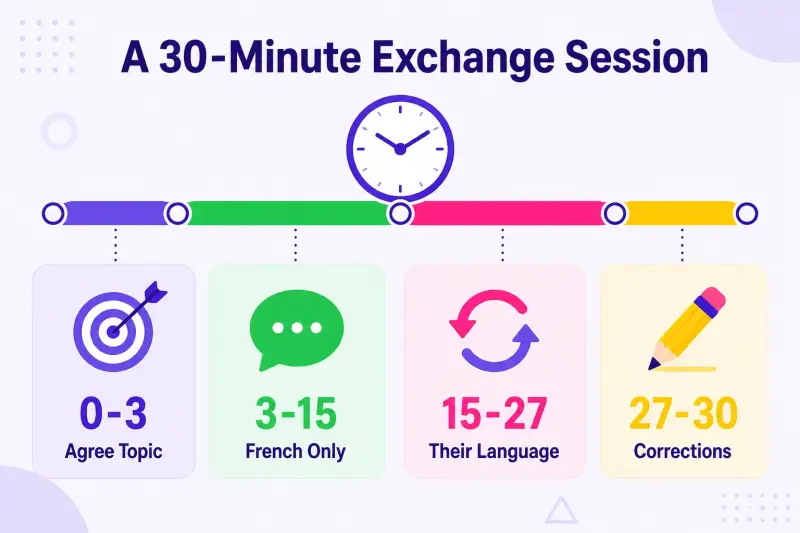
- Minutes 0-3: agree the topic. Decided in advance is better. "Tell me about your weekend" works forever.
- Minutes 3-15: French only. Your partner corrects errors that block understanding immediately, and saves the smaller ones for the end.
- Minutes 15-27: their language. You do the same for them.
- Minutes 27-30: three corrections each, written down. Written, not spoken. Notes are what turn a nice chat into study.
Then two follow-ups that cost almost nothing and double the value:
- Add the three corrections to your spaced-review deck the same day. A 2022 meta-analysis pooling 98 effect sizes from 48 experiments with 3,411 learners found spaced review retained material better than the same time spent in a single block.
- Use the corrected phrases in your next session on purpose. A correction used twice becomes a habit.
The single biggest predictor of whether an exchange lasts is whether the next session is booked before the current one ends. Not "let's talk again soon". A day and a time.
How this works on the HelloTalk platform
The HelloTalk platform is designed for this exact continuity problem, so each feature below maps to a point where exchanges usually break down.
Chat-based learning. Text chat is the low-pressure entry and the fallback for days when voice is too much. Translation, phonetic transcription and read-aloud are built into the message thread, which in French matters more than in most languages: read-aloud lets you hear how a written sentence actually sounds, closing the spelling-to-sound gap that makes French listening hard. Real-time grammar correction flags your gender and agreement errors while the conversation is still open, so your partner does not have to remember them all.
Moments. Post three French sentences publicly and several native speakers will correct the same text. This is the part of an exchange that does not depend on scheduling at all, which makes it the most reliable ten minutes in the plan. The plurality of corrections also teaches you which of your errors are actual rules and which are matters of taste. Scrolling the feed gives you casual written French, complete with the abbreviations and slang that never appear in a coursebook.
Voicerooms and Livestreams. French voice rooms run around the clock, and joining as a silent listener is normal and expected. That is the fix for the liaison problem: several native speakers talking over each other, at full speed, with none of it slowed down for you. Livestream mini-lessons add a host and a topic when you want French input without the obligation to produce.
AI learning tools. AI pronunciation scoring names the sound you are missing, which for French learners is usually the u, the r or the nasal vowels, and it does so without your partner having to be blunt about it. AI grammar correction explains the rule behind each fix so corrections generalise. Image translation handles a French menu or form on the spot.
HelloTalk's scale is what makes the format above sustainable rather than lucky: 70M+ registered users across 200+ countries studying 260+ languages, with over 1 billion messages daily, so when one partner goes quiet the next is already online. 90% of HelloTalk's core features are free, and HelloTalk was named Google Play's Best Social App in 2017 with a global Google Play homepage feature in 2024.
Safety and etiquette, briefly
An exchange is a study arrangement, and treating it that way keeps it comfortable for both people.
- Keep early conversations on the platform rather than moving to private contact details straight away.
- Share what you would share with a new colleague: your city, your job, your interests. Nothing more specific until you know someone well.
- Meet in public places if an exchange becomes an in-person one, and take your time getting there.
- Be clear about what you are looking for. Language practice is the arrangement; saying so plainly prevents mismatched expectations.
- Correct kindly and ask to be corrected. Both sides are doing something difficult in front of a stranger.
Common mistakes with French exchanges
- Ending a session without booking the next. The main cause of death.
- Letting the exchange drift into your own language. Set the halfway timer and honour it.
- Not asking to be corrected. Politeness will otherwise cost you months of uncorrected errors.
- One partner only. Two or three means a cancellation does not cost you the week.
- Starting voice at zero words. Text for the first three weeks, then switch.
- No notes. A pleasant conversation you did not write anything down from was social, not study.
- Treating the exchange as the whole plan. It supplies speaking hours, not a syllabus. Pair it with a course, as set out in the French three-month method stack and the schedule in the three-month French weekly milestone system.
FAQ
How do I find a French language exchange partner? Use a dedicated exchange platform and filter for native French speakers learning your language. State your level, your available times and one shared interest in your first message. Contact several people rather than one, because most exchanges take two or three attempts to stick.
Is a French language exchange free? Yes. On HelloTalk, 90% of core features are free, and the exchange itself is a time trade rather than a payment. The real cost is scheduling and the awkwardness of the first few sessions.
How much French do I need before starting an exchange? About 200 words for text chat, which most learners reach in two to three weeks. Voice becomes comfortable around 400 to 500 words, roughly week five or six.
How often should we meet? Two 30-minute sessions a week produces a noticeable change within a month. Four sessions is where delivery speed improves clearly. More than five with the same partner tends to run out of topics.
Is an exchange partner as good as a French tutor? For fluency and listening, competitive and free. For grammar explanation, exam preparation and guaranteed attendance, a tutor is better. Many learners use exchanges weekly and a tutor once a month for the questions that pile up.
What should we talk about? Ordinary life first: weekend, food, work, complaints about the weather. Boring topics are correct, because they are the ones you will need repeatedly. Add one shared interest for the sessions where you both have energy.
What if my partner never corrects me? Ask directly, in the first session, and make it easy: "please stop me when I get the gender wrong". Most people will not correct a stranger unless invited.
Find two partners, agree a thirty-minute split format, and book the next session before you hang up. You can start looking free on HelloTalk.