Duolingo vs Pimsleur vs Language Exchange: Which Method Actually Wins?

These three are not three apps. They are three different theories of how a language enters your head, and that is why comparing them by star rating is useless.
Duolingo bets on gamified repetition. Pimsleur bets on audio recall. Language exchange bets on unscripted conversation with a human being. They do not compete for the same job, which is why the honest answer to "which one wins" depends entirely on whether you currently need vocabulary, pronunciation, or the ability to speak without a script.
Here is how access works, what each one trains, and where it stops.
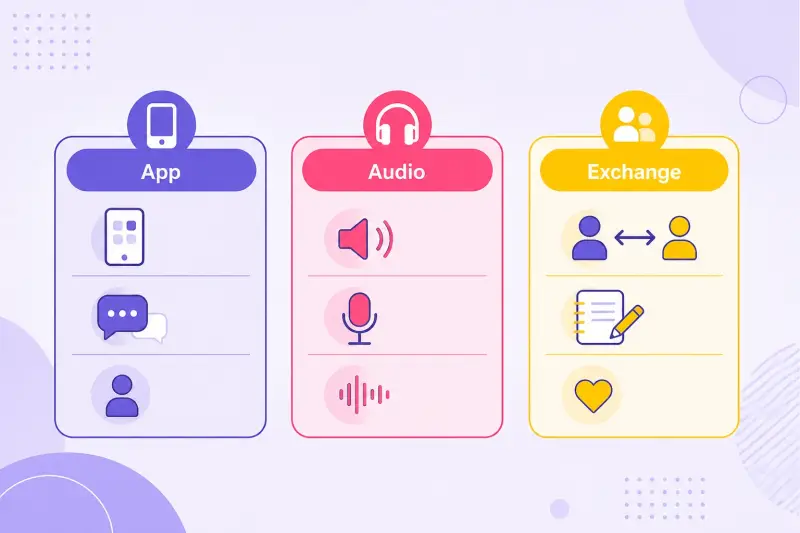
The comparison, side by side
The table separates what each method trains from the point where it stops helping. That distinction matters because a convenient daily format is not automatically a complete learning system.
| Duolingo | Pimsleur | Language exchange | |
|---|---|---|---|
| Access model | Free ad-supported tier with optional paid plans | Paid subscription | Free exchange on many platforms; HelloTalk keeps 90% of core features free |
| Session shape | 5-15 minute gamified lessons | 30-minute audio lessons, listen and respond aloud | 10-60 minutes of live chat, voice or text |
| Trains | Recognition vocabulary, basic patterns, daily habit | Pronunciation, sentence rhythm, speaking reflex | Retrieval under pressure, listening to real speech, correction |
| Reading and writing | Yes | Minimal | Yes, in text chat |
| Corrects your actual mistakes | Fixed answers only | No, it cannot hear you | Yes, by a person who knows the language |
| Where it stops | Spontaneous speech | Intermediate ceiling, narrow vocabulary | Needs a starter vocabulary from somewhere |
| Best used | Month 0-3, as habit and vocabulary base | Month 0-4, in commute time | Week 1 onward, forever |
The table gives the overall verdict; the sections below test each method against the same questions: what it builds well, where it reaches a ceiling, and what must be added to keep progressing.
Duolingo: daily habit, hard ceiling
Duolingo's real product is not lessons. It is the streak. It gets people to open a language app on day 40, which most learners never manage alone, and the free tier lowers the barrier to keeping that habit.
What it delivers well: a few hundred to a couple of thousand recognition words, sentence patterns you can imitate, and a sense of momentum. The January 2026 move of its answer-explanation feature to the free tier made the free version meaningfully better than it was a year ago.
Where it stops: recognition is not production. Being able to select the right answer from four options is a different skill from producing the sentence from nothing, and the gap between the two is the single most common reason people say they finished a course but cannot speak. Duolingo also cannot correct a mistake it did not anticipate, which is most of the mistakes you will actually make.
Use it as the vocabulary faucet, not as the plan.
Pimsleur: the speaking reflex in a structured course
Pimsleur is audio-first. A native speaker models a phrase, you respond out loud, the interval before you hear it again stretches. It has been running on that method since the 1960s, and for pronunciation and sentence rhythm it holds up.
What it delivers well: you speak from lesson one, out loud, in complete sentences. Thirty minutes of walking or driving becomes real practice time. Pronunciation from Pimsleur users tends to be noticeably better than from app-only learners, because the model sound arrives before you form the habit of reading the word wrong in your head.
Where it stops: it requires a paid subscription, and the vocabulary is deliberately narrow. It is a course, so it ends. And it cannot hear you, which means it never tells you that your version of a sound is wrong. It gives you the model and trusts you to match it.
Use it in dead time, and expect to outgrow it around the intermediate stage.
Language exchange: the messy one that keeps working
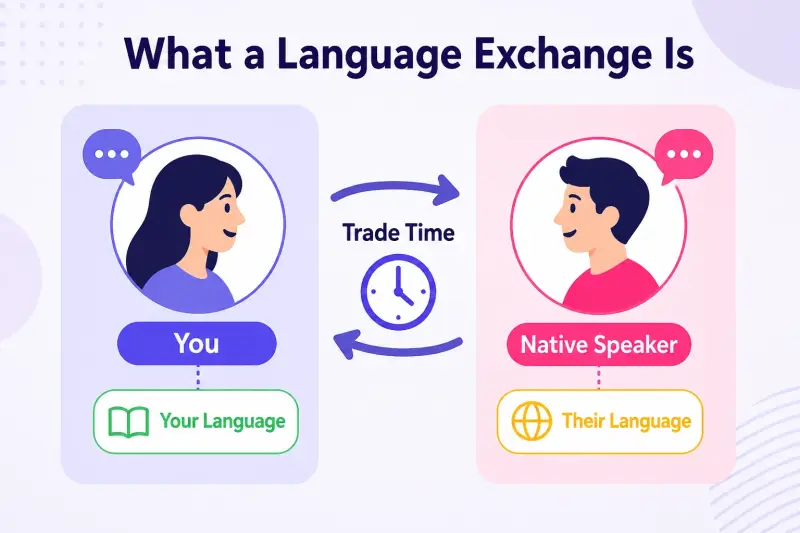
An exchange is you and a native speaker of your target language who wants to learn yours. You trade time. It is free, it is unpredictable, and it is the only one of the three that responds to what you personally get wrong.
What it delivers well: everything the other two structurally cannot. Real speech at real speed, including the swallowed syllables and filler words no course teaches. Correction aimed at your errors, not a textbook's average learner. And the specific skill of retrieving a word while somebody waits, which is what fluency feels like from the inside.
Where it stops: you need something to say. From absolute zero, an exchange is 40 minutes of two people smiling at each other. A language exchange becomes efficient at roughly 200 to 300 known words, which most learners reach inside three weeks with any app.
The other real limitation is logistics: time zones, no-shows, and partners who drift off after two sessions. That part is solvable with volume, which is where a large platform helps. HelloTalk carries 70M+ registered users in 200+ countries across 260+ languages, moving over 1 billion messages daily, and it was named Google Play's Best Social App in 2017 with a global Google Play homepage feature in 2024. The practical effect of that scale is simple: when one partner goes quiet, the next one is already online.
How the three fit together
Nobody should be choosing one. The efficient version is a stack:
- Duolingo or a similar app, 10-15 minutes a day, as the vocabulary source.
- Pimsleur or another audio course, in commute or walking time, for pronunciation and sentence reflex.
- Language exchange, two to four sessions a week, starting the moment you have 200 words.
The third one is what converts the other two from knowledge into speech. We laid out the full method stack and the hour math behind it in our guide to the best ways to learn a language in 2026.
What the exchange side looks like in practice
On the HelloTalk platform, four features carry most of the weight:
Chat-based learning. Text is the low-stakes entry point. Built-in translation, phonetic transcription and read-aloud sit inside the thread, so you can decode a message without leaving the conversation, and real-time grammar correction catches your errors while the exchange is still happening. This is the difference between an exchange and a chat: correction, not just contact.
Moments. Write three sentences publicly, get corrected by several native speakers at once. Where an app gives you one right answer, Moments gives you three natural ones and the disagreement between them, which is closer to how the language actually works.
Voicerooms and Livestreams. Voice rooms run 24 hours, and joining as a silent listener is normal and expected. If Pimsleur trained your mouth, listening in on native speakers arguing about football trains your ears. Livestream mini-lessons give you a topic and a host when free conversation feels like too much.
AI learning tools. AI pronunciation scoring names the specific sound you are missing, which is exactly the feedback an audio course cannot give you. AI grammar correction explains the rule behind the fix. Image translation handles anything you can photograph. With 90% of HelloTalk's core features free, the exchange leg of the stack is the cheapest one.
Common mistakes when picking between them
- Treating the free app as the whole plan. It is the cheapest 20% of the work.
- Paying for audio and skipping people. Good pronunciation with no conversation experience produces a learner who sounds great for one sentence.
- Starting an exchange at zero words. Give it three weeks and 200 words first.
- Judging a method by how good it feels. Gamified apps feel best and correct least. Discomfort is a signal you are working at the edge of your ability.
- Assuming one tool has to lose. They train different skills and work best as a sequence.
For a broader look at matching tools to your specific target, we compared method families by goal in how to choose a language learning method for your goal, and the theory behind input-heavy versus syllabus-heavy learning in immersion versus structured learning. If you want to see how exchange platforms differ from each other rather than from apps, we covered that in HelloTalk compared with other language learning apps.
FAQ
Is Pimsleur worth adding if I already use Duolingo? If pronunciation matters to you and you have commute time, yes. It fills the gap Duolingo leaves. If your commute is five minutes and your goal is reading, spend that money on a tutor instead.
Can I get to conversational level on Duolingo alone? You can reach a solid recognition vocabulary and understand simple written sentences. Producing unscripted speech needs practice with a person, because that is the specific skill Duolingo does not train.
Is language exchange really free? On HelloTalk, 90% of core features are free, and the exchange itself is a time trade rather than a payment. The cost is scheduling and the awkwardness of the first few sessions.
Which should a complete beginner start with first? Start an app and an audio course together in week one, then add exchange partners in week three or four once you have a couple of hundred words. Waiting longer than that is the more common mistake.
Does Pimsleur or Duolingo cover more languages? Pimsleur offers over 50 languages, Duolingo around 40 courses. Language exchange is not limited by a course catalogue at all, which matters for less commonly taught languages.
How many exchange sessions a week make a difference? Two sessions of 30 minutes is enough to feel a change in about a month. Four is where delivery speed noticeably improves.
Do I need to teach my own language in return? That is the trade, and it is lighter work than it sounds. Explaining your own language also sharpens how you hear grammar in the one you are learning.
Pick the app for words, the audio for your mouth, and a partner for everything else. When you are ready for the third piece, HelloTalk is free to join and someone is online right now.