DW Learn German vs Duolingo vs HelloTalk: Best Free German Tools Compared
These three come up in almost every conversation about learning German without paying for it. They are also the three most likely to be described as alternatives to each other, which is the mistake worth clearing up first.
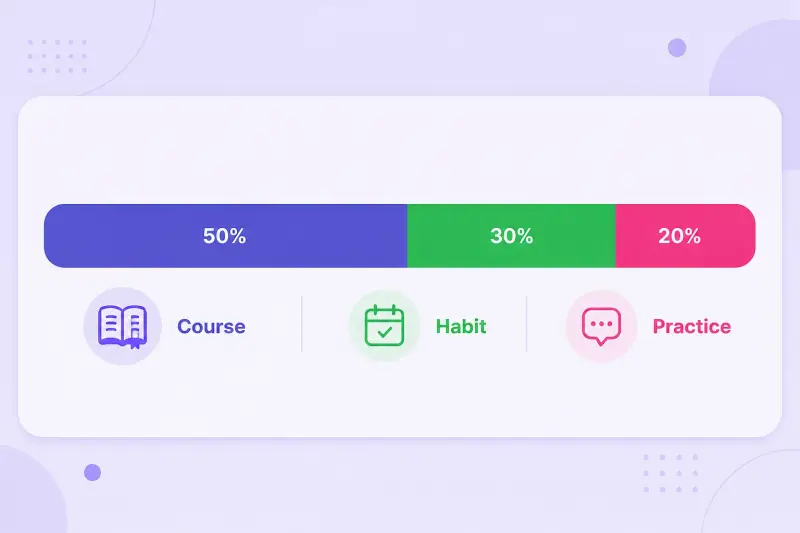
DW Learn German is a course, Duolingo is a habit engine, and HelloTalk is a practice partner, so they occupy three different slots in a German plan rather than competing for one. A learner using all three is not being indecisive; a learner using only one is missing something specific.
Here is what each does, what each cannot do, and how to divide your week between them.
Straight comparison
Read the table by task rather than by brand. Each column is strongest in a different part of the learning cycle: curriculum, habit formation, or real interaction.
| DW Learn German | Duolingo | HelloTalk | |
|---|---|---|---|
| Access | Free, all levels, no paywall | Free ad-supported tier with optional paid plans | 90% of HelloTalk's core features free |
| Levels covered | A1 to B1 in the Nicos Weg course, with material up to advanced | Single German course, roughly A1 to lower B1 in coverage | Any level, because your partner adapts |
| Structure | Sequenced curriculum with placement test | Sequenced tree, gamified | Unstructured by design |
| Grammar explanation | Explicit, with exercises and reference pages | Light, mostly implicit | On demand, from a native speaker |
| Speaking practice | None with feedback | Sentence repetition, no human feedback | Text and voice with real people |
| Corrects your own mistakes | Fixed-answer exercises | Fixed answers only | Yes, in real time, by a person |
| Best for | Building the backbone, weeks 1-30 | Daily streak and first 1,000 words | Converting knowledge into speech, week 2 onward |
| Weakness | Nothing responds to you | Recognition ceiling, no unscripted output | Needs a starter vocabulary from elsewhere |
That table is the short answer. The next three sections unpack the curriculum, habit, and interaction columns in turn, so you can see why the tools complement one another instead of competing for one permanent winner.
DW Learn German: the free course that behaves like a paid one
Deutsche Welle's German offer is unusual because it is genuinely complete and genuinely free. Nicos Weg spans A1, A2 and B1, with each level built from around 76 short video episodes plus interactive exercises, a free placement test at the entrance, and free certificates at the end.
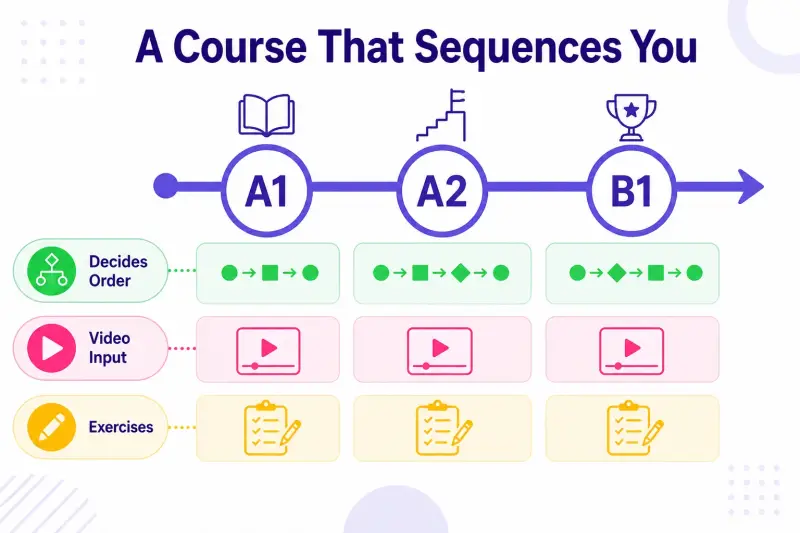
What it does well: sequencing. It decides what you learn on Tuesday. German rewards this more than most languages, because the grammar has dependencies. You cannot sensibly meet adjective endings before cases, and cases assume you know gender. A course that respects the order saves months of confused backtracking.
It also uses video with real actors in real situations, so the input is closer to natural speech than audio-lab recordings.
What it cannot do: hear you, correct you, or answer the question you actually have. It is one-directional. Finish the whole B1 course and you will read and understand well, and you will still be nervous the first time a German speaker asks you something unscripted.
Use it as the spine, five days a week.
Duolingo: good at the thing it is good at
Duolingo's German course is the most-used free German tool in the world, and the reason is not pedagogy. It is the streak. It gets people to open the app on day 60.
What it does well: recognition vocabulary, sentence patterns, and habit. The free tier is ad-supported and workable, and the January 2026 move of its answer-explanation feature to the free tier made the free version noticeably more useful. Ten minutes a day at breakfast is a real contribution.
What it cannot do: German grammar depth or unscripted output. Selecting the correct article from four options is a recognition task, and German case endings are a production task, which is why learners routinely finish long Duolingo streaks and still hesitate over der, dem and den in speech. It also cannot correct an error it did not anticipate, and German learners make a lot of unanticipated errors.
Use it as the vocabulary faucet, not the curriculum. On German specifically, DW is the stronger course; Duolingo is the stronger habit.
HelloTalk: the part the other two structurally cannot do
Neither a course nor an app can respond to what you personally get wrong. That is what a native speaker does, and it is the reason speaking practice sits in a category of its own.
Four features carry the work, and each maps onto a gap the other two tools leave:
Chat-based learning. Text conversation with German native speakers, with translation, phonetic transcription and read-aloud built into the message thread, so a wall of compound nouns is decodable without switching apps. Real-time grammar correction is the piece that matters here: your dative errors get flagged in the moment, which is what converts the article table from knowledge into reflex. No fixed-answer exercise can do that, because your mistake is yours.
Moments. Post two or three German sentences publicly and several native speakers correct the same text. That plurality is the point. Where an exercise has one right answer, Moments shows you three natural options and where Germans themselves disagree, which is closer to the truth about the language. Reading other people's Moments is free daily input at the informal register no textbook covers.
Voicerooms and Livestreams. German voice rooms run around the clock, and you can enter as a listener and say nothing at all. This is the cheapest listening upgrade available: native speakers talking to each other, overlapping, using particles like doch and mal the way they actually use them. Livestream mini-lessons put structure back in when you want a topic rather than open conversation.
AI learning tools. AI pronunciation scoring identifies the specific sound you are producing wrong, which for German learners is usually the ch, the ü, or the final consonant devoicing. AI grammar correction explains the case behind the correction rather than just fixing it. Image translation turns any German sign, form or menu into material.
HelloTalk's scale is what makes German partners easy to find at any hour: 70M+ registered users, 200+ countries, 260+ languages, and over 1 billion messages daily. 90% of HelloTalk's core features are free, and HelloTalk was named Google Play's Best Social App in 2017 with a global Google Play homepage feature in 2024.
How to split a week across all three
A workable German week that costs nothing:
- DW Learn German, five sessions of 25-30 minutes. This is the curriculum.
- Duolingo or a spaced-review deck, ten minutes daily. This is retention.
- HelloTalk, text daily and two voice conversations a week. This is production.
Total: about six hours a week, or roughly 300 hours a year, which puts B1 within range of a single year given the Cambridge estimate of 350 to 400 guided hours.
The most common failure is not choosing the wrong tool but running only the first two, because they are comfortable and they generate visible progress markers. Streaks and completed units feel like results. Speaking is where they become results.
We ranked the wider set of free German material by which skill gap it fixes in the best free German resources ranked by need, and the specific case-and-gender problem in free German grammar resources that make it stick.
Common mistakes when combining these tools
- Running two courses at once. DW and Duolingo both sequence content, and following both means finishing neither. Pick DW as the spine.
- Waiting until A2 to start conversations. Two hundred words is enough. Text chat removes the time pressure.
- Treating the streak as the goal. A 400-day streak with no spoken German is a real outcome people reach.
- Skipping DW's placement test. If you have prior German, starting at A1 wastes weeks.
- Learning nouns without articles. Every tool here shows you the article; only you can decide to memorise it with the noun.
For a look at how exchange platforms differ from one another, rather than from courses and apps, see HelloTalk compared with other language exchange apps. Our earlier piece on learning German through online communities covers the community side in more depth.
FAQ
Is DW Learn German better than Duolingo for German? As a course, yes. DW covers A1 to B1 with explicit grammar, exercises and a placement test, entirely free. Duolingo is better at producing a daily habit and a first vocabulary base. Most learners benefit from DW as the course and Duolingo as the ten-minute habit.
Is HelloTalk free for learning German? 90% of core features are free, including text chat, voice, Moments and the correction tools. That makes an all-free German plan realistic: DW for structure, a review app for retention, HelloTalk for speaking.
Can Duolingo alone get me to B1 German? It can build recognition vocabulary and basic patterns, but German case production and unscripted speech are outside what it trains. Learners who rely on it alone typically read better than they speak, by a wide margin.
Which one should I start with as a complete beginner? DW Learn German A1 in week one, a review habit in week one, and HelloTalk text conversations in week two or three once you have roughly 150 to 200 words.
Does DW Learn German go past B1? Nicos Weg runs A1 to B1, and DW publishes further material for higher levels, including news read at reduced speed. For B2 and above, most learners add native media and conversation rather than another course.
Do I need Duolingo at all if I use DW plus HelloTalk? Not strictly. Its role is daily retention, and any free spaced-review deck does the same job. Keep it if the streak keeps you consistent.
How many hours a week does this three-tool plan need? About six: two and a half hours of course work, one hour of review, and two to three hours of conversation. That pace makes a year to B1 realistic for German.
Use DW for the structure, a review habit for retention, and a German native speaker for everything neither can do. You can start the third piece free on HelloTalk.