
German Grammar for Beginners: The Free Resources That Actually Make It Stick
Almost everyone learning German understands the case system before they can use it. That gap is the whole problem, and it is why "best free German grammar resource" is usually the wrong search.
The explanations are not scarce. Free German grammar references online are excellent, exhaustive and mostly interchangeable. The bottleneck is not understanding the rule; it is producing the right ending in under a second while thinking about something else, and no amount of reading achieves that.
So this is a guide to free German grammar resources sorted by whether they build understanding or build production, plus the daily routine that closes the gap between the two.
What actually has to become automatic
German grammar for beginners comes down to four interlocking systems:
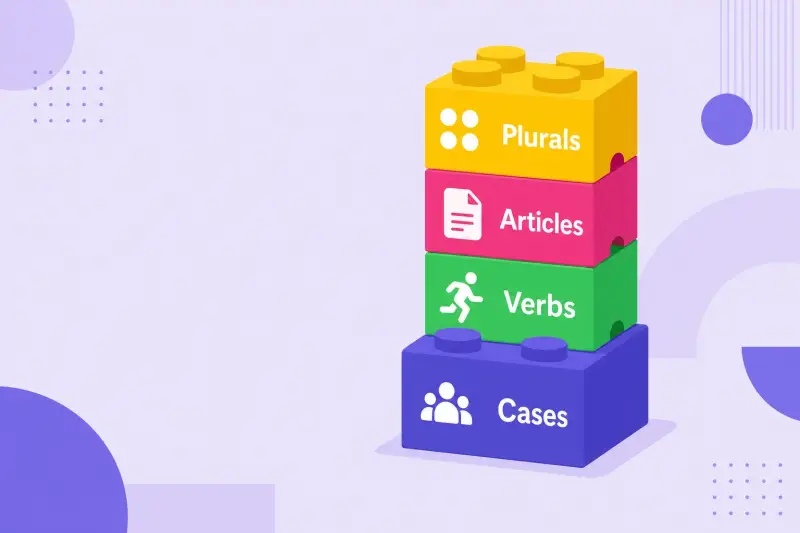
- Three genders. Every noun is der, die or das, and the gender is mostly unpredictable from meaning.
- Four cases. Nominative for the subject, accusative for the direct object, dative for the indirect object, genitive for possession.
- Nine two-way prepositions. an, auf, hinter, in, neben, über, unter, vor, zwischen. They take accusative when there is movement toward a place and dative when there is not.
- Adjective endings, which depend on gender, case, number, and which kind of article came before.
Because gender and case interact, the definite article alone has sixteen slots to fill across the four cases and three genders plus plural, and every adjective ending downstream depends on getting that slot right. This is why German grammar feels heavier than French or Spanish grammar even though German vocabulary is closer to English.
The Foreign Service Institute places German one difficulty tier above French and Spanish at roughly 900 class hours to professional working proficiency, and this system is the main reason.
Free resources, sorted by what they actually build
The useful distinction is not which resource contains the most grammar, but whether it builds understanding or production. Use the table to pair explanation with the drills, correction, and conversation that make the same pattern available under pressure.
| Resource type | What it gives you | Understanding or production? | How to use it |
|---|---|---|---|
| DW Learn German grammar pages and exercises | Sequenced explanation plus fill-in practice, free, A1 to B1 | Both, weighted to understanding | Read the page once, do the exercises twice |
| Free online grammar references | Complete tables, every exception, searchable | Understanding only | Look up, do not study cover to cover |
| Free spaced-review decks | Nouns stored with their article, patterns retrieved on schedule | Production, for vocabulary | 10-15 minutes daily, never skip |
| Free conjugation and declension trainers | Rapid drilling of endings | Production, mechanical | 5 minutes daily, in the same slot |
| Native-speaker correction on your own writing | The specific ending you personally get wrong | Production, targeted | Post 3 sentences daily |
| Voice conversation with a native speaker | Endings under time pressure | Production, hardest and most valuable | 2-4 times weekly |
Notice how the last two rows are the only ones aimed at your errors rather than the average learner's. That is the distinction most resource lists miss.
The daily routine that makes it stick
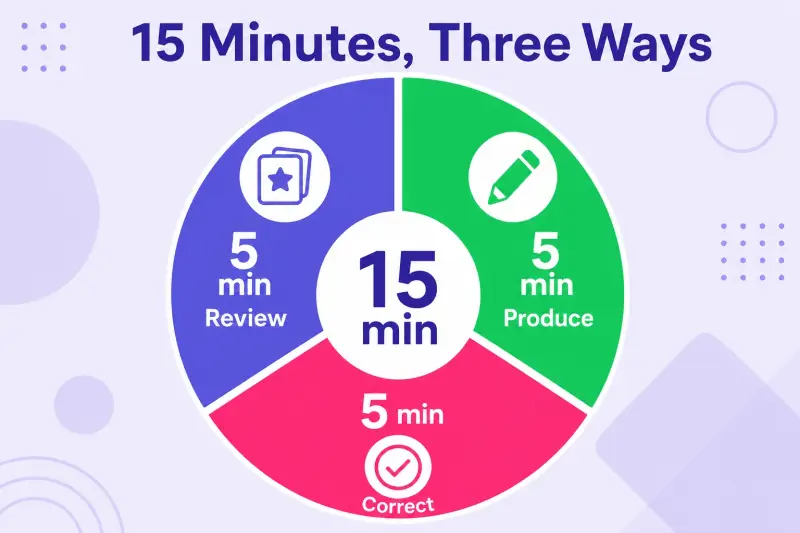
Fifteen minutes, split three ways. This is the part that converts the free explanations into usable German.
Five minutes: article-with-noun review. Every new noun enters your review deck with its article attached, always. Never "Tisch"; always "der Tisch". Learning a German noun without its article means learning it twice, because you will have to relearn the gender later at roughly three times the cost.
Five minutes: five-sentence production. Pick one target: today, dative after mit and bei. Write five sentences using it about your actual day. Not exercises, real sentences with real content. Content makes the pattern memorable in a way that filling in blanks does not.
Five minutes: get those five sentences corrected. This is the step almost every free-resource plan skips, and it is the one that determines whether the ending becomes a habit or a coin flip. A correction that arrives the same day rewrites the pattern. A mistake repeated uncorrected for three weeks fossilises into something that takes months to remove.
Spacing matters more than volume here. A 2022 meta-analysis pooling 98 effect sizes from 48 experiments with 3,411 learners found spaced review outperformed the same total time spent in a single block. Fifteen minutes daily beats two hours on Sunday, reliably.
Where the correction comes from, for free
This is the piece the HelloTalk platform supplies, and for German grammar specifically it is unusually well matched.
Chat-based learning. Text chat with German native speakers gives you production with time to think, which is the right difficulty level for someone still working out cases. Translation, phonetic transcription and read-aloud sit inside the message thread, so you can decode a reply full of compound nouns without leaving the conversation. Real-time grammar correction is the core of it: your case and ending errors get flagged while the exchange is live, which is exactly the same-day feedback the routine above needs.
Moments. Post your five sentences publicly and several native speakers correct the same text. For German grammar this plurality is genuinely informative, because you learn which endings are hard rules and which are regional or stylistic preferences. Reading other people's Moments also shows you cases used in casual German, where genitive is often replaced by von plus dative, which no textbook emphasises enough.
Voicerooms and Livestreams. Voice rooms run around the clock, and case endings under real-time pressure are a different skill from case endings on paper. You can enter as a listener first and just absorb how endings sound in fast speech. Livestream mini-lessons often cover grammar topics with a host, which is useful when you want an explanation from a person rather than a page.
AI learning tools. AI grammar correction explains the rule behind the fix, so a corrected sentence becomes a transferable pattern rather than a one-off repair. AI pronunciation scoring points at the specific sound you are missing, which matters for German endings because -em, -en and -er are easy to blur into the same mumble. Image translation lets you photograph a German sign and see the case in the wild.
HelloTalk has 70M+ registered users in 200+ countries studying 260+ languages, with over 1 billion messages daily, so finding a German speaker willing to correct three sentences takes minutes. 90% of HelloTalk's core features are free, which keeps the whole grammar plan free.
The order to learn German grammar in
Do not learn the four cases at once. The sequence that works:
- Nominative and accusative, with the article table for both. Weeks 1-3.
- Present tense verbs, including the common irregulars. Weeks 1-4, overlapping.
- Dative, introduced through prepositions you use constantly: mit, bei, zu, von. Weeks 4-8.
- Two-way prepositions, once dative exists. Weeks 6-10.
- Perfect tense, which is how spoken German expresses the past far more often than the simple past. Weeks 8-12.
- Adjective endings. Weeks 10-16, and expect them to keep leaking for a while.
- Genitive, last. In everyday speech it is frequently replaced by von plus dative anyway.
Free courses broadly follow this order, which is a good reason to use one rather than assembling your own path. We covered which free German course to build around in the best free German resources ranked by need, and compared the main free tools directly in DW Learn German, Duolingo and HelloTalk.
Common mistakes with German grammar
- Studying the full case table before using any of it. Sixteen cells memorised in one sitting will be gone in four days.
- Learning nouns without articles. The single most expensive shortcut in German.
- Doing exercises instead of producing sentences. Blanks with three options are recognition. Speech is production.
- Skipping correction. Uncorrected production teaches you your own errors very efficiently.
- Genitive too early. It is the least used case in speech and it will distract you from dative, which is everywhere.
- Treating adjective endings as a memory task. They are the last thing to automate and they respond only to volume of output.
- Reading grammar in English about German. Useful once per topic. After that, produce.
If you want the whole timeline rather than the grammar slice, see the free German learning roadmap from beginner to conversational.
FAQ
What is the best free German grammar resource for beginners? DW Learn German's grammar pages paired with its exercises, because they are sequenced to match a course rather than presented as a reference. Add a free spaced-review deck for nouns with articles and native-speaker correction for your own output.
How long does it take to learn German cases? Understanding all four takes a few weeks. Producing them accurately in speech typically takes three to six months of daily short output with correction. The understanding is fast; the automation is not.
Do I need to learn all four cases at once? No, and it is counterproductive. Nominative and accusative first, then dative through common prepositions, then genitive last since spoken German often replaces it with von plus dative.
How do I remember German noun genders? Store every noun with its article from the first encounter, review on a spaced schedule, and learn the reliable patterns (most nouns ending in -ung, -heit, -keit and -schaft are feminine; most ending in -chen are neuter).
Can I learn German grammar without a teacher? Yes, if you replace the teacher's correction with something. Free explanations are abundant; feedback on your own errors is what needs sourcing, and a native-speaker exchange partner covers it.
Is German grammar harder than French grammar? Different rather than uniformly harder, though the case system gives German more to automate. The Foreign Service Institute does place German a tier above French in class hours needed for professional proficiency.
When should I start speaking if my grammar is still wrong? Immediately. Grammar accuracy improves faster with corrected speech than with additional study, and waiting until it is right postpones the only activity that makes it right.
Read each rule once, then produce five sentences and get them corrected the same day. If you want German native speakers to do that correcting, HelloTalk is free to start.